All species › Waders, gulls and terns › Oystercatchers › Black Oystercatcher
Position in the tree Birds Aves › Birds with a flexible palate Neognathae › All other modern birds Neoaves › Birds of the elements Elementaves › Cranes and waders Gruimorphae
Black Oystercatcher | Haematopus bachmani
Amerikaanse zwarte scholekster | Ostrero negro
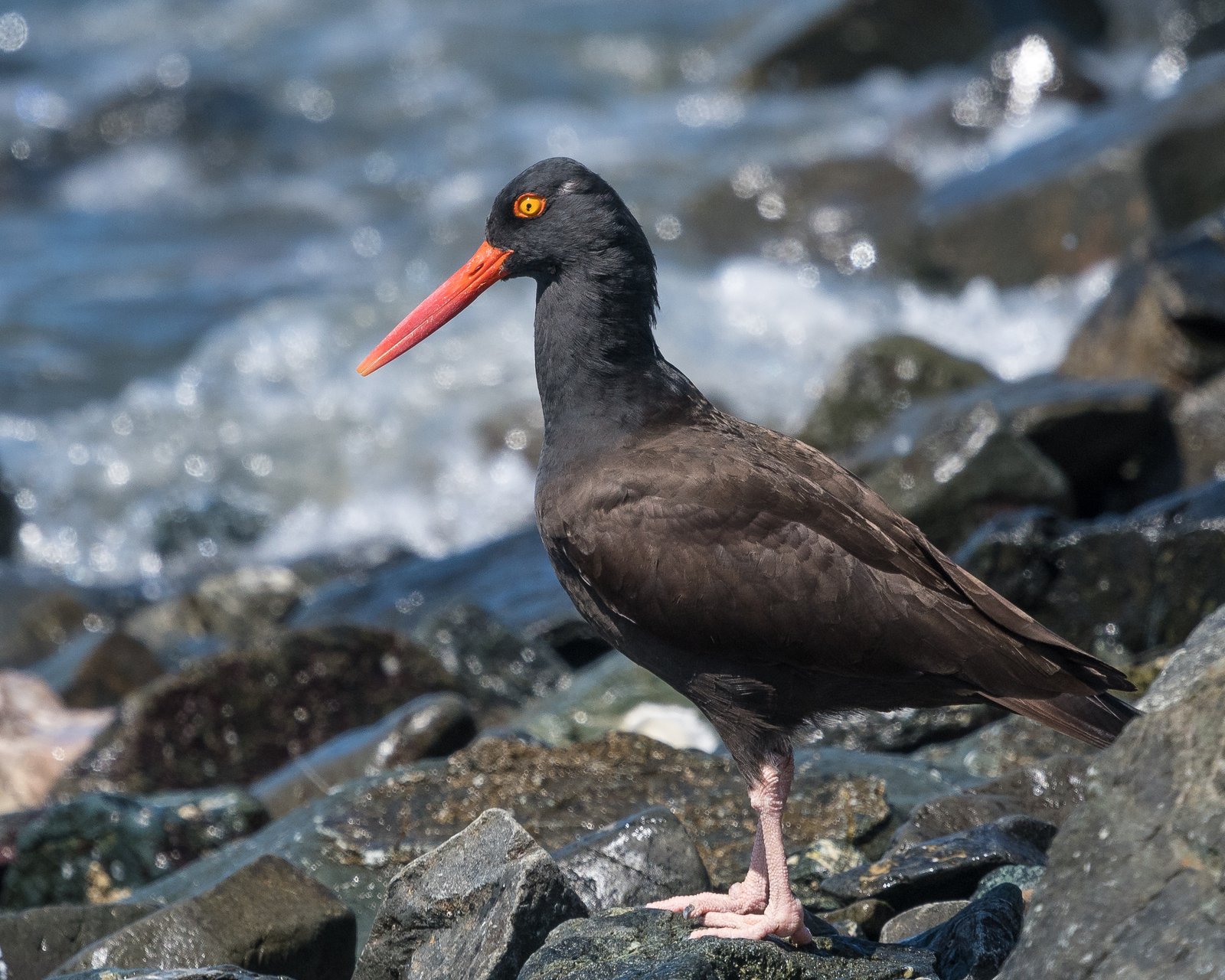
The Black Oystercatcher is an all-dark, stocky oystercatcher with a long, orange-red bill and pale pink legs, tied to the rocky shores of the Pacific Ocean. In the guide area it reaches the southern limit of its range: it is a scarce resident along the Pacific coast of Baja California and on the offshore islands.
Voice
Very noisy. The call is a loud, piercing wheep or kleep, often in series. In courtship and territorial disputes, pairs walk or fly side by side giving an accelerating, shrill piping that runs into a trill.
Recording: Barry Edmonston — CC BY-NC-SA 4.0 · shortened to the first 60 s, mono · xeno-canto
Identification
42–47 cm, stocky, with a thick neck and short, sturdy, pale pink legs. The entire plumage is blackish brown, darkest on the head and neck; in flight the wings are plain dark, without white. The bill is long, straight, laterally flattened and bright orange-red; the eye is yellow with a red eye-ring. The sexes are alike; the female has on average a slightly longer bill. Juveniles are browner, with pale fringes to the feathers of the upperparts and a dark bill tip.
Confusion species
American Oystercatcher Haematopus palliatus has a white belly, a white wing bar and a white rump; along the coast of Baja California mixed pairs and hybrids occur with a mottled, partly dark belly. Black Turnstone Arenaria melanocephala and Surfbird Calidris virgata feed on the same rocks, but are much smaller, with short, dark bills.
Habitat
Rocky shores with a wide intertidal zone, rocky islets and gravel and boulder beaches, where the birds feed on rocks exposed at low tide. It eats mussels, shellfish attached to rocks such as limpets, and crabs; shells are prised or hammered open with the bill. It lives year-round in fixed pairs on a coastal territory. The nest is a scrape lined with a few shell fragments or pebbles on a rock or gravel beach above the high-tide line.
Where the bird is most at home, classified by the vegetation units of Mexico and Central America.


Range and movements
In the guide area only along the Pacific coast of Baja California, from the United States border south to northern Baja California Sur, including offshore islands such as Todos Santos, San Martín, San Benito, Cedros and Natividad. Absent elsewhere in Mexico and Central America. Outside the guide area along the Pacific coast of North America north to Alaska and the Aleutians.
- Resident
- dark = core range, pale = thinly spread
How and when to look
Found on rocky shores at low tide, such as at Punta Banda and La Bufadora south of Ensenada and on the rocks of the Todos Santos Islands. Despite the dark plumage the birds draw attention with their loud calls and brightly coloured bill.
Conservation status
Not globally threatened. The population in Mexico is small and confined to a narrow coastal strip and a number of islands; human disturbance, introduced predators on breeding islands and oil pollution are possible threats.
Scientific name
Haematopus bachmani | Audubon, 1838
Audubon described the species in 1838 and placed it straight away in the genus where it still stands. The genus Haematopus was introduced in 1758 by Linnaeus. Haematopus is Greek, from haima 'blood' and pous 'foot', after the red legs. bachmani honours the American clergyman and naturalist John Bachman (1790–1874), friend and collaborator of Audubon. The specimen the first description was based on came from mouth of the Columbia River, north-western United States.