All species › Waders, gulls and terns › Stilts and avocets › Black-necked Stilt
Position in the tree Birds Aves › Birds with a flexible palate Neognathae › All other modern birds Neoaves › Birds of the elements Elementaves › Cranes and waders Gruimorphae
Black-necked Stilt | Himantopus mexicanus
Amerikaanse steltkluut | Candelero americano
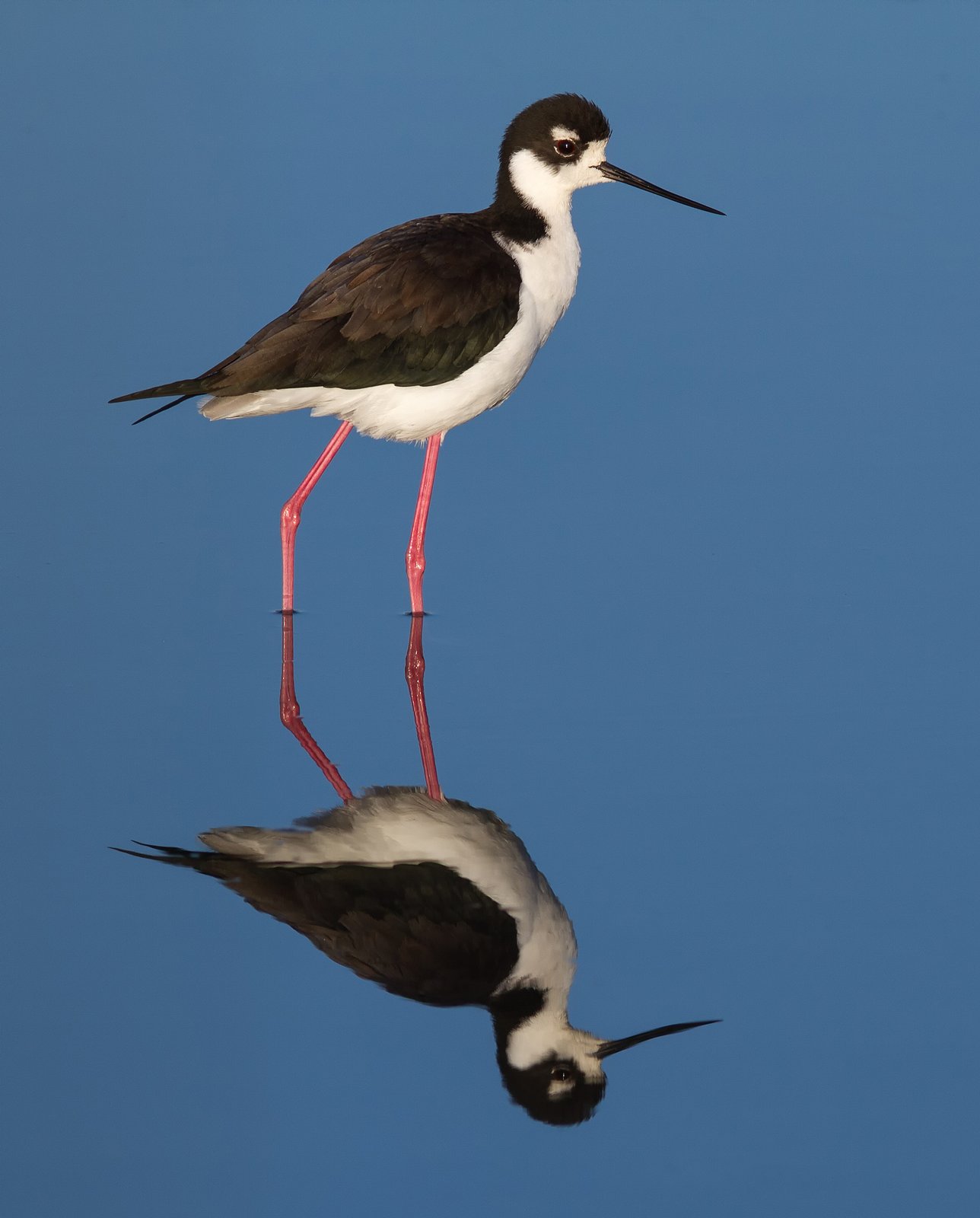
The Black-necked Stilt is a slender black-and-white shorebird with a needle-thin, straight bill and very long pink legs. It is one of the most widespread shorebirds in the guide area, occurring from Baja California to Panama at almost any shallow fresh or salt water, from the coast up to the plateau. Flocks are noisy and conspicuous from afar.
Voice
Noisy. The call is a sharp, yapping kyep or kek, repeated in series, which becomes persistent and urgent when the birds are disturbed in the breeding season; the whole group then joins in. Also often calls in flight.
Recording: José María Loaiza B. — CC BY-NC-SA 4.0 · converted to mono · xeno-canto
Identification
35–39 cm, much of it leg. The upperparts, hindneck and head are glossy black, with a white spot above the eye; foreneck, breast and belly are white. The bill is black, long, thin and straight, the legs bright pink to red. The female has a browner back than the male. Juveniles are grey-brown above with pale feather fringes and have duller legs. In flight the wings are all black above and below, a white wedge shows on the back and rump, and the legs project well beyond the tail.
Confusion species
American Avocet Recurvirostra americana has an upturned bill, blue-grey legs and white and black in the wing. Greater Yellowlegs Tringa melanoleuca is spotted grey, with yellow legs and no sharp black-and-white contrast. American Oystercatcher Haematopus palliatus is also black and white, but stocky, with a thick orange-red bill and short legs.
Habitat
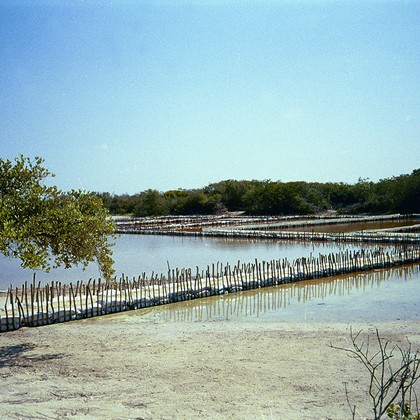
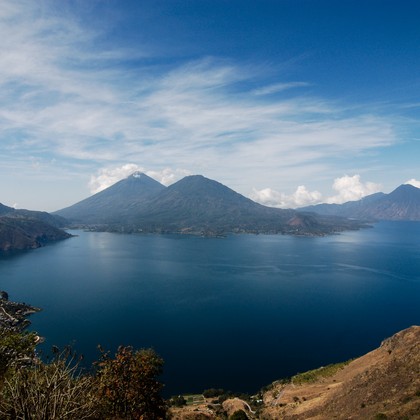
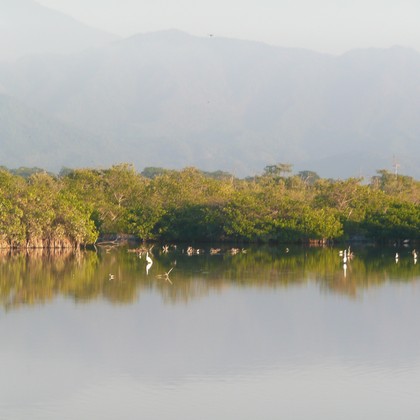
Shallow fresh, brackish and salt water with open margins: salt pans, lagoons, coastal marshes, rice fields, fish and shrimp ponds, flooded pastures, sewage ponds and lake edges, from sea level up to the plateau. It forages by wading in shallow water, picking insects, small crustaceans, small snails and small fish from the surface or from the water. It breeds in loose colonies; the nest is a shallow scrape on an islet, dyke or bare shore, and the parents defend nest and young noisily.
Where the bird is most at home, classified by the vegetation units of Mexico and Central America.



Range and movements
Throughout Mexico, along both coasts and on the lakes of the interior and the plateau, and further in the lowlands of all of Central America to Panama, especially along the Pacific coast and in large wetlands. In the northern winter birds from the United States join those in Mexico. Birds in the guide area belong to the nominate subspecies H. m. mexicanus. Outside the guide area from the United States and the Greater Antilles far into South America, and on Hawaii, where a separate subspecies lives.
- Resident
- dark = core range, pale = thinly spread
How and when to look
Found almost anywhere with shallow water and open margins, including fish ponds, salt pans and rice fields along the Pacific coast. Good places include Palo Verde in Costa Rica and the salt pans and shrimp farms around the Gulf of Fonseca. In the breeding season the birds fly at an intruder with loud calls; an alarmed group indicates a colony nearby.
Conservation status
Not threatened. In the guide area common and widespread; the species makes much use of man-made wetlands such as rice fields, fish ponds and salt pans. The loss and pollution of shallow coastal wetlands is a local threat.
Scientific name
Himantopus mexicanus | (Müller, 1776)
Müller described the species in 1776 as Charadrius Mexicanus; because it was later moved to another genus, the author and year stand in brackets. The genus Himantopus was introduced in 1760 by Brisson. Himantopus is Greek, from himas 'strap, thong' and pous 'foot': 'strap-foot', after the long thin legs. mexicanus means 'of Mexico', the country of the type locality. The specimen the first description was based on came from Mexico.