All species › Waders, gulls and terns › Oystercatchers › American Oystercatcher
Position in the tree Birds Aves › Birds with a flexible palate Neognathae › All other modern birds Neoaves › Birds of the elements Elementaves › Cranes and waders Gruimorphae
American Oystercatcher | Haematopus palliatus
Amerikaanse bonte scholekster | Ostrero americano
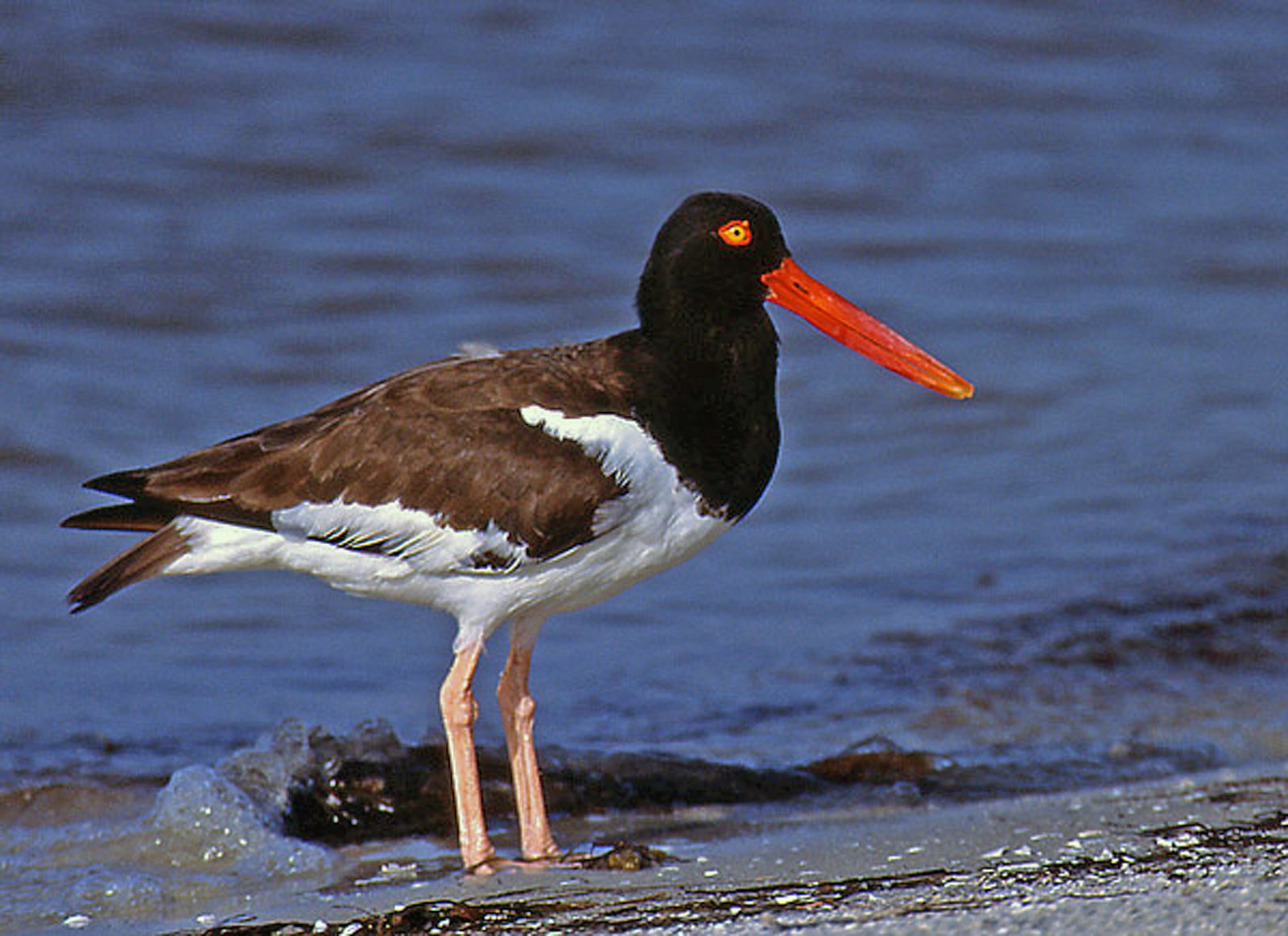
The American Oystercatcher is a large, stocky shorebird with a black head, a dark brown back, a white belly and a long, straight, orange-red bill. It lives along sandy and rocky coasts on both oceans, from Baja California and the Gulf coast of Mexico to Panama, but is scarce and local in much of the guide area.
Voice
Very noisy. The call is a loud, piercing kleep or wheek, often in series. In territorial disputes and courtship, pairs walk or fly side by side giving an accelerating, shrill piping that runs into a trill.
Recording: Jonas Nilsson — CC BY-NC-SA 4.0 · converted to mono · xeno-canto
Identification
40–44 cm, stocky, with a thick neck and fairly short, sturdy, pale pink legs. Head and neck are black, back and upperwing dark brown, breast and belly white. The bill is long, straight, laterally flattened and bright orange-red; the eye is yellow with an orange-red eye-ring. In flight a broad white wing bar and a white rump stand out. The sexes are alike; juveniles have a browner head, pale fringes to the feathers of the upperparts and a duller bill with a dark tip. In birds of northwestern Mexico the border between the black breast and the white belly is mottled rather than sharp.
Confusion species
Black Oystercatcher Haematopus bachmani, only along the Pacific coast of Baja California, is all dark, with no white in the wing or rump; hybrids with a mottled belly also occur there. Black Skimmer Rynchops niger is also black and white with a red-and-black bill, but has short legs, long narrow wings and a lower mandible longer than the upper. Willet Tringa semipalmata also shows a striking black-and-white wing pattern in flight, but is grey and has a dark bill.
Habitat
Sandy beaches, rocky shores, tidal flats with shellfish beds, estuaries, mangrove edges and small islands at sea; always close to salt water. It eats mainly shellfish such as mussels and oysters, which are prised or hammered open with the bill, as well as crabs, worms and other invertebrates. The nest is a shallow scrape in sand or gravel above the high-tide line, often on beach ridges or islets.
Where the bird is most at home, classified by the vegetation units of Mexico and Central America.





Range and movements
In Mexico along the Pacific coast of Baja California and around the Gulf of California, and further south along the mainland coast to Oaxaca and Chiapas; on the Atlantic side from Tamaulipas along the Gulf coast to the Yucatán Peninsula. In Central America scarce and local along the Pacific coast from Guatemala to Panama, and rarer on the Caribbean coast; in larger numbers in the Gulf of Panama, including the Pearl Islands. Northwestern Mexico has the subspecies H. p. frazari, elsewhere the nominate H. p. palliatus occurs. Outside the guide area along the coasts of the eastern United States, in the Caribbean and in South America to Chile and Argentina.
- Resident
- dark = core range, pale = thinly spread
How and when to look
Good places are the beaches and islets of the Gulf of California, the coast of the Yucatán Peninsula and the Gulf of Panama. The birds are often heard first: pairs call loudly when disturbed and fly off low over the water, showing the white wing bar.
Conservation status
Not threatened. In the guide area locally fairly common in the Gulf of California, scarce elsewhere. Disturbance of nesting beaches by recreation and dogs, coastal development and the flooding of nests at high tide are the main threats.
Scientific name
Haematopus palliatus | Temminck, 1820
Temminck described the species in 1820 and placed it straight away in the genus where it still stands. The genus Haematopus was introduced in 1758 by Linnaeus. Haematopus is Greek, from haima 'blood' and pous 'foot', after the red legs. palliatus is Latin for 'cloaked', from pallium 'cloak', after the dark brown back and wings. The specimen the first description was based on came from Venezuela (restricted later; originally South America).