All species › Waders, gulls and terns › Stilts and avocets › American Avocet
Position in the tree Birds Aves › Birds with a flexible palate Neognathae › All other modern birds Neoaves › Birds of the elements Elementaves › Cranes and waders Gruimorphae
American Avocet | Recurvirostra americana
Amerikaanse kluut | Avoceta americana
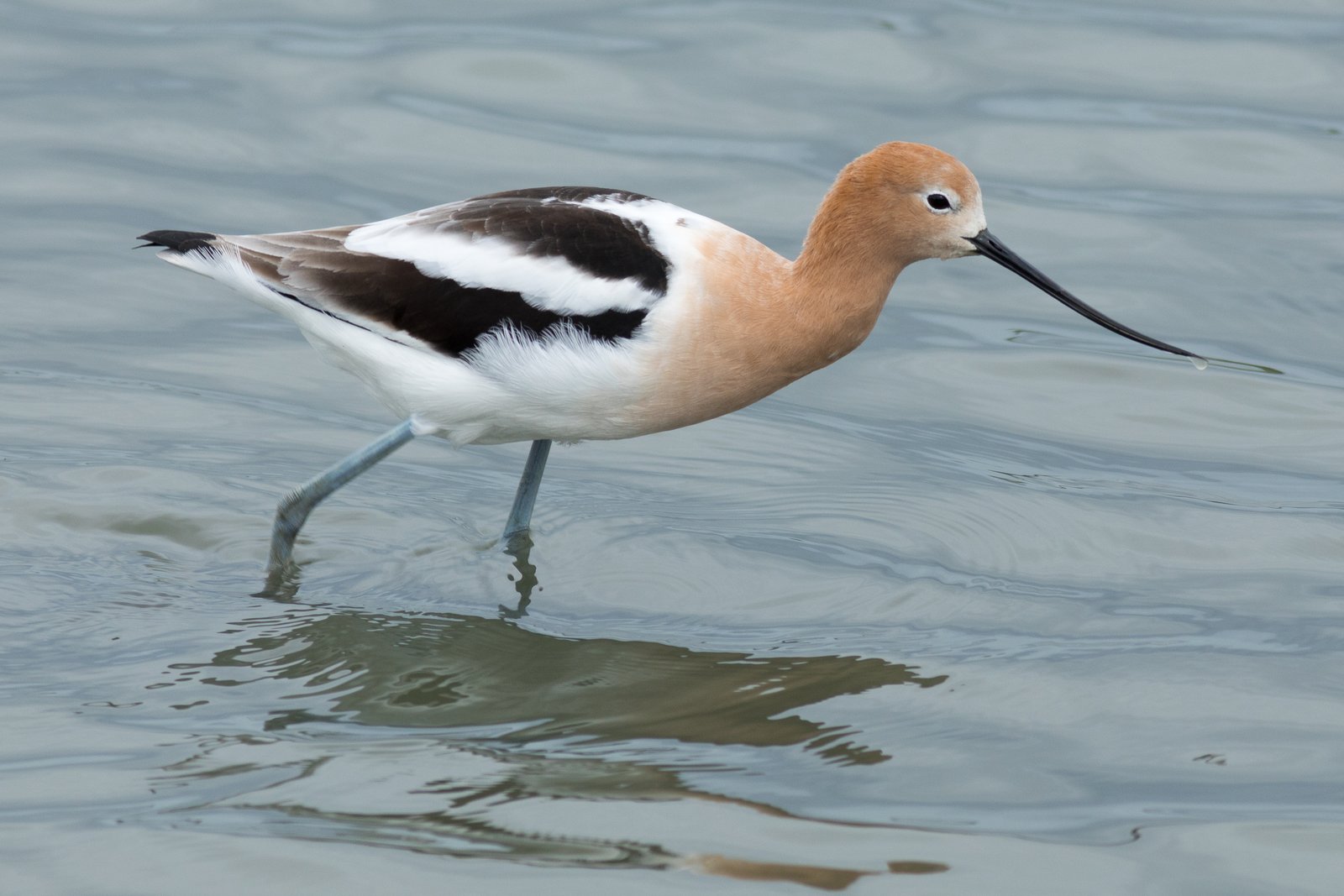
The American Avocet is a large, slender shorebird with crisp black-and-white plumage, long blue-grey legs and a thin, upturned bill. It breeds in western North America and locally in northern Mexico and on the Mexican Plateau. In the northern winter it is a common visitor along the coasts and on the inland lakes of Mexico; further south it quickly becomes scarcer.
Voice
A loud, nasal wheet or kleet, often repeated, especially when disturbed and in flight. Usually silent in winter.
Recording: Craig Robertson — CC BY-NC-SA 4.0 · converted to mono · xeno-canto
Identification
43–47 cm, with a long neck and a thin, black, distinctly upcurved bill. Back and wings are patterned black and white: two broad black bands run along the back and the wing has a large white patch, the rest of the body is white. In breeding plumage the head, neck and breast are warm rusty orange; in non-breeding plumage, in which most birds in the guide area are seen, these are white with a grey wash. The female has a shorter, more strongly curved bill than the male. In flight the legs project well beyond the tail and the black-and-white wing pattern is conspicuous at long range.
Confusion species
Black-necked Stilt Himantopus mexicanus is black above and white below, with a straight needle-like bill and much longer pink legs. Marbled Godwit Limosa fedoa often forages in similar small groups, but is warm brown, with a thicker two-toned bill and no black and white in the wing. Greater Yellowlegs Tringa melanoleuca is spotted grey, with yellow legs and a straight or barely upturned bill.
Habitat
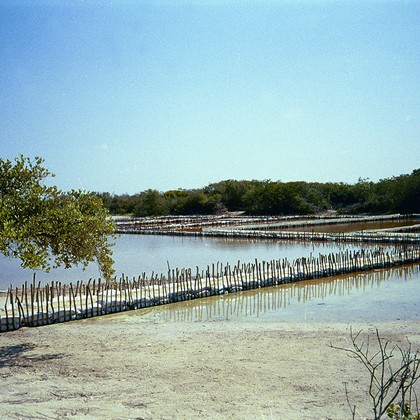
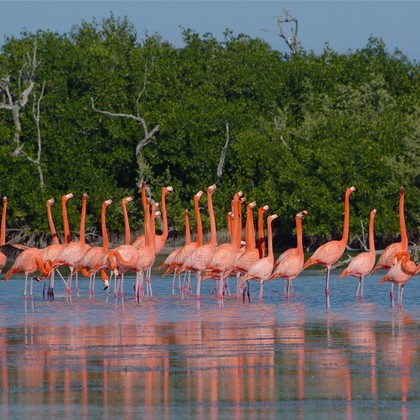
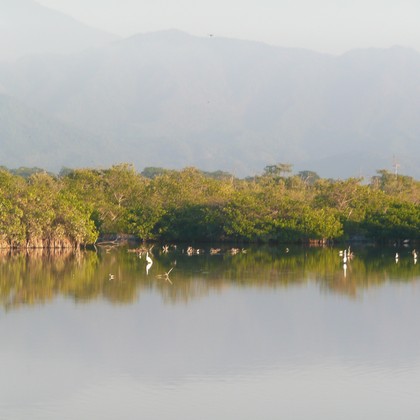
Shallow, often saline or brackish water with bare margins: salt pans, lagoons, tidal flats, inland saline lakes, flooded rice fields and sewage ponds, from the coast up to the plateau. It forages by wading through shallow water and sweeping the bill sideways through the water and the top layer of mud, and also picks prey from the surface. It eats mainly small crustaceans, insect larvae and other invertebrates. Often in flocks, sometimes among other shorebirds. The nest is a shallow scrape on a bare shore or islet, often in loose colonies.
Where the bird is most at home, classified by the vegetation units of Mexico and Central America.


Range and movements
Breeds locally in northern Mexico and on the plateau, mainly at shallow, often saline inland lakes. In winter common along the coasts of Baja California and the Gulf of California, along the Pacific coast south to Nayarit, on the Gulf coast and on the lakes of the central highlands; in smaller numbers south to Oaxaca, Chiapas and the Yucatán Peninsula. In Central America a scarce winter visitor in Guatemala, El Salvador and Honduras, rare in Nicaragua and Costa Rica and a vagrant in Panama. Outside the guide area it breeds in western and central North America and also winters along the coasts of the United States.
- Resident
- Summer visitor (c. Apr–Sep)
- Winter visitor (c. Oct–Mar)
- Passage (Mar–Apr, Oct–Nov)
- dark = core range, pale = thinly spread
How and when to look
Good places in winter are the lagoons and salt pans of Baja California, such as at Guerrero Negro, the coastal lagoons of Sinaloa and Nayarit and the remnants of Lake Texcoco near Mexico City. A group of avocets stands out at a distance because the birds walk and sweep in the same rhythm. The upturned bill is only clearly visible at closer range; in flight the wing pattern is the most reliable feature.
Conservation status
Not threatened. The world population is considered stable. In Mexico the species depends on shallow saline and brackish wetlands on the coast and on the plateau; drainage, the filling of coastal lagoons and the drying out of inland lakes are the main threats.
Scientific name
Recurvirostra americana | Gmelin, 1789
Gmelin described the species in 1789 and placed it straight away in the genus where it still stands. The genus Recurvirostra was introduced in 1758 by Linnaeus. Recurvirostra is Latin, from recurvus 'curved backwards' and rostrum 'bill', after the upturned bill. americana is Latin for 'American'. The specimen the first description was based on came from North America.