All species › Passerines › New World blackbirds, troupials and allies › Black-backed Oriole
Position in the tree Birds Aves › Birds with a flexible palate Neognathae › All other modern birds Neoaves › Landbirds Telluraves › Falcons, parrots and passerines Australaves › Falcons and passerines Eufalconimorphae › Parrots and passerines Psittacopasserae
Black-backed Oriole | Icterus abeillei
Zwartrugtroepiaal | Bolsero dorsioscuro
Black-backed Oriole is an oriole of the highlands of central Mexico and occurs nowhere else. It was long treated together with Bullock's Oriole and Baltimore Oriole as a single species. In winter it is one of the few birds that eat the overwintering monarch butterflies in the highland fir forests.
Voice
The song is a short series of whistles and rattling notes, similar to that of Bullock's Oriole. The call is a dry rattle and a short chek.
Recording: Manuel Grosselet — CC BY-NC-SA 4.0 · converted to mono · xeno-canto
Identification
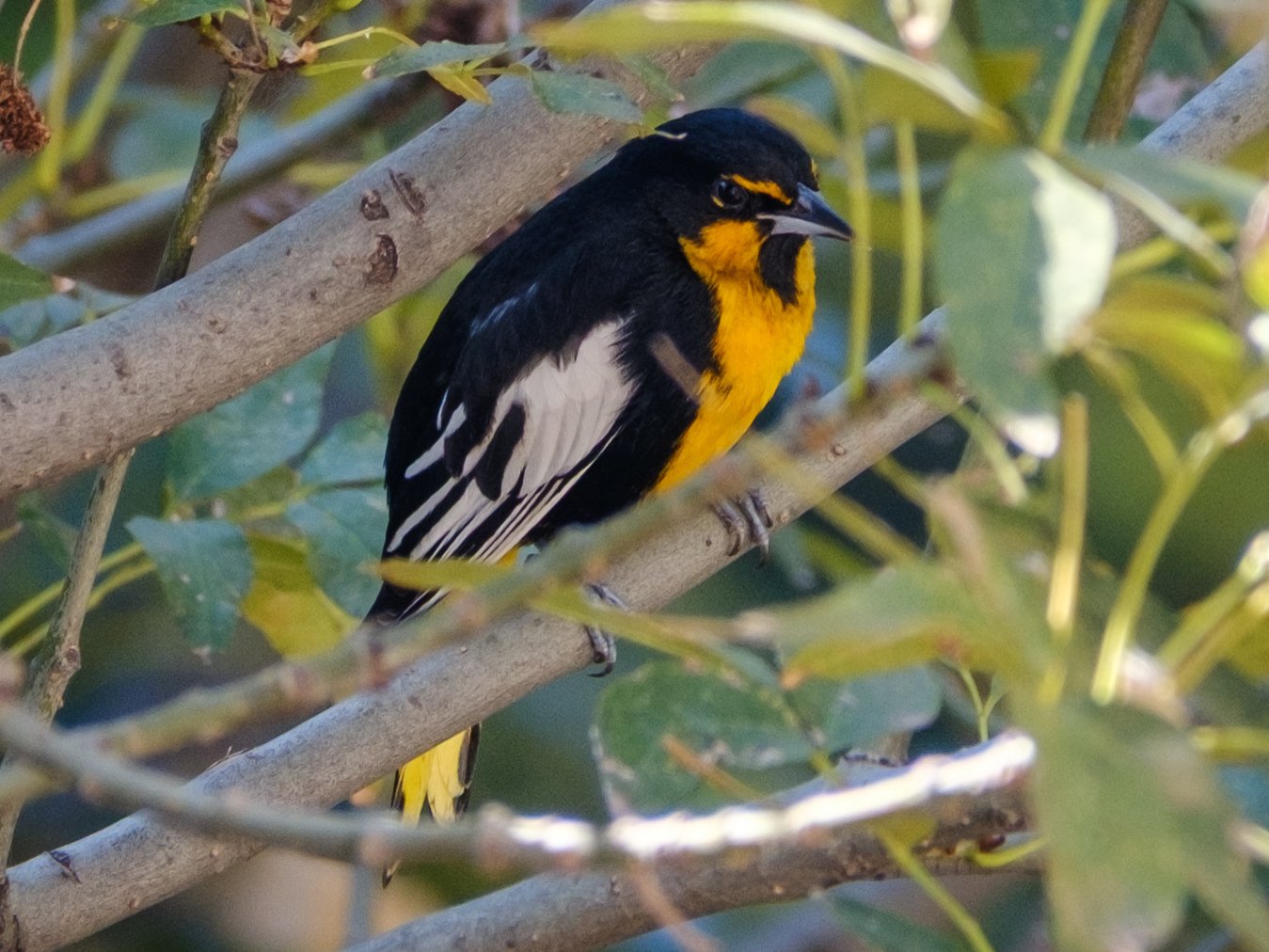
18–20 cm. Medium-sized oriole with a straight, pointed bill. The male is largely black above: head, throat and back are black, and the black continues over the sides of the breast and the flanks. The centre of breast and belly is orange. The wing is black with a large white patch on the wing coverts and white edges to the flight feathers; the tail is black with orange sides. The female is olive-grey above and yellowish below with two white wing bars, often with some black on the throat.
Confusion species
The male Bullock's Oriole Icterus bullockiorum, which occurs in the same area in winter, has orange cheeks, supercilium and flanks; females are greyer on the belly and otherwise very similar. The male Baltimore Oriole Icterus galbula has orange flanks and only a single white wing bar. Scott's Oriole Icterus parisorum is yellow rather than orange.
Habitat
Pine-oak woodland, oak woodland, riparian woodland and open woodland in the highlands, also parks, gardens and orchards with tall trees. In winter also in the pine and sacred fir forests where monarch butterflies overwinter. It eats insects, fruit and nectar.
Where the bird is most at home, classified by the vegetation units of Mexico and Central America.





Range and movements
Endemic to the highlands of central Mexico, from Durango and Zacatecas south and east through Jalisco, Guanajuato, Michoacán, the State of México, Hidalgo, Puebla and Tlaxcala to western Veracruz and northern Oaxaca. In winter some birds move to other parts of the highlands.
- Resident
- dark = core range, pale = thinly spread
How and when to look
In winter often seen at the reserves with overwintering monarch butterflies in Michoacán and the State of México, where it picks the butterflies off the branches.
Conservation status
Not threatened (LC). Fairly common within its limited range. The conversion of highland forest to farmland is a threat, although the species also uses parks and gardens.
Scientific name
Icterus abeillei | (Lesson, 1839)
Lesson described the species in 1839 as Xanthornus Abeillei; because it was later moved to another genus, the author and year stand in brackets. The genus Icterus was introduced in 1760 by Brisson. Icterus is from Ancient Greek ikteros, a yellow bird usually taken to be the golden oriole, the sight of which was thought to cure jaundice. abeillei honours the French physician, ornithologist and collector Grégoire Abeillé (1798–1848). The specimen the first description was based on came from Mexico.