All species › Passerines › New World blackbirds, troupials and allies › Baltimore Oriole
Position in the tree Birds Aves › Birds with a flexible palate Neognathae › All other modern birds Neoaves › Landbirds Telluraves › Falcons, parrots and passerines Australaves › Falcons and passerines Eufalconimorphae › Parrots and passerines Psittacopasserae
Baltimore Oriole | Icterus galbula
Baltimoretroepiaal | Turpial de Baltimore
Baltimore Oriole breeds in eastern North America and in the guide area is a numerous passage migrant and winter visitor, from southern Mexico to Panama. It was formerly treated together with Bullock's Oriole as a single species; on the Great Plains, outside the guide area, hybrids between the two occur.
Voice
The song is a series of clear, whistled notes in a varying rhythm, different for each male; rarely heard in winter. The call is a dry, rattling series and a clear, two-note hee-lee.
Recording: Bobby Wilcox — CC BY-NC-SA 4.0 · converted to mono · xeno-canto
Identification
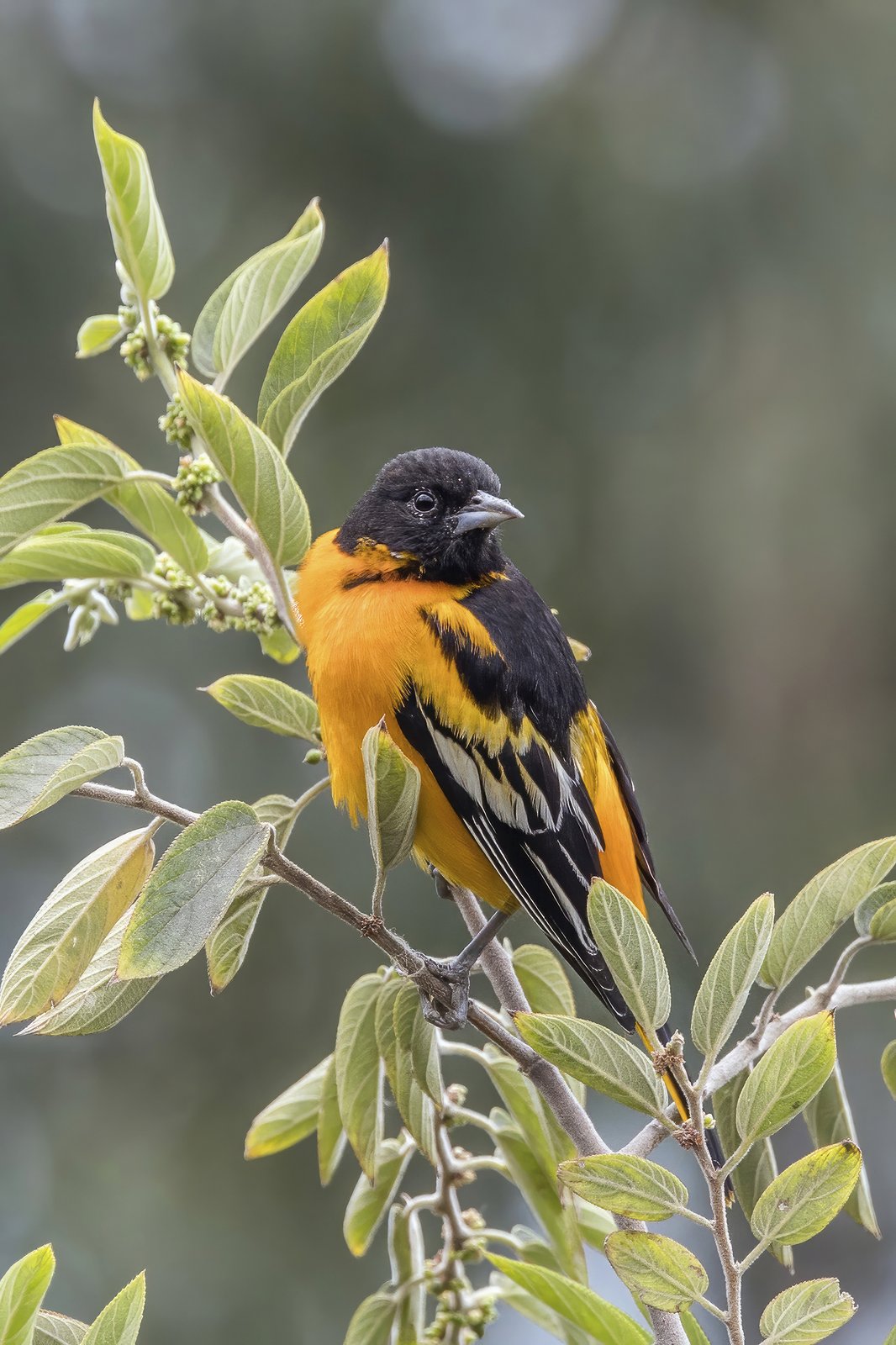
17–19 cm. Medium-sized oriole with a straight, pointed bill. The male has an all-black head, throat and back; breast, belly, rump and shoulder are bright orange. The wing is black with a white wing bar and white edges to the flight feathers; the tail is black with orange outer corners. The female is variable: brownish olive on the back, yellow-orange to orange on breast and belly, sometimes with some black on head and throat, and with two white wing bars. In winter many birds are duller than in the breeding season.
Confusion species
The male Bullock's Oriole Icterus bullockiorum has orange cheeks and supercilium and a large white wing patch; the female has a greyish-white belly. Orchard Oriole Icterus spurius is smaller; the male is black and chestnut, the female yellow-green without an orange tone. Other orioles in the guide area have an orange or yellow back, or a black throat patch on an otherwise yellow or orange head.
Habitat
In winter in forest edges, secondary forest, riparian woodland, shade-coffee plantations, gardens and parks with flowering trees, from sea level into the foothills and lower mountains. It takes insects, fruit and nectar; in winter often in small groups at flowering trees such as coral trees.
Where the bird is most at home, classified by the vegetation units of Mexico and Central America.





Range and movements
Breeds in southern Canada and the eastern and central United States. Winters from southern Mexico through all of Central America to northern Colombia and Venezuela, in small numbers also in Florida and the Caribbean. In spring and autumn it migrates through eastern Mexico and across the Gulf of Mexico; scarce in northern and western Mexico.
- Winter visitor (c. Oct–Mar)
- dark = core range, pale = thinly spread
How and when to look
In winter best seen in flowering trees in gardens, parks and coffee plantations; the rattling call often gives away birds in the canopy.
Conservation status
Not threatened (LC). Widespread and common in eastern North America, although numbers there are declining. In the guide area a common winter visitor; the loss of forest and shade coffee also affects this species.
Scientific name
Icterus galbula | (Linnaeus, 1758)
Linnaeus described the species in 1758 as C[oracias] Galbula; because it was later moved to another genus, the author and year stand in brackets. The genus Icterus was introduced in 1760 by Brisson. Icterus is from Ancient Greek ikteros, a yellow bird usually taken to be the golden oriole, the sight of which was thought to cure jaundice. galbula is the Latin name for a yellow bird, again probably the golden oriole. The specimen the first description was based on came from Virginia.