All species › Owls › Owls › Black-and-white Owl
Position in the tree Birds Aves › Birds with a flexible palate Neognathae › All other modern birds Neoaves › Landbirds Telluraves › Raptors, owls, kingfishers and woodpeckers Afroaves › Hawks and owls Hieraves
Black-and-white Owl | Strix nigrolineata
Zwart-witte bosuil | Búho blanquinegro
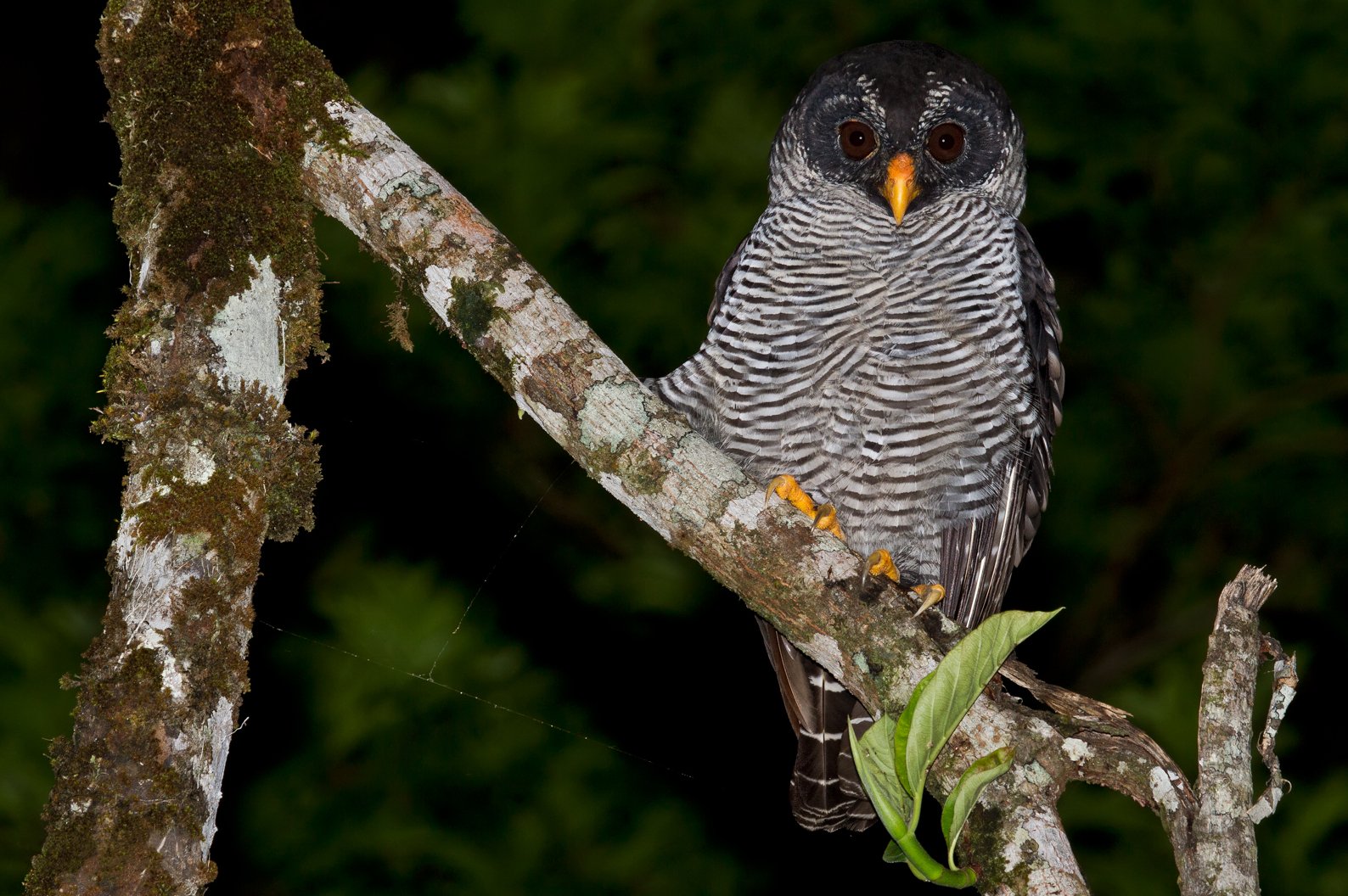
The Black-and-white Owl is a medium-sized forest owl without ear tufts, with a black face and finely black-and-white barred underparts. It lives in humid lowland forest and forest edge from southern Mexico to Panama and on into northwestern South America. At night it often hunts around streetlights and lit buildings at the forest edge, where it takes bats and large insects. Like the Mottled Owl, it used to be placed in the genus Ciccaba.
Voice
The song is a series of a few deep, short hoots ending in a louder, slightly higher and drawn-out note, hoo-hoo-hoo-HOOah. Also a single deep hoot and a hoarse, rising scream. Heard mainly in the first hours after sunset and before dawn.
Recording: Juan Freile — CC BY-NC-SA 4.0 · converted to mono · xeno-canto
Identification
35–40 cm, with a round head without ear tufts and dark eyes. Face, crown and upperparts are sooty black; an eyebrow of white dots runs above the eyes and a narrow white-barred collar crosses the hindneck. The underparts are white with dense, narrow black bars from throat to undertail coverts. The tail is black with a few narrow white bars. Bill and toes are yellow to orange-yellow. Male and female are alike.
Confusion species
The Mottled Owl Strix virgata is smaller and brown, with a brown facial disc and streaks rather than bars on the underparts. The Spectacled Owl Pulsatrix perspicillata is larger, with yellow eyes, white spectacles on a dark head and a plain yellowish belly. The Crested Owl Lophostrix cristata has long white ear tufts and plain brownish underparts.
Habitat
Humid lowland rainforest, foothill forest, gallery forest, forest edge, clearings with large trees, older secondary woodland and sometimes mangrove; also shade plantations and villages and parks at the forest edge. It occurs mainly in the lowlands up to about 1,000 metres, locally higher. It hunts bats, large insects, small rodents and frogs, often from a branch near a light.
Where the bird is most at home, classified by the vegetation units of Mexico and Central America.







Range and movements
Resident on the Caribbean side of southern Mexico, from southern Veracruz and northern Oaxaca to Tabasco, Chiapas, Campeche and Quintana Roo, and on the Pacific side of Chiapas; also a small local population in Nayarit. Further through all of Central America to Panama, commoner on the Caribbean side than on the Pacific side. Outside the guide area in western Colombia, Ecuador and northwestern Venezuela.
- Resident
- dark = core range, pale = thinly spread
How and when to look
Lodges, research stations and parks in the lowlands are the best places: in Costa Rica, for example, the rainforests of the Caribbean side and the area around Carara, in Belize and at Tikal in Guatemala. After dark it sometimes waits near outdoor lamps or streetlights for insects and bats. In Nayarit it is seen along the old road between La Bajada and Jalcocotán.
Conservation status
Not threatened. The species is fairly widespread, but depends on forest and becomes locally scarce where lowland forest disappears.
Scientific name
Strix nigrolineata | (Sclater, 1859)
Sclater described the species in 1859 as Ciccaba nigrolineata; because it was later moved to another genus, the author and year stand in brackets. The genus Strix was introduced in 1758 by Linnaeus. Strix is the Latin word for 'owl'; in classical lore the strix was a night bird said to suck the blood of infants. nigrolineata is Latin, from niger 'black' and lineatus 'lined', after the fine black barring on the white underparts. The specimen the first description was based on came from Oaxaca, Mexico.