All species › Owls › Owls › Mottled Owl
Position in the tree Birds Aves › Birds with a flexible palate Neognathae › All other modern birds Neoaves › Landbirds Telluraves › Raptors, owls, kingfishers and woodpeckers Afroaves › Hawks and owls Hieraves
Mottled Owl | Strix virgata
Bonte bosuil | Búho café
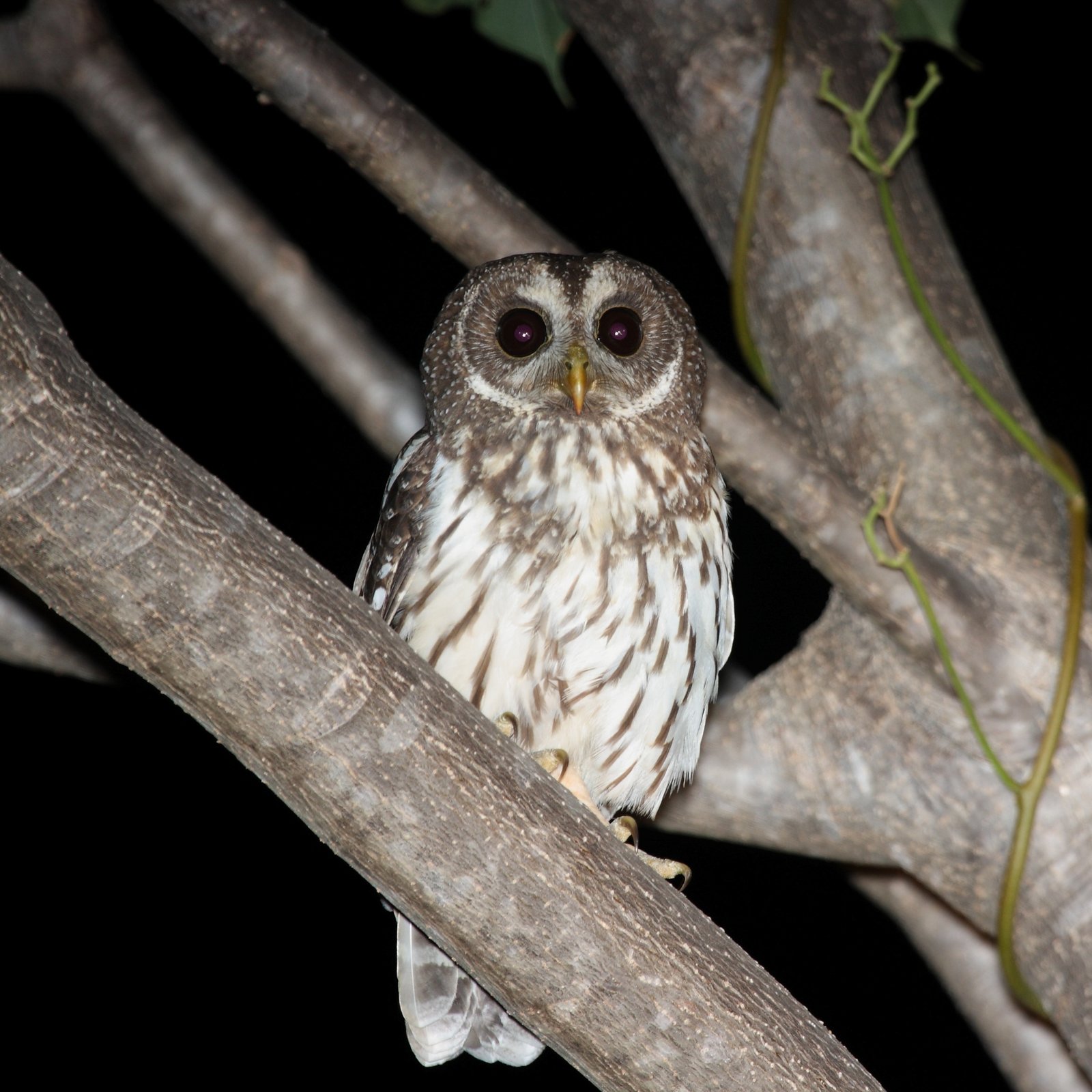
The Mottled Owl is a medium-sized forest owl without ear tufts and with dark eyes. It is the commonest Strix owl of the guide area, ranging from northwestern and northeastern Mexico to Panama, from the lowlands into the mountains. It lives in humid and dry forest, forest edge and shade plantations. It used to be placed in the genus Ciccaba and is strictly nocturnal.
Voice
The territorial call is a series of deep, emphatic hoots, hoo-hoo-hoo-hoo, sometimes a short series of two or three low notes. Also a hoarse, drawn-out scream, keeeeeh, given mainly by females and young birds. Heard year-round, most often in the dry season.
Recording: David Ruíz Domínguez — CC BY-NC-SA 4.0 · shortened to the first 60 s, mono · xeno-canto
Identification
30–38 cm, with a round head without ear tufts and large, dark brown eyes. The facial disc is brown with whitish eyebrows and a pale area around the bill. Crown, back and wings are dark brown, finely mottled and speckled with buff. The underparts are off-white to buff with distinct dark brown streaks; the upper breast is usually darker brown. There is also a dark morph with buff underparts. The tail is dark with narrow pale bars. Male and female are alike.
Confusion species
The Black-and-white Owl Strix nigrolineata has a black face and finely black-and-white barred underparts. The Spectacled Owl Pulsatrix perspicillata is much larger, with yellow eyes, a dark breast band and a plain yellowish belly. The Crested Owl Lophostrix cristata has long white ear tufts. The Stygian Owl Asio stygius has ear tufts and yellow eyes. The Cinereous Owl Strix sartorii and the Fulvous Owl Strix fulvescens are larger and have a barred neck and upper breast.
Habitat
Lowland rainforest, foothill and montane forest, dry deciduous forest, gallery forest, forest edge and older secondary forest; also shade coffee, cacao and parks and gardens with tall trees near forest. It occurs from sea level to about 2,500 metres. It hunts from a perch for rodents, bats, small birds, reptiles, frogs and large insects. It nests in a tree cavity or in an old nest of another bird.
Where the bird is most at home, classified by the vegetation units of Mexico and Central America.







Range and movements
Resident throughout the guide area south of northern Mexico: on the Pacific side from Sonora and Sinaloa southward, on the Caribbean side from Nuevo León and Tamaulipas, through the Yucatán Peninsula and all of Central America to Panama. Outside the guide area in South America to northern Argentina; occasional in southern Texas.
- Resident
- dark = core range, pale = thinly spread
How and when to look
Best at night along forest edges and forest roads, listening for the deep hoots, for example around Tikal in Guatemala, in Belize or in the forests of Costa Rica. A bird perched on a roadside branch sometimes allows good views in torchlight. By day it roosts hidden in dense foliage.
Conservation status
Not threatened. The species is widespread and can also live in plantations and disturbed forest, but depends on trees; deforestation has caused local disappearances.
Scientific name
Strix virgata | (Cassin, 1849)
Cassin described the species in 1849 as Syrnium virgatum; because it was later moved to another genus, the author and year stand in brackets. The genus Strix was introduced in 1758 by Linnaeus. Strix is the Latin word for 'owl'; in classical lore the strix was a night bird said to suck the blood of infants. virgata is Latin for 'striped', after the streaked underparts. The specimen the first description was based on came from Bogotá, Colombia (later restricted).