All species › Passerines › Antbirds › Bicolored Antbird
Position in the tree Birds Aves › Birds with a flexible palate Neognathae › All other modern birds Neoaves › Landbirds Telluraves › Falcons, parrots and passerines Australaves › Falcons and passerines Eufalconimorphae › Parrots and passerines Psittacopasserae
Bicolored Antbird | Gymnopithys bicolor
Tweekleurige miervogel | Hormiguero bicolor centroamericano
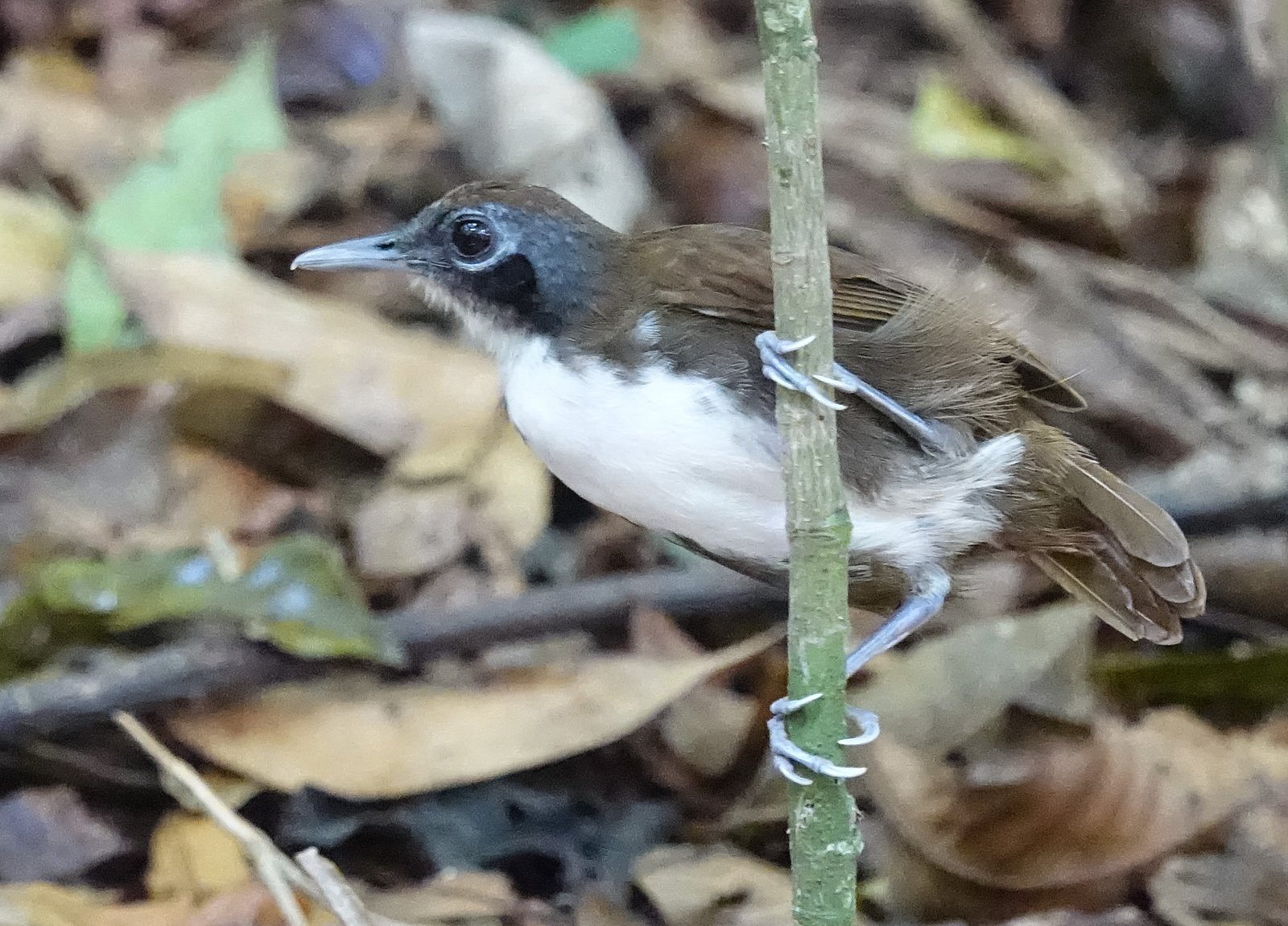
The Bicolored Antbird is an antbird of the understorey of humid forest, with brown upperparts, a white throat and breast and bare bluish-grey skin around the eye. Like the Ocellated Antbird it follows army-ant swarms and catches the insects that flee ahead of the ants. At ant swarms it is often the most numerous antbird. In the guide area it lives from Honduras to Panama.
Voice
Song a series of whistled notes that first rises and then falls, turning into harsh notes. Also a harsh, rasping call and a fast rattle.
Recording: Juan Freile — CC BY-NC-SA 4.0 · shortened to the first 60 s, mono · xeno-canto
Identification
14–15 cm. Upperparts, wings and tail warm brown; crown brown. Sides of head blackish, with bare bluish-grey skin around the eye. Throat, breast and centre of belly white; flanks brown. Sexes alike.
Confusion species
Ocellated Antbird Phaenostictus mcleannani is larger, with a black face, a large bright blue eye patch and a scaly pattern of black spots. Spotted Antbird Hylophylax naevioides is smaller, with black spots on the breast and pale wing bars.
Habitat
Understorey of humid evergreen lowland and foothill forest, also mature secondary forest; locally higher on the slopes. It lives almost exclusively with army-ant swarms, dropping from low branches and saplings onto flushed insects and spiders.
Where the bird is most at home, classified by the vegetation units of Mexico and Central America.




Range and movements
Caribbean slope of Honduras, Nicaragua and Costa Rica, in south-western Costa Rica also on the Pacific slope; in Panama on both slopes. Outside the guide area in western Colombia and western Ecuador.
- Resident
- dark = core range, pale = thinly spread
How and when to look
Often present in numbers at an active army-ant swarm, for example at La Selva in Costa Rica and along Pipeline Road (Camino del Oleoducto) in Panama. Standing quietly at the edge of the swarm gives the best views.
Conservation status
Not threatened. Common in continuous forest; declines where forest becomes fragmented and army ants disappear.
Scientific name
Gymnopithys bicolor | (Lawrence, 1863) (GBIF: Gymnopithys leucaspis)
Lawrence described the species in 1863 as Pithys bicolor; because it was later moved to another genus, the author and year stand in brackets. The genus Gymnopithys was introduced in 1857 by Bonaparte. Gymnopithys is Greek, from gumnos 'bare' and the antbird genus Pithys, after the bare skin around the eye. bicolor is Latin for 'two-coloured', after the white underparts contrasting with the rufous-brown upperparts. The specimen the first description was based on came from Lion Hill on the Panama Railroad, Panama.