All species › Passerines › Antbirds › Jet Antbird
Position in the tree Birds Aves › Birds with a flexible palate Neognathae › All other modern birds Neoaves › Landbirds Telluraves › Falcons, parrots and passerines Australaves › Falcons and passerines Eufalconimorphae › Parrots and passerines Psittacopasserae
Jet Antbird | Cercomacra nigricans
Rouwmiervogel | Hormiguero azabache
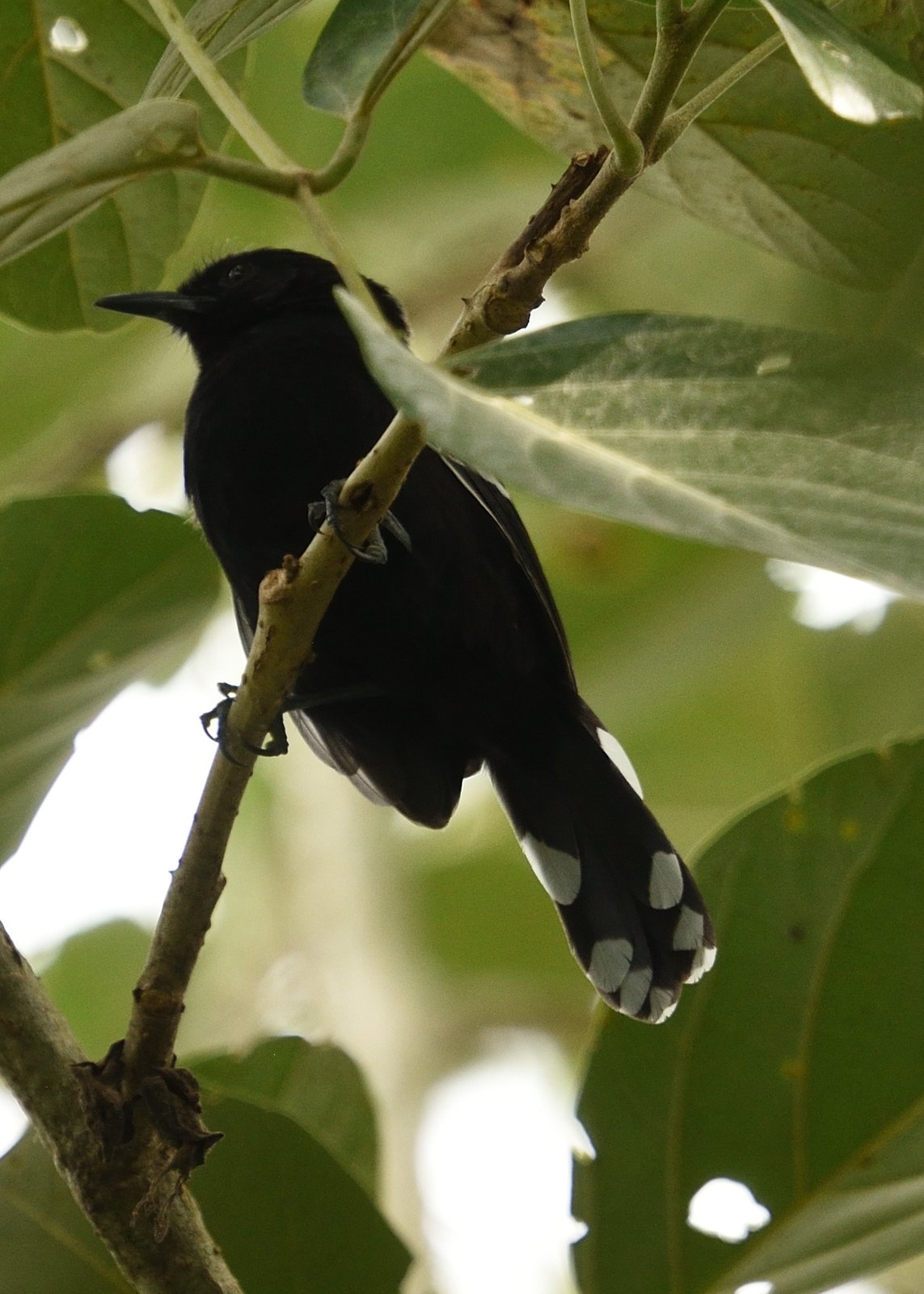
The Jet Antbird is a slender, long-tailed antbird of dense thickets and vine tangles at forest edges. The male is jet black with white fringes on the wing coverts and white tail tips; the female is dark grey with white streaks on throat and breast. In the guide area it occurs only in Panama, where it is local and scarce.
Voice
Song a repeated series of short, harsh double notes. Male and female often sing in duet.
Recording: Peter de Rouw — CC BY-NC-SA 4.0 · converted to mono · xeno-canto
Identification
14–15 cm. Male: jet black; wing coverts edged white, forming two or three narrow wing bars; tail fairly long, black with broad white tips. Female: dark slate grey, throat and breast streaked white; wing and tail pattern as in the male. Bill fairly slender.
Confusion species
The male Black Antshrike Thamnophilus nigriceps (eastern Panama) is also black, but has a heavier, hook-tipped bill and lacks the white wing bars and tail tips. Dusky Antbird Cercomacroides tyrannina is grey rather than black and shows much less white in wing and tail.
Habitat
Dense vine tangles and thickets at forest edges, in second growth and around clearings in the lowlands, often near water. It eats insects gleaned from leaves and stems.
Where the bird is most at home, classified by the vegetation units of Mexico and Central America.



Range and movements
In the guide area only in Panama, locally. Outside the guide area in northern South America, including Colombia, Venezuela and western Ecuador.
- Resident
- dark = core range, pale = thinly spread
How and when to look
Best located by its song in dense vine tangles at forest edges; the white tail tips stand out when it shows briefly.
Conservation status
Not threatened. In the guide area local and scarce; more widespread outside the guide area.
Scientific name
Cercomacra nigricans | Sclater, 1858
Sclater described the species in 1858 and placed it straight away in the genus where it still stands. He introduced the genus Cercomacra in that same work. Cercomacra is Greek, from kerkos 'tail' and makros 'long': 'long-tail'. nigricans is Latin for 'blackish', after the largely black male. The specimen the first description was based on came from Santa Marta, Colombia.