All species › Passerines › Antbirds › Ocellated Antbird
Position in the tree Birds Aves › Birds with a flexible palate Neognathae › All other modern birds Neoaves › Landbirds Telluraves › Falcons, parrots and passerines Australaves › Falcons and passerines Eufalconimorphae › Parrots and passerines Psittacopasserae
Ocellated Antbird | Phaenostictus mcleannani
McLeannans miervogel | Hormiguero ocelado
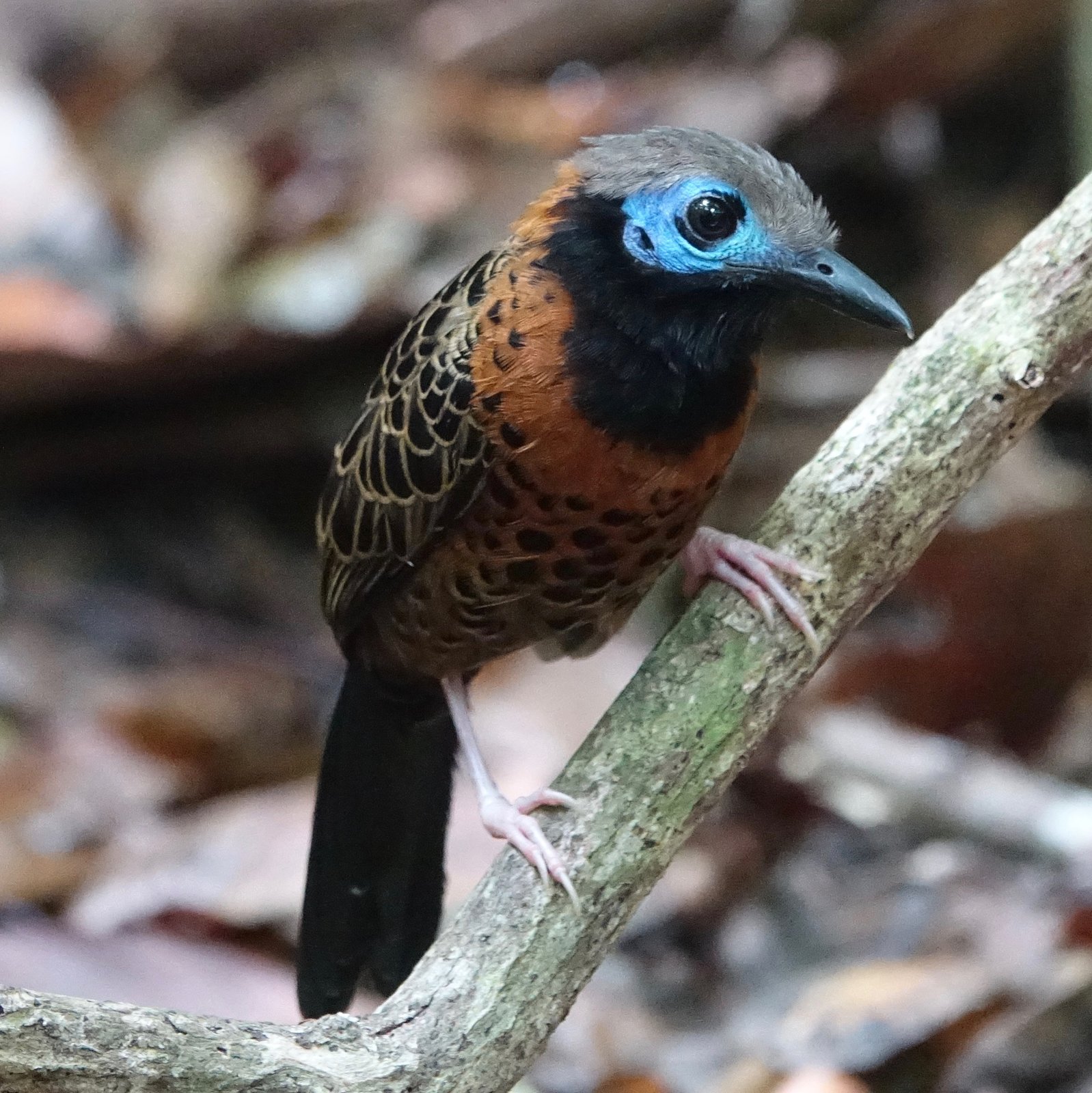
The Ocellated Antbird is a large antbird of the floor of humid lowland forest, with bare blue skin around the eye and plumage covered in black, pale-edged spots. It is a professional follower of army-ant swarms, catching the insects that flee ahead of the ants. At an ant swarm it is often the largest and dominant antbird. In the guide area it lives from eastern Honduras to Panama.
Voice
Song a long series of whistled notes that first rises and accelerates and then falls. At ant swarms also harsh, rattling calls.
Recording: Iván Lau — CC BY-NC-SA 4.0 · converted to mono · xeno-canto
Identification
19–20 cm. Large bare patch of skin around the eye bright blue; throat and front of face black; crown brown. Upperparts and underparts rufous to cinnamon, densely marked with black spots edged pale, creating a scaly pattern. Tail fairly long and dark. Legs pinkish to greyish. Sexes alike.
Confusion species
Bicolored Antbird Gymnopithys bicolor follows the same ant swarms but is smaller, with plain brown upperparts and an unspotted white throat and breast. Other antbirds at ant swarms are smaller and lack the scaly pattern and the large blue eye patch.
Habitat
Floor and understorey of humid evergreen lowland and foothill forest, especially undisturbed forest; mostly at lower elevations. It lives almost exclusively with army-ant swarms, dropping from low branches and saplings onto flushed insects and other small animals.
Where the bird is most at home, classified by the vegetation units of Mexico and Central America.



Range and movements
Caribbean slope of eastern Honduras, Nicaragua and Costa Rica; in Panama over much of the country. Outside the guide area in north-western Colombia and north-western Ecuador.
- Resident
- dark = core range, pale = thinly spread
How and when to look
Best seen at an active army-ant swarm; the hissing and calling of the attending birds give such a swarm away. Well-known sites are La Selva in Costa Rica and Pipeline Road (Camino del Oleoducto) in Panama.
Conservation status
Not threatened. Depends on large, continuous forest with army ants; disappears where forest becomes fragmented.
Scientific name
Phaenostictus mcleannani | (Lawrence, 1861)
Lawrence described the species in 1861 as Phlogopsis MeLeannani (sic); because it was later moved to another genus, the author and year stand in brackets. The genus Phaenostictus was introduced in 1909 by Ridgway. Phaenostictus is Greek, from phainō 'to display' and stiktos 'spotted', after the boldly scaled plumage. mcleannani honours James McLeannan (fl. 1860), an American engineer on the Panama Railroad and bird collector. The specimen the first description was based on came from Lion Hill on the Panama Railroad, Panama.