All species › Pigeons and doves › Pigeons and doves › Grey-fronted Quail-Dove
Grey-fronted Quail-Dove | Geotrygon caniceps
Grijskopkwartelduif | Paloma perdiz camao
The Grey-fronted Quail-Dove is one of two quail-doves found only in Cuba, the other being the Blue-headed Quail-Dove. It is a compact, shy ground bird of moist, shady forest that searches the leaf litter on foot and, when disturbed, tends to walk away rather than fly. In Cuba it is called camao. Until recently it was treated as a single species with the White-fronted Quail-Dove of Hispaniola; today the two are regarded as separate species.
Voice
A long series of short, low, hollow notes, hoo or coo, which may be delivered slowly or in quick succession. The direction of the sound is often unclear; it usually comes from the forest floor or a low branch in dense cover. The song is heard mainly in the early morning and during the breeding season.
Recording: GABRIEL LEITE — CC BY-NC-SA 4.0 · converted to mono · xeno-canto
Identification
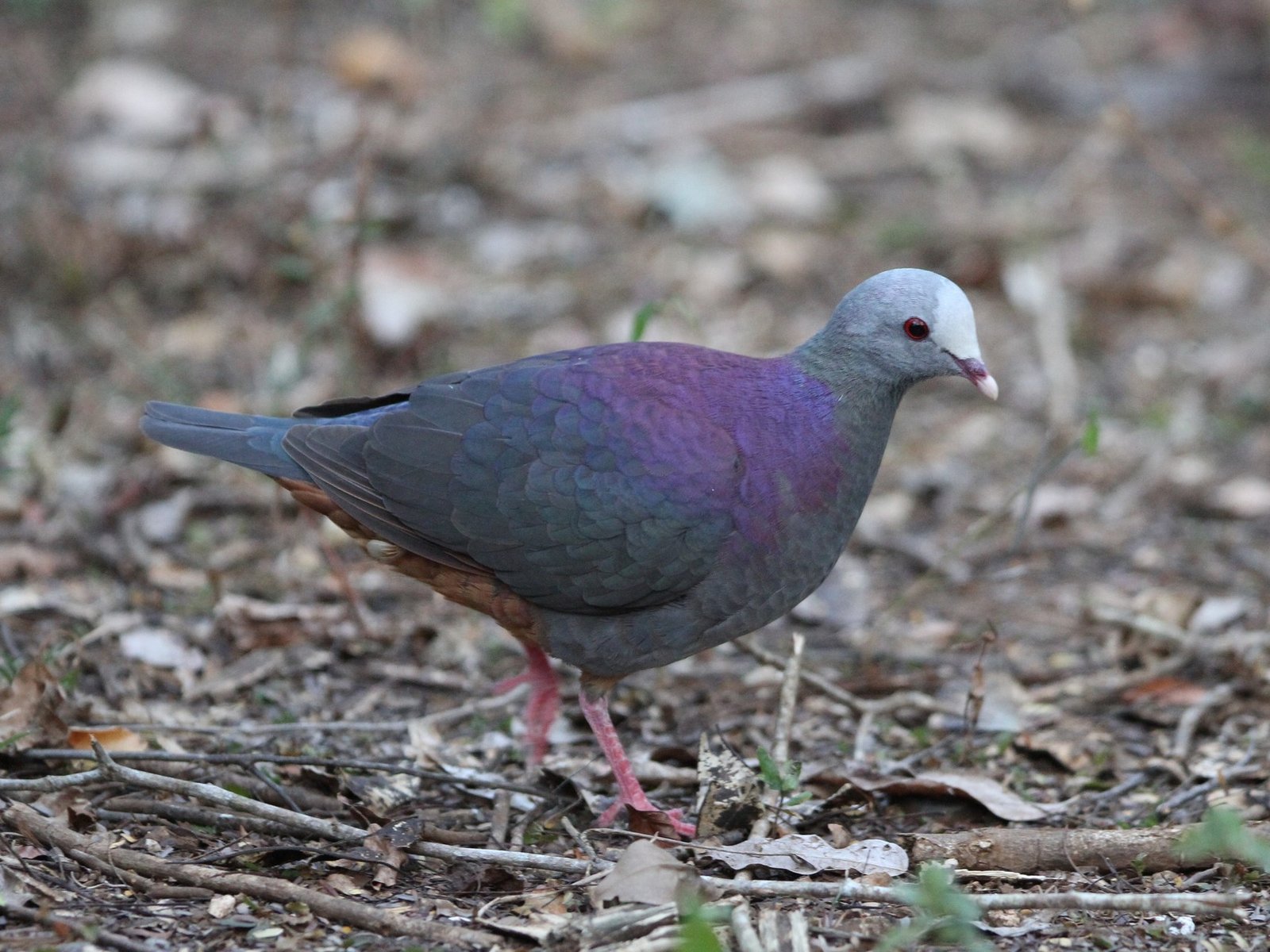
26–30 cm, compact and short-tailed, with a round head and short, strong legs. The forehead is greyish white, shading to grey on the rest of the head, with a faint purple gloss on the hindcrown. The throat is mid-grey, darkening towards the breast; the sides of the breast are glossed purple. The back and wings are dark slate grey with a purplish-blue sheen on the mantle, the belly is cream and the undertail coverts are rufous. The sexes are similar; the female is slightly duller. Juveniles are browner and lack the gloss.
Confusion species
Blue-headed Quail-Dove Starnoenas cyanocephala is larger and warm brown, with a bright blue crown, a black throat patch edged with white and a white stripe below the eye. Key West Quail-Dove Geotrygon chrysia is rufous above, with a distinctive white stripe below the eye and pale underparts. Ruddy Quail-Dove Geotrygon montana is mostly rusty brown with a pale cheek stripe and lacks grey on the head and breast. The very similar White-fronted Quail-Dove Geotrygon leucometopia lives only in Hispaniola and does not occur in Cuba.
Habitat
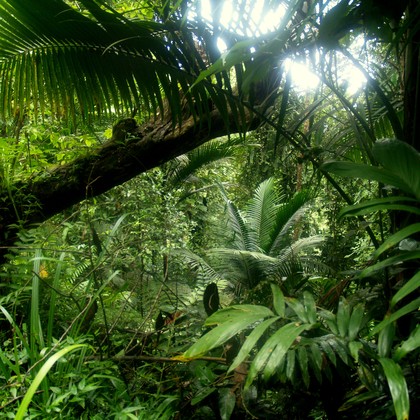
Moist primary and mature secondary forest with dense undergrowth and a deep layer of leaf litter, from the lowlands to about 1,200 m, including semi-evergreen forest and forest on limestone. It feeds on the ground on seeds, fallen fruit and small invertebrates and stays close to cover. It avoids open ground and heavily logged forest. The nest is a loose platform of twigs, low in shrubs, creepers or on a broken stump.
Where the bird is most at home, classified by the vegetation types of the Caribbean.



Range and movements
Only in Cuba. The species was formerly found throughout the island but is now restricted to a number of larger forest areas, including the Sierra del Rosario in the west, the forests of the Zapata Peninsula and forest areas in the east of the island. Reports from Hispaniola refer to the White-fronted Quail-Dove, which until recently was included in the same species. The Grey-fronted Quail-Dove does not occur outside Cuba.
- Resident
- dark = core range, pale = thinly spread
How and when to look
The Zapata Peninsula, particularly the forest around Bermejas, is a well-known site, where local guides know the stretches of forest in which quail-doves walk across the tracks in the early morning. Standing still on a track at first light produces more than walking about; the bird often appears suddenly on the ground and vanishes just as quickly. The low call is the first lead.
Conservation status
Vulnerable. The population is small and declining as a result of hunting and the loss of forest. Because the species is increasingly confined to isolated forest areas, it is sensitive to further fragmentation. Part of the remaining population lives in protected areas such as Zapata.
Scientific name
Geotrygon caniceps | (Gundlach, 1852)
Gundlach described the species in 1852 as Columba caniceps; because it was later moved to another genus, the author and year stand in brackets. The genus Geotrygon was introduced in 1847 by Gosse. Geotrygon is Greek, from gē 'earth, ground' and trugōn 'turtle dove': 'ground dove'. caniceps is Latin, from canus 'grey' and -ceps '-headed', after the grey head. The specimen the first description was based on came from Cuba.