All species › Pigeons and doves › Pigeons and doves › Ruddy Quail-Dove
Ruddy Quail-Dove | Geotrygon montana
Rosse kwartelduif | Paloma perdiz rojiza
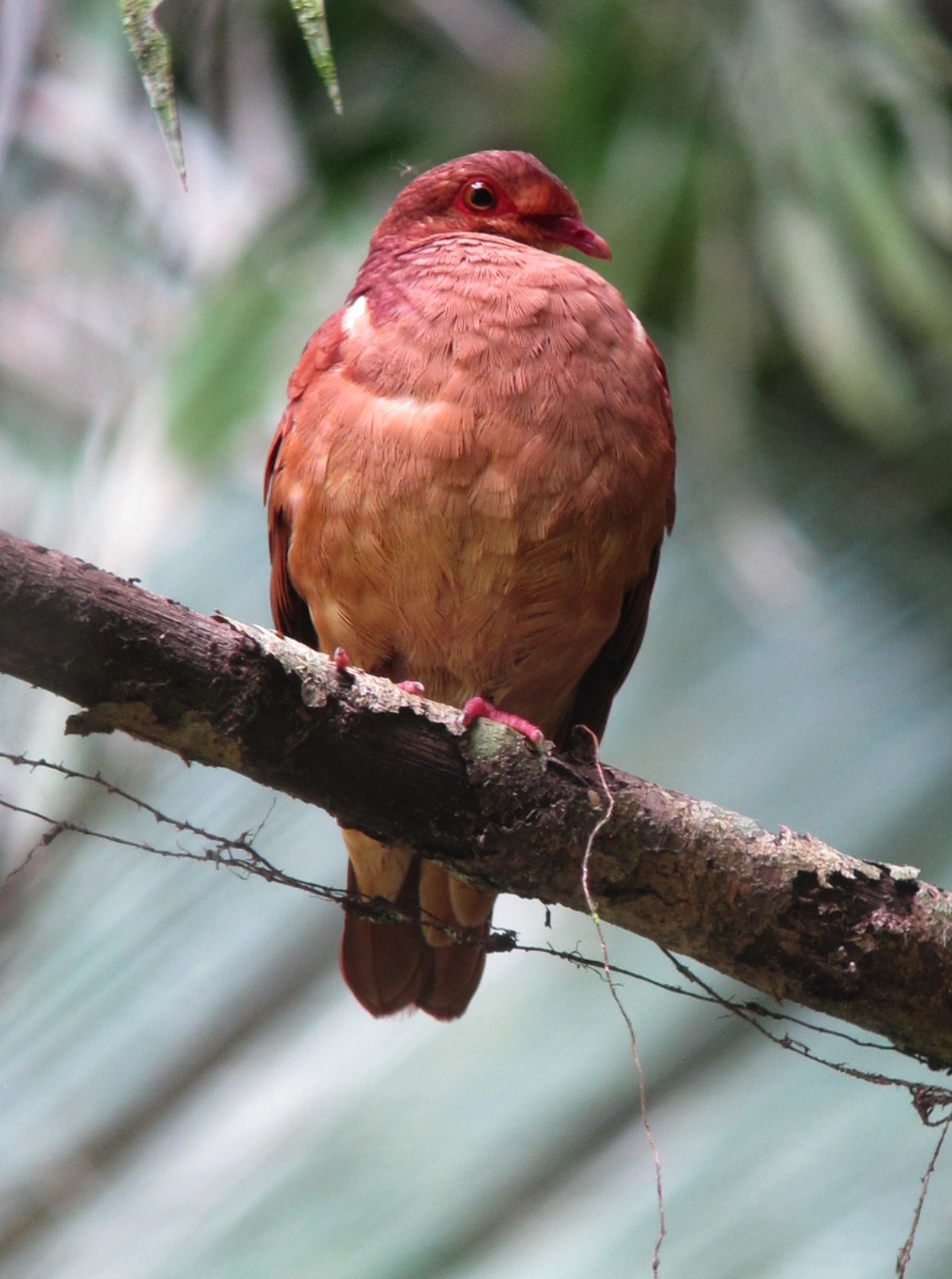
The Ruddy Quail-Dove is the most widespread quail-dove of tropical America and the only one in the region found in both the Greater and the Lesser Antilles. It is a compact, rufous dove that lives hidden on the forest floor and is usually noticed only when it flushes from underfoot or shoots low across a track. In Cuba it is called boyero; on the French Antilles the name perdrix rouge is used.
Voice
A low, soft, mournful ooooo that fades away and is repeated at intervals of a few seconds for long periods, often from the ground or a low branch. The sound carries further than it seems, but its direction often cannot be determined in the forest. On take-off the wings clatter audibly.
Recording: Richard E. Webster — CC BY-NC-SA 4.0 · shortened to the first 60 s, mono · xeno-canto
Identification
23–28 cm, compact and round in build, with a short tail and fairly long pink legs; the bill is reddish. The male is warm rusty brown to chestnut above with a purplish gloss on the mantle. The face is rusty brown, with a clear pale buff stripe below the eye, bordered by a rufous moustachial stripe. Breast and flanks are pinkish buff-brown, the belly paler. The female has the same pattern but is olive-brown rather than rufous above and drabber below, with a less clean-cut face pattern. Juveniles resemble the female and show pale and dark barring on the upperparts.
Confusion species
In Cuba, Hispaniola and Puerto Rico, Key West Quail-Dove Geotrygon chrysia has a white, not buff, stripe below the eye, a pale throat and a green- and purple-glossed nape; female Ruddy Quail-Dove can look very similar. Grey-fronted Quail-Dove Geotrygon caniceps (Cuba) and White-fronted Quail-Dove Geotrygon leucometopia (Hispaniola) have a grey or white head and a dark blue back. In Cuba, Blue-headed Quail-Dove Starnoenas cyanocephala is larger, with a blue crown and black bib; in Jamaica, Crested Quail-Dove Geotrygon versicolor is larger, with grey head and breast. In the Lesser Antilles and Puerto Rico, Bridled Quail-Dove Geotrygon mystacea is larger and darker olive-brown, with a white stripe below the eye. The doves of the genus Leptotila, such as Caribbean Dove and Grey-fronted Dove, are slimmer, with a pale belly and white tail tips.
Habitat
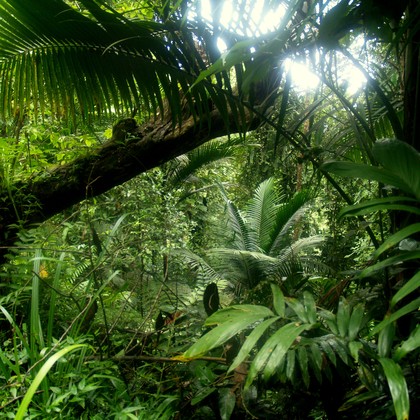
Humid and semi-evergreen forest, lowland and montane rainforest, limestone karst forest and dense scrub forest, and also coffee plantations with shade trees; from sea level into the mountains. It lives on the forest floor, walking through the leaf litter in search of seeds, fallen fruit and small invertebrates. The nest is a flimsy platform of twigs and leaves, low in a shrub or sometimes on the ground, with two pale brown or buff eggs.
Where the bird is most at home, classified by the vegetation types of the Caribbean.




Range and movements
In Cuba with the Isla de la Juventud, Jamaica, Hispaniola (Haiti and the Dominican Republic) and Puerto Rico, and in the Lesser Antilles on Guadeloupe, Dominica, Martinique, Saint Lucia, Saint Vincent and Grenada; scarce or irregular on a few smaller islands, such as Antigua and the Virgin Islands. In Trinidad locally in forest; it does not occur in Tobago. Beyond the region from Mexico through Central America and in South America to Bolivia, Paraguay, north-eastern Argentina and southern Brazil. A rare vagrant to Florida and southern Texas.
- Resident
- dark = core range, pale = thinly spread
How and when to look
In almost any larger forest in the Greater Antilles and on the wooded islands of the Lesser Antilles, but seldom seen well. The best chance is early in the morning on a quiet forest track, where the birds sometimes walk into the open; waiting quietly in one spot yields more than walking on. The low, fading call shows the way, and a rufous dove shooting low and fast across a track is usually this species.
Conservation status
Not threatened. The species has a very large range and is fairly common on many islands, including Cuba. On a number of islands it is hunted and suffers from forest loss and from introduced predators such as cats, rats and mongooses, but no decline at the scale of the region is known.
Scientific name
Geotrygon montana | (Linnaeus, 1758)
Linnaeus described the species in 1758 as Columba montana; because it was later moved to another genus, the author and year stand in brackets. The genus Geotrygon was introduced in 1847 by Gosse. Geotrygon is Greek, from gē 'earth, ground' and trugōn 'turtle dove': 'ground dove'. montana is Latin for 'of the mountains', although the species lives mostly in lowland forest. The specimen the first description was based on came from Jamaica.