All species › Pigeons and doves › Pigeons and doves › White-fronted Quail-Dove
White-fronted Quail-Dove | Geotrygon leucometopia
Witvoorhoofdkwartelduif | Paloma perdiz dominicana
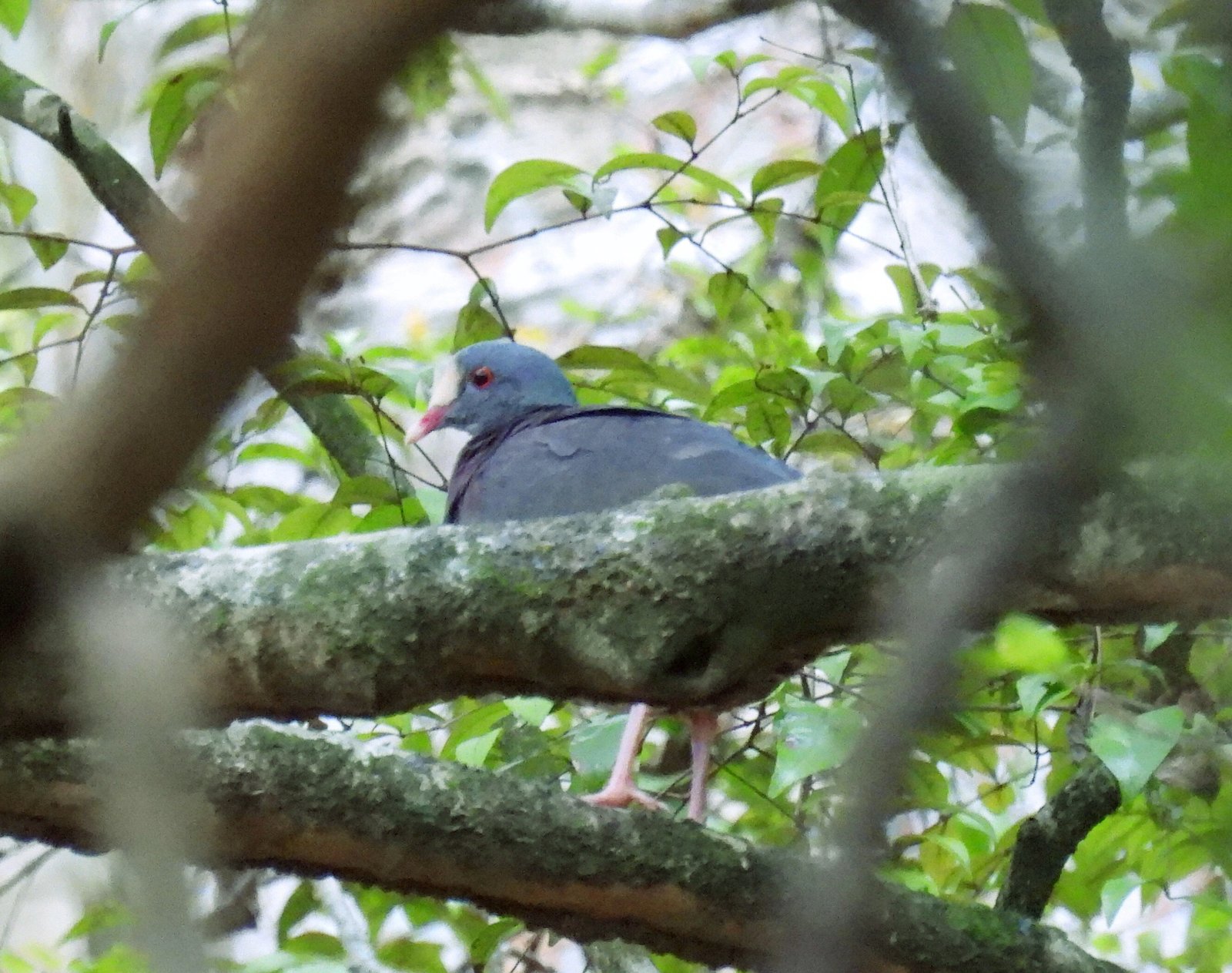
The White-fronted Quail-Dove is a shy ground dove of the montane forests of Hispaniola, now seen almost exclusively in the Dominican Republic. It walks quietly over the forest floor, turning leaves, and vanishes among the ferns and shrubs at the slightest disturbance. Until recently it was treated as a single species with the Grey-fronted Quail-Dove of Cuba; the two are now regarded as separate species. Its small range and hunting make it threatened.
Voice
A series of short, low, hollow notes, hoo or coo, slow or in quick succession, often from dense cover. In quiet montane forest the sound carries a long way. The call is often the only sign of the bird, which otherwise keeps hidden on the ground or on a low branch.
Recording: Jesse Fagan — CC BY-NC-SA 4.0 · shortened to the first 60 s, mono · xeno-canto
Identification
About 28 cm, compact and short-tailed. Its distinctive feature is the broad, bright white forehead, contrasting sharply with the slate-grey crown and head. The neck has a reddish-purple to violet gloss, and the upperparts are a darker grey with a metallic purplish-blue sheen. The breast is grey and the lower belly rufous. The eye is red and the legs reddish. The sexes are alike. Juveniles are duller and browner, with a less sharply defined forehead.
Confusion species
Key West Quail-Dove Geotrygon chrysia, which also lives in Hispaniola, is rufous above, has a white stripe below the eye and lacks the white forehead and the grey. Ruddy Quail-Dove Geotrygon montana is mostly rusty brown, likewise without grey. Grey-fronted Quail-Dove Geotrygon caniceps is very similar but has a less white forehead and lives only in Cuba, so the two never occur side by side.
Habitat
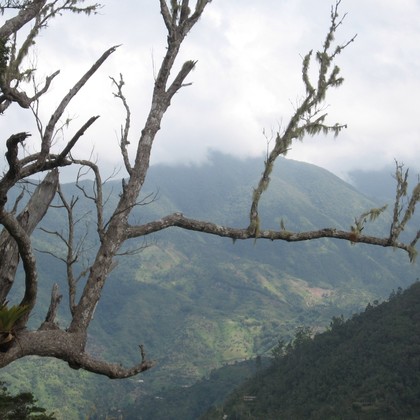
Moist broadleaf forest with dense undergrowth and plenty of leaf litter, mainly in the mountains up to about 1,800 m, including montane rainforest and cloud forest; locally also in semi-evergreen forest at lower elevations. There are also a few records from drier areas with cactus and scrub. It feeds on the ground on seeds, fallen fruit and small invertebrates. The nest is a loose platform of twigs low in the vegetation.
Where the bird is most at home, classified by the vegetation types of the Caribbean.


Range and movements
Only in Hispaniola. Almost all recent records come from the Dominican Republic, where the species occurs in the montane forests of, among others, the Sierra de Bahoruco and the Cordillera Central. In Haiti, where it was formerly reported from the mountains in the south, it may have disappeared. The species does not occur outside Hispaniola.
- Resident
- dark = core range, pale = thinly spread
How and when to look
The Sierra de Bahoruco in the south-west of the Dominican Republic is where most birders see the species, often with a local guide who knows the stretches of forest where the doves walk on or beside the tracks in the early morning. A quiet watch at first light works better than searching; the call often betrays the bird's presence before it shows itself.
Conservation status
Endangered. The population is estimated at fewer than 1,700 adults and is declining because of forest loss, hunting and introduced predators. The range is very small, and the forest in the mountains of Hispaniola is under pressure from clearance, logging and fire. Part of its habitat lies within national parks.
Scientific name
Geotrygon leucometopia | (Chapman, 1917)
Chapman described the species in 1917 as Oreopeleia leucometopius; because it was later moved to another genus, the author and year stand in brackets. The genus Geotrygon was introduced in 1847 by Gosse. Geotrygon is Greek, from gē 'earth, ground' and trugōn 'turtle dove': 'ground dove'. leucometopia is Greek, from leukos 'white' and metōpon 'forehead', after the white forehead. The specimen the first description was based on came from Mt. Tina, Azua Province, Dominican Republic.