All species › Passerines › New World warblers › Golden-crowned Warbler
Golden-crowned Warbler | Basileuterus culicivorus
Goudhaanzanger | Reinita coronidorada
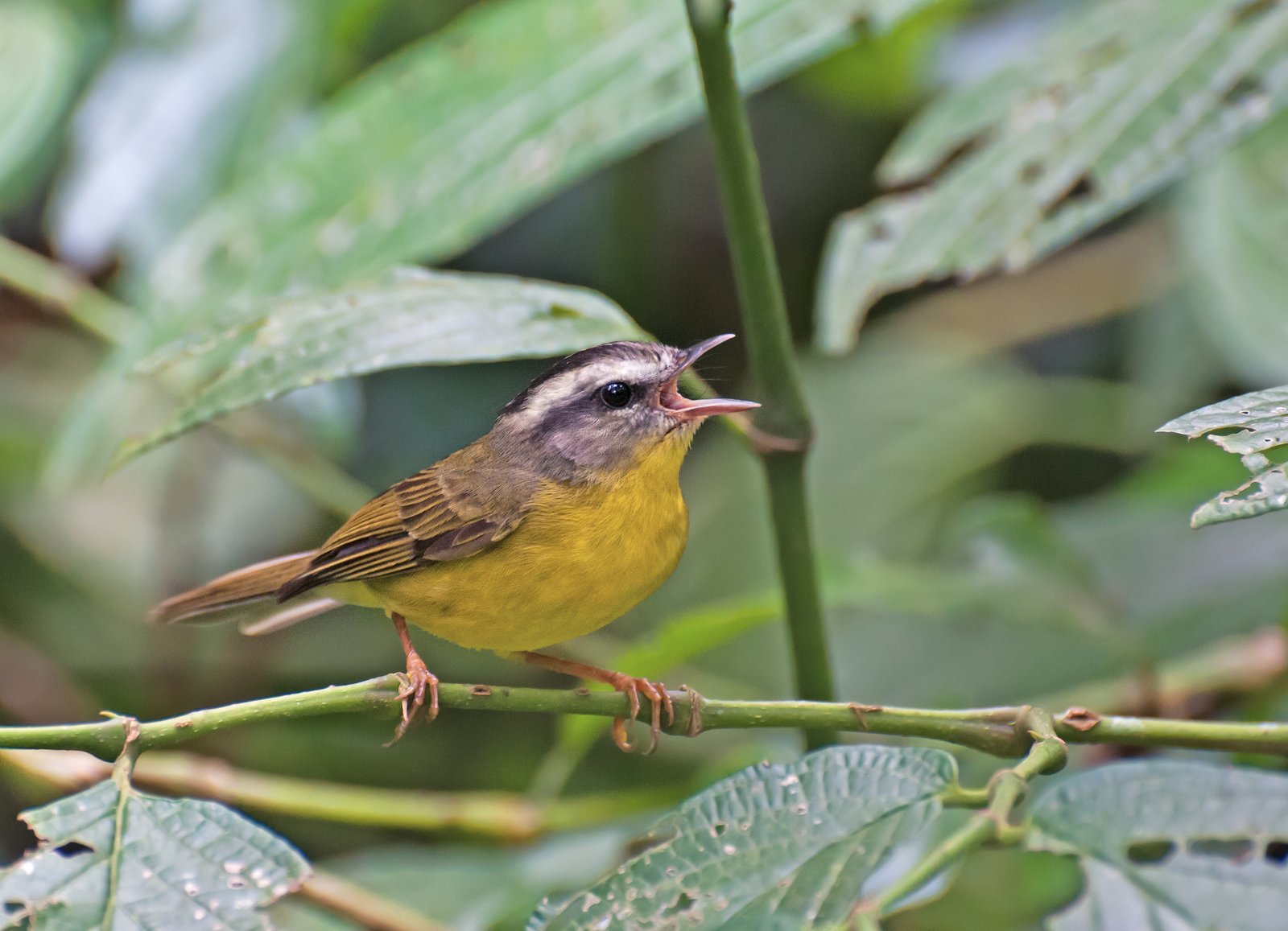
The Golden-crowned Warbler is a small tropical wood-warbler with a yellow crown stripe between two black stripes, widespread in forests from Mexico to Argentina. In the Caribbean it lives only on Trinidad, as a resident of the subspecies olivascens, which also occurs in north-eastern Venezuela. It is a regular member of mixed flocks in the lower level of the forest.
Voice
The song is a high, thin series rising at the end, like pit-see-see-see-sweet, often answered by a second bird. The call is a sharp tsip, and a dry, rattling chek when alarmed.
Recording: Marcos E. Sosa — CC BY-NC-SA 4.0 · converted to mono · xeno-canto
Identification
12–13.5 cm, with a fairly short, fine bill. Upperparts grey-green to olive-green, underparts yellow. On the head a yellow to orange-yellow central crown stripe, bordered on each side by a broad black stripe; below it a pale, yellowish or grey supercilium and a dark eye-line. No wing bars and no white tail spots. The sexes are alike. Young birds are duller and browner, with hardly any head stripes except the eye-line.
Confusion species
Golden-fronted Greenlet Pachysylvia aurantiifrons is also olive-green and yellow, but has a yellowish-brown forehead without black head stripes and a thicker bill. Scrub Greenlet Hylophilus flavipes has a pale bill, a pale eye and a plain head. Among winter visitors, Canada Warbler Cardellina canadensis has a grey back, a white or yellow eye-ring and a streaked breast band; Tennessee Warbler Leiothlypis peregrina is green and white, with a pale supercilium but no black crown stripes.
Habitat
Moist and semi-evergreen forest and lowland rainforest, also older secondary growth and shady forest edges, from the foothills up into montane forest. It forages in pairs or family groups in the lower and middle levels for insects, with quick movements and often swinging its tail, and forms the core of many mixed flocks with antbirds, manakins and tanagers.
Where the bird is most at home, classified by the vegetation types of the Caribbean.



Range and movements
In the region only on Trinidad: mainly in the forest of the Northern Range, such as the Arima Valley, and also in the forested parts of the Central Range and locally in the south of the island. Not on Tobago. Outside the region from Mexico through Central America to Colombia and Venezuela, and on through eastern and southern South America to north-eastern Argentina and Uruguay.
- Resident
- dark = core range, pale = thinly spread
How and when to look
The forest trails in the Arima Valley and elsewhere in the Northern Range, where mixed flocks often move through the understorey. The high, rising song and the rattling alarm usually give the birds away first; the crown stripes are best seen when a bird briefly looks down.
Conservation status
Not threatened. The species has a very large range and tolerates secondary forest. On Trinidad it is fairly common in the forest of the Northern Range.
Scientific name
Basileuterus culicivorus | (Deppe, 1830)
Deppe described the species in 1830 as Sylvia culicivora; because it was later moved to another genus, the author and year stand in brackets. The genus Basileuterus was introduced in 1848 by Cabanis. Basileuterus is Greek, from basileuteros 'more kingly', after the coloured crown stripe recalling a little crown. culicivorus is Latin, from culex, culicis 'gnat' and -vorus '-eating': 'gnat-eater'. The specimen the first description was based on came from Xalapa, Veracruz (Mexico).