All species › Passerines › New World warblers › Canada Warbler
Canada Warbler | Cardellina canadensis
Canadese zanger | Reinita canadiense
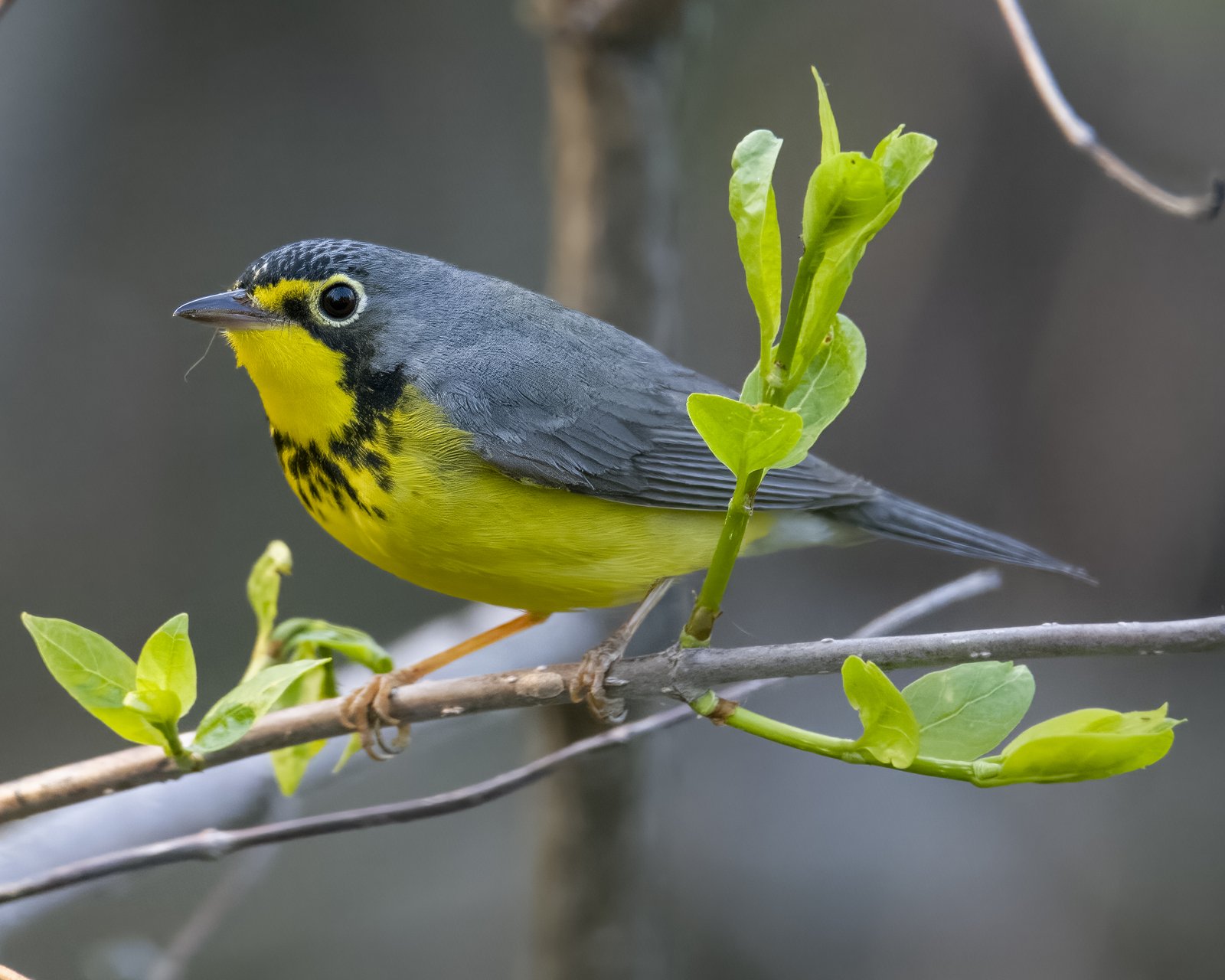
The Canada Warbler is a grey-and-yellow wood-warbler with a 'necklace' of dark streaks across the breast, breeding in moist forest with dense undergrowth in Canada and the north-eastern United States. It migrates through Central America to the Andes, where it winters, and so touches the Caribbean only at the edge: most records are autumn passage migrants.
Voice
The call is a dry chup or chip. The song, rarely heard in the region, is a rapid, irregular series of clear notes, introduced by a short chip.
Recording: Sue Riffe — CC BY-NC-SA 4.0 · converted to mono · xeno-canto
Identification
12–15 cm, with a fairly long tail. Upperparts plain blue-grey, underparts bright yellow with white undertail coverts. A pale eye-ring, white or yellowish, forms spectacles with the yellow lores. The male has a black forehead and black cheeks and a necklace of black streaks across the breast. The female is duller, with a grey head and a faint grey necklace. Young birds in autumn resemble the female, sometimes with barely any necklace. No wing bars and no white tail spots.
Confusion species
Magnolia Warbler Setophaga magnolia also has grey upperparts, yellow underparts and a streaked breast, but white wing bars, a yellow rump and a white band halfway along the tail. Kentucky Warbler Geothlypis formosa is olive-green above, with a yellow supercilium and black sideburns. Wilson's Warbler Cardellina pusilla is olive-green above, without a necklace or a distinct eye-ring. Mourning Warbler Geothlypis philadelphia has a grey hood and an olive-green back.
Habitat
On migration in moist and semi-evergreen forest, montane forest, limestone forest and coastal woodland, especially in dense undergrowth and along forest edges. It forages actively low in the vegetation for insects, also catches prey in flight and often flicks its tail.
Where the bird is most at home, classified by the vegetation types of the Caribbean.




Range and movements
A rare passage migrant in the Bahamas, Cuba and Puerto Rico, with most records in autumn; very rare in Jamaica, Hispaniola, the Cayman Islands, the Turks and Caicos Islands and the Virgin Islands. A vagrant in the Lesser Antilles (including Guadeloupe and Barbados), the ABC Islands and Trinidad. Breeds in Canada, around the Great Lakes and in the Appalachians, and winters in the northern Andes, from Venezuela and Colombia to Peru. The map shows year-round and breeding-season records in the region that do not fit the known status.
- Resident
- Summer visitor (c. Oct–Mar)
- Passage (Mar–Apr, Oct–Nov)
- dark = core range, pale = thinly spread
How and when to look
The chance is greatest in September and October in the Bahamas and Cuba, in dense undergrowth where other migrant warblers are feeding. The spectacles and necklace are visible on a bird low in the thicket.
Conservation status
Not threatened, but the breeding population has been declining for decades by about 3% a year, most steeply in the north-east of the breeding range; in Canada the species is listed as threatened. Forest loss in the Andes, where it winters, is considered one of the causes.
Scientific name
Cardellina canadensis | (Linnaeus, 1766)
Linnaeus described the species in 1766 as Muscicapa canadensis; because it was later moved to another genus, the author and year stand in brackets. The genus Cardellina was introduced in 1850 by Bonaparte. Cardellina is a diminutive of the Italian dialect word cardella 'goldfinch'. canadensis is Latin for 'of Canada'. The specimen the first description was based on came from Canada.