All species › Birds of prey › Hawks, eagles and kites › Griffon Vulture
Griffon Vulture | Gyps fulvus
Vale gier | Buitre leonado
A colossal soaring bird that hangs on stiff, near-flat wings for hours on thermals above the sierras. Where a carcass falls in Iberia, dozens of Griffons gather within the hour, alerted by each other's descending flights.

Click a thumbnail to switch the photo above.
Voice
Virtually silent in flight. At carcasses and roosts it hisses, grunts and snarls: a hoarse chrrrrr and sharp hissing between squabbling birds. Heard mainly at feeding stations and in the colonies during the breeding season from January to June.
Recording: Thomas Signeau — CC BY-SA 4.0 · Wikimedia Commons
Identification
Huge, with very broad wings, deeply fingered tips and a short square tail that barely projects behind the wings. Soars on flat or slightly raised wings with the hands pushed forward. Sandy body and pale coverts contrast strongly with black flight feathers; white downy ruff, bare pale neck. Juveniles darker with a brown ruff.
Confusion species
Cinereous Vulture: the same size but uniformly dark, with a broader, more rectangular wing, a longer wedge-shaped tail and no contrast between pale coverts and dark flight feathers. Against the light use the head: Cinereous shows a heavy dark head, Griffon a pale slender neck. Lammergeier: much longer pointed wings and a wedge-shaped tail.
Habitat
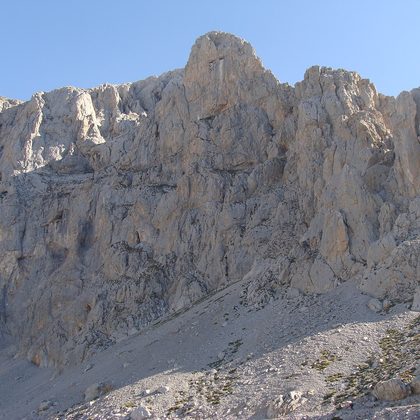
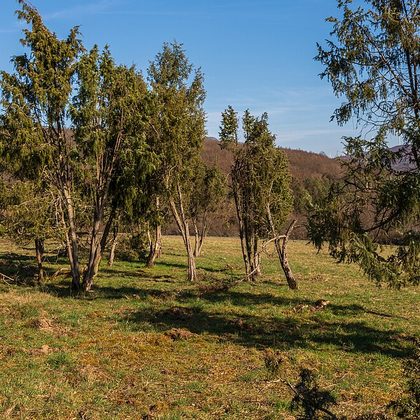
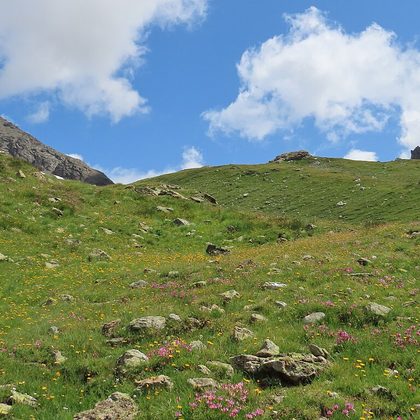
Limestone cliffs and gorges for the colonies, surrounded by extensive livestock country — dehesa (Iberian parkland of old oaks over grazed grassland), cereal steppe and mountain slopes where stock dies. Ranges tens of kilometres daily and relies on dependable slope lift along ridges and the edge of the meseta.
Where the bird is most at home, classified with EUNIS — the European standard for habitats.

Range and movements
Iberia is the stronghold — Pyrenees, Ebro valley, Cantabrian mountains, the Sistema Ibérico, Extremadura and the Andalusian sierras — with further colonies in the Causses and the southern Alps, on the Italian peninsula and Sardinia, in the Balkans and in Anatolia. Immatures wander far north; in recent summers parties have appeared regularly in north-west Europe.
- Resident
- Breeding (summer)
- Winter
- Passage
- dark = core range, pale = thinly spread
How and when to look
April to September, from mid-morning through the heat of the day once thermals are working. Sit at a known colony — Monfragüe, the Hoces del Duratón, the Foz de Arbayún or Riaño — and watch from the gorge rim, looking down onto soaring birds.
Conservation status
Not globally threatened (IUCN: Least Concern). Strongly recovered since legal protection and the reopening of carcass sites after the strict EU rules of the BSE crisis. Continuing threats are illegal poison baits aimed at predators, veterinary anti-inflammatories such as diclofenac in livestock carcasses, collisions with turbines and power lines, and the decline of extensive stock farming.
Scientific name
Gyps fulvus | (Hablizl, 1783)
Hablizl described the species in 1783 as Vultur fulvus; because it was later moved to another genus, the author and year stand in brackets. The genus Gyps was introduced in 1809 by De Savigny. Gyps is Greek gups 'vulture'. fulvus is Latin for 'tawny', after the colour of the back and wing coverts. The specimen the first description was based on came from Gilan, Iran.