All species › Waders, gulls and terns › Skuas › Great Skua
Great Skua | Stercorarius skua
Grote jager | Págalo grande
The Great Skua has the size of a Herring Gull but the build and behaviour of a bird of prey: broad-winged, short-tailed and heavy-headed. It forces Gannets to give up their catch and will kill auks, gulls and young seabirds outright.
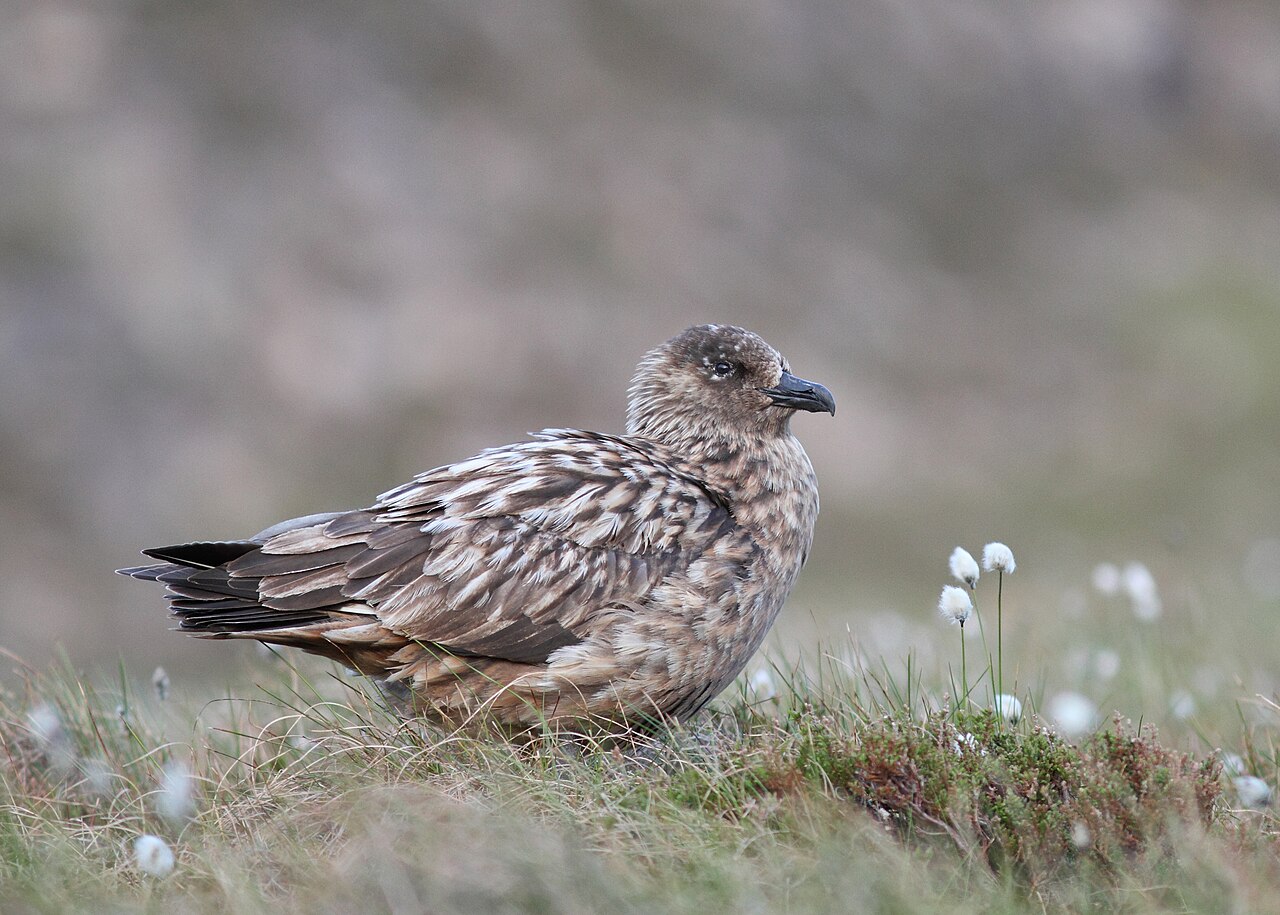
Click a thumbnail to switch the photo above.
Voice
Silent away from the colony: along the coast you will hear nothing, even from a bird passing close inshore. At the breeding sites in the British Isles, the Faroes and Iceland it gives a hoarse, barking uk-uk-uk as it dives at walkers, and a long harsh scream during the wing-raising display. Anyone crossing Hermaness or Foula in June gets both the call and the bird itself, at once.
Recording: Stein Ø. Nilsen — CC BY-NC-SA 4.0 · Wikimedia Commons
Identification
Huge and compact, with broad wings, a short wedge-shaped tail and a thick black hooked bill on a heavy head. The plumage is wholly dark brown with warm rufous and golden streaking on mantle, coverts and neck, so that at close range the bird looks streaked; at sea it simply reads as dark. The clincher in flight is the large, brilliant white flash at the base of the primaries, above and below the wing — far bigger and whiter than in any other skua. The central tail feathers are barely elongated and project a centimetre at most, so anyone looking for streamers here will be disappointed. Juveniles are plainer and colder brown with less streaking, a darker head and a blue-grey bill base.
Confusion species
Pomarine Jaeger is slimmer, with a longer hand, pale underparts in most birds and a far narrower white flash; its shape suggests a large gull, where a Great Skua suggests a Buzzard out at sea. Parasitic and Long-Tailed Jaegers are clearly smaller, finer and lighter in flight. A dark juvenile Great Black-Backed Gull can mislead at range, but lacks the white primary flash and has a much longer tail and a pale bill base. The southern relatives from subantarctic waters are not to be expected in Europe.
Habitat
It breeds in loose colonies on coastal heath and tundra in the British Isles, the Faroes, Iceland, Scandinavia and Svalbard, usually near large seabird colonies. For the rest of the year it is pelagic, concentrating over shallow fishing grounds and behind trawlers. Its diet is stolen fish, carrion, fishery discards and seabirds it kills itself, up to the size of a Gannet; in the breeding season auk and storm-petrel colonies are a standing food supply.
Where the bird is most at home, classified with EUNIS — the European standard for habitats.



Range and movements
Virtually the whole world population breeds in the North Atlantic, centred on the British Isles and Iceland and extending to the Faroes and Scandinavia. Along the North Sea and the Channel a passage migrant and winter visitor: the first birds appear in July, the peak runs from mid-September to mid-November, and several hundred winter on the southern North Sea, including over the Bruine Bank. Off the Atlantic coast of Iberia and in the Bay of Biscay in autumn and winter, in smaller numbers as far as the Mediterranean.
- Resident
- Breeding (summer)
- Winter
- Passage
- dark = core range, pale = thinly spread
How and when to look
Seawatching on a north-westerly of force 6 or more in October gives the best chance; Great Skuas often come closer inshore than the other species and fly low and heavily over the waves. Watch for commotion far out: a Gannet that suddenly plunges with a brown bird on its tail is almost always this one. Outside gale days, a winter boat trip to the shallow banks of the southern North Sea produces reliable sightings.
Conservation status
Still Least Concern globally, but the species took a severe blow from highly pathogenic avian influenza in 2022: thousands died in the colonies of the British Isles, and subsequent counts showed declines of between a half and well over three quarters. Reduced fishery discards and competition for sandeels also weigh on breeding success. Because virtually the entire world population nests in a handful of North Atlantic colonies, the species is vulnerable despite its favourable global status.
Scientific name
Stercorarius skua | (Brünnich, 1764)
Brünnich described the species in 1764 as Catharacta skua; because it was later moved to another genus, the author and year stand in brackets. The genus Stercorarius was introduced in 1760 by Brisson. Stercorarius is Latin for 'of dung', from stercus 'dung': the food disgorged by seabirds when pursued by skuas was once taken for excrement. skua comes from Faroese skúgvur, the name for this bird; the island of Skúvoy is renowned for its colony. The specimen the first description was based on came from the Faroe Islands and Iceland.