All species › Waders, gulls and terns › Auks › Atlantic Puffin
Atlantic Puffin | Fratercula arctica
Papegaaiduiker | Frailecillo atlántico
The Atlantic Puffin is unmistakable in breeding dress, yet in the southern North Sea you almost always meet it in drab winter plumage, far offshore. That makes it a genuine identification problem among passing Razorbills and Guillemots.
Click a thumbnail to switch the photo above.
Voice
Silent at sea. At the colony a deep, drawn-out groan rises from the burrow, roughly arr-uh-arrrr, like a chainsaw being started, loudest in the evening. It does not carry far and is heard only when you walk among the burrows on a breeding island, from May to early August.
Recording: British Library — CC BY-SA 4.0 · Wikimedia Commons
Identification
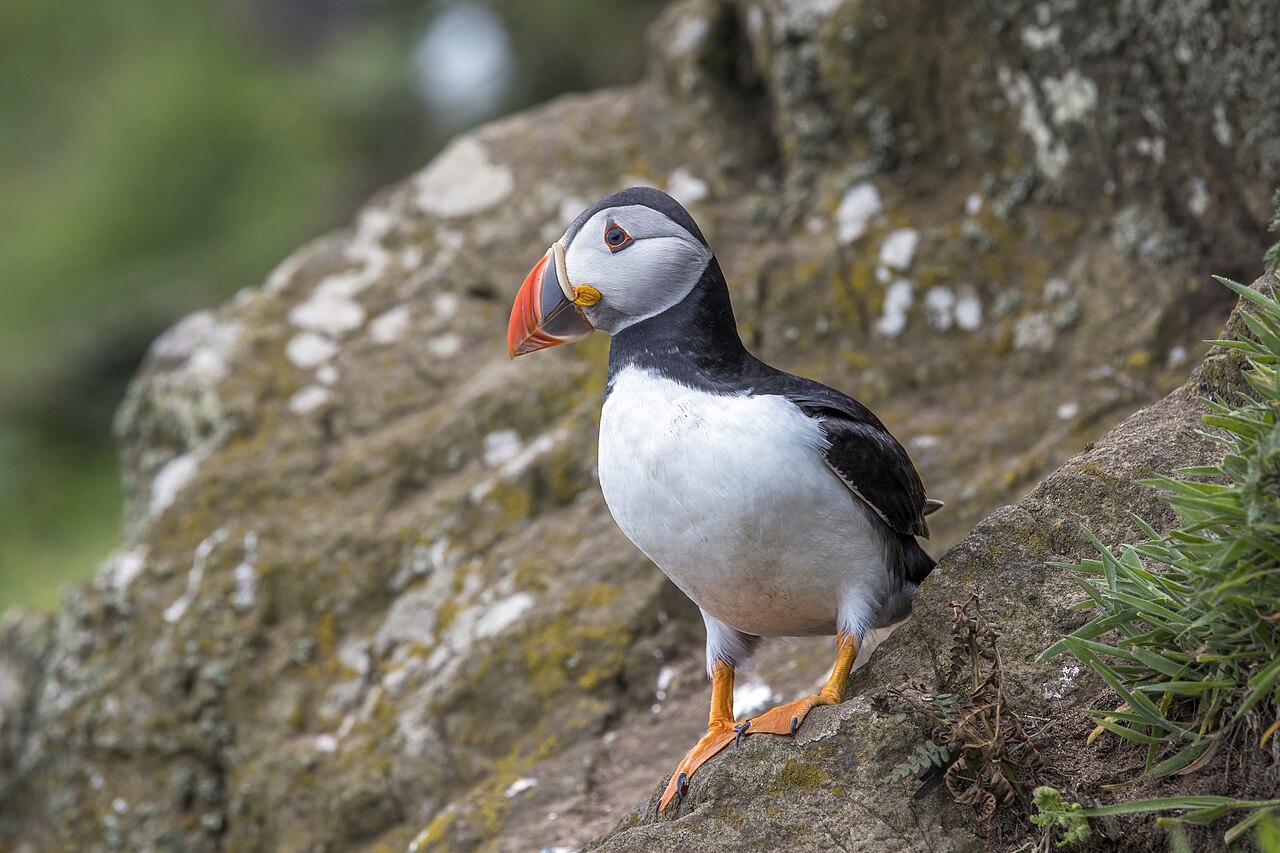
Stocky, with a large rounded head and a short neck. In summer a deep triangular bill with blue-grey, yellow and red plates, a pale grey-white face mask, a black collar and bright orange legs, plus a red orbital ring with grey horny ornaments. In winter the outer bill plates are shed: the bill becomes smaller and duller and the face turns dark grey, so the bird stands out much less. In flight the dark underwing is decisive, together with the bulbous head, the whirring beats and the orange feet trailing behind. Immatures show a distinctly narrower, dark bill.
Confusion species
Razorbill and Guillemot are slimmer, longer-billed and show a white underwing in flight; on the water the Puffin's steep forehead is obvious. Little Auk is far smaller, with a minimal bill and a white line on the scapulars. A distant winter Puffin is regularly written off as a Razorbill; look for the shorter, deeper bill, the greyish face and the absence of white running back behind the eye.
Habitat
Breeds in self-dug burrows in the grassy tops of islands and cliffs and in crevices in boulder fields, with colonies in Iceland, the Faroes, Scandinavia and the British Isles. Outside the breeding season it disperses widely over the Atlantic and the northern North Sea, diving for sandeels, sprat and young herring. In winter it rarely comes within sight of land.
Where the bird is most at home, classified with EUNIS — the European standard for habitats.


Range and movements
The southern North Sea coast lies at the edge of the wintering range: most records come from seawatches in strong winds, from ferries and from birds found dead on the beach. Substantial numbers winter in the Bay of Biscay and off Galicia, with smaller numbers in the western Mediterranean. For the North Sea the nearest colonies are on the British Isles and in Scandinavia.
- Resident
- Breeding (summer)
- Winter
- Passage
- dark = core range, pale = thinly spread
How and when to look
To see the bird properly, travel in May, June or July to a colony such as Skomer, the Farne Islands, Runde or Látrabjarg, where birds land within metres carrying bills full of sandeels. When in doubt, always note the underwing: that feature holds up when colour and bill shape are lost to backlight.
Conservation status
Vulnerable on the global list and assessed still less favourably in Europe, with steep declines in the core colonies of Scandinavia and Iceland. The main driver is food shortage: warmer sea water shifts the stocks of sandeels and young herring, so chicks are underfed and broods fail year after year. Introduced rats and mink on breeding islands, net bycatch and oil pollution add to the pressure; limiting the sandeel fishery counts as the most direct management measure.
Scientific name
Fratercula arctica | (Linnaeus, 1758)
Linnaeus described the species in 1758 as Alca arctica; because it was later moved to another genus, the author and year stand in brackets. The genus Fratercula was introduced in 1760 by Brisson. Fratercula is Medieval Latin for 'little friar', after the black-and-white plumage that recalls monastic robes. arctica means 'northern', from Greek arktos 'bear', a reference to the constellation of the Great Bear in the northern sky. The specimen the first description was based on came from Norway.