All species › Waders, gulls and terns › Skuas › Pomarine Jaeger
Pomarine Jaeger | Stercorarius pomarinus
Middelste jager | Págalo pomarino
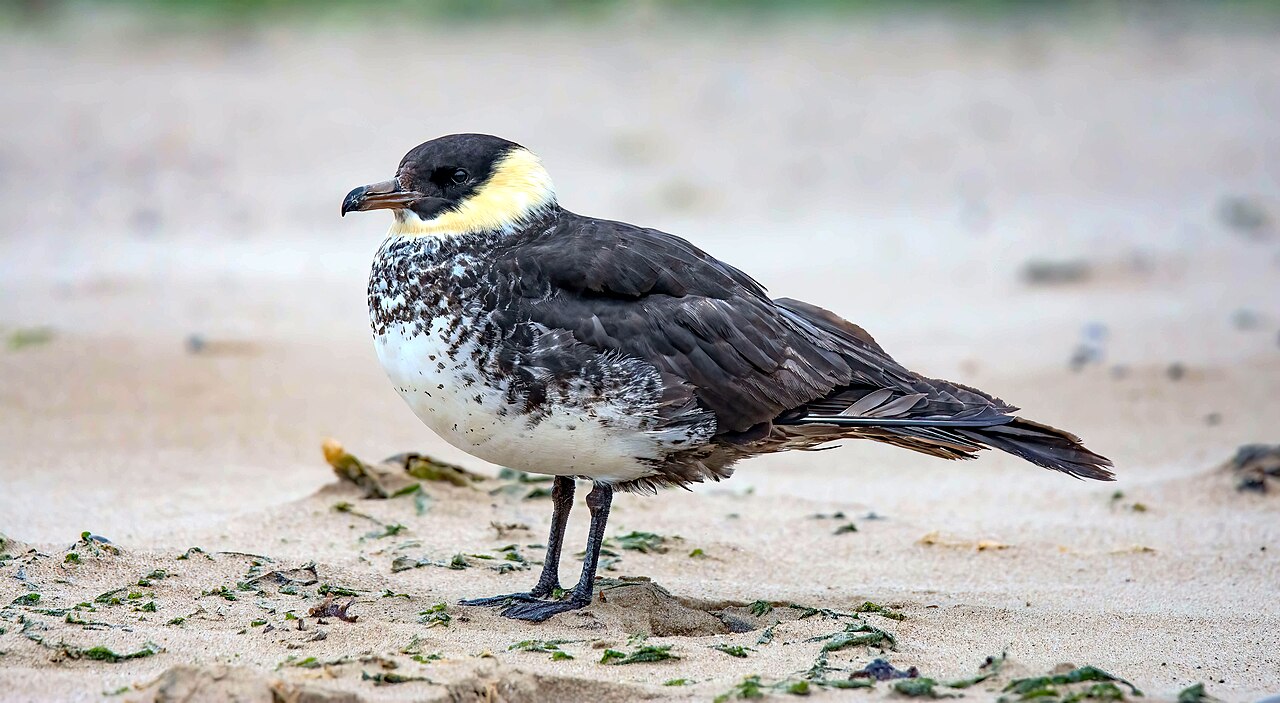
The Pomarine Jaeger is the heavy-set middle size: broad-chested, slow-winged, and in adults fitted with two twisted, spoon-tipped tail streamers. Along the North Sea coast it is above all a bird of late autumn gales, in numbers that swing wildly from year to year.
Click a thumbnail to switch the photo above.
Voice
Away from the colony it is silent: a bird passing the North Sea coast goes by without a sound, and that is the normal picture. On the Siberian tundra territorial flights produce a hoarse, barking wek-wek, and attacks on intruders a short nasal note. Since European contact with the species is almost entirely a matter of seawatching, its voice is of no practical use to the field observer here.
Recording: Benjamin Drillat — CC BY-NC-SA 4.0 · Wikimedia Commons
Identification
Bulky and barrel-bodied, with a broad wing base, a heavy head and a thick, clearly bicoloured bill whose dark tip covers about half its length. The wingbeats are slower and stiffer than a Parasitic Jaeger's and the silhouette suggests a small Great Skua rather than a gull. Pale adults show a black cap, yellow neck sides, a broad and solid dark breast band and heavily barred flanks and undertail coverts; the two central tail feathers are elongated, widened at the tip and twisted about their axis so that they read as spoons or blobs — by autumn they are often broken or moulted. Juveniles are colder greyish brown than a young Parasitic, with a notably plain head, strongly barred upper- and undertail coverts and a blunt tail projection; the best feature at that age is the double white flash on the underwing, formed by pale primary bases together with pale greater primary coverts.
Confusion species
Parasitic Jaeger is slimmer, with a narrower hand, faster wingbeats, a finer bill and pointed straight streamers; its juveniles are warmer rufous, have a clearly streaked head and show only a single white flash on the underwing. Great Skua is larger and broader still, uniformly dark brown, with no pale underparts and far bigger white wing flashes. Long-Tailed Jaeger is much smaller and finer, with a grey mantle and almost no white in the hand. A heavy dark jaeger with a double underwing flash and a thick pale bill base in October is almost always this species.
Habitat
It breeds on wet, low-lying coastal tundra in Siberia and North America, hunting lemmings almost exclusively; in poor lemming years it does not breed and spends the summer wandering at sea. It winters on tropical and subtropical seas, usually over the continental shelf and not far from land. On migration it robs gulls and auks of their catch, takes carrion and regularly follows fishing vessels — unlike the Long-Tailed Jaeger, which seldom joins them.
Where the bird is most at home, classified with EUNIS — the European standard for habitats.

Range and movements
It does not breed in Europe; all European records concern migrants from Siberia and Greenland. Along the southern North Sea coast October and early November are the core of the season, in numbers that vary strongly from year to year. In Iberia it is seen mainly off the Basque and Galician coasts and through the Strait of Gibraltar, with an autumn peak in October and November and the occasional wintering bird.
- Resident
- Breeding (summer)
- Winter
- Passage
- dark = core range, pale = thinly spread
How and when to look
Wait for the weather rather than the date: a firm westerly to north-westerly of force 6 or more in the second half of October gives the best odds, especially around a rising tide. Choose a watchpoint with deep water close inshore and scan low over the waves — Pomarine Jaegers fly heavily and in a straight line, often clear of the stream of gulls. In irruption years adults may linger for days over shallow fishing grounds such as the Bruine Bank and are better seen from a boat than from the beach.
Conservation status
Least Concern globally, with a large but strongly fluctuating world population. The numbers reaching Europe depend almost entirely on the lemming cycle in Siberia, and the weakening of that cycle under milder, wetter Arctic winters is the main long-term threat. At sea, bycatch in fisheries is a local factor but does not drive the trend.
Scientific name
Stercorarius pomarinus | (Temminck, 1815)
Temminck described the species in 1815 as Lestris pomarinus; because it was later moved to another genus, the author and year stand in brackets. The genus Stercorarius was introduced in 1760 by Brisson. Stercorarius is Latin for 'of dung', from stercus 'dung': the food disgorged by seabirds when pursued by skuas was once taken for excrement. pomarinus contracts Greek pōma 'lid' and rhis 'nostrils': the nostrils lie beneath the horny cere on the bill. The specimen the first description was based on came from arctic Europe.