All species › Passerines › Gnatwrens and gnatcatchers › California Gnatcatcher
California Gnatcatcher | Polioptila californica
Californische muggenvanger | Perlita californiana
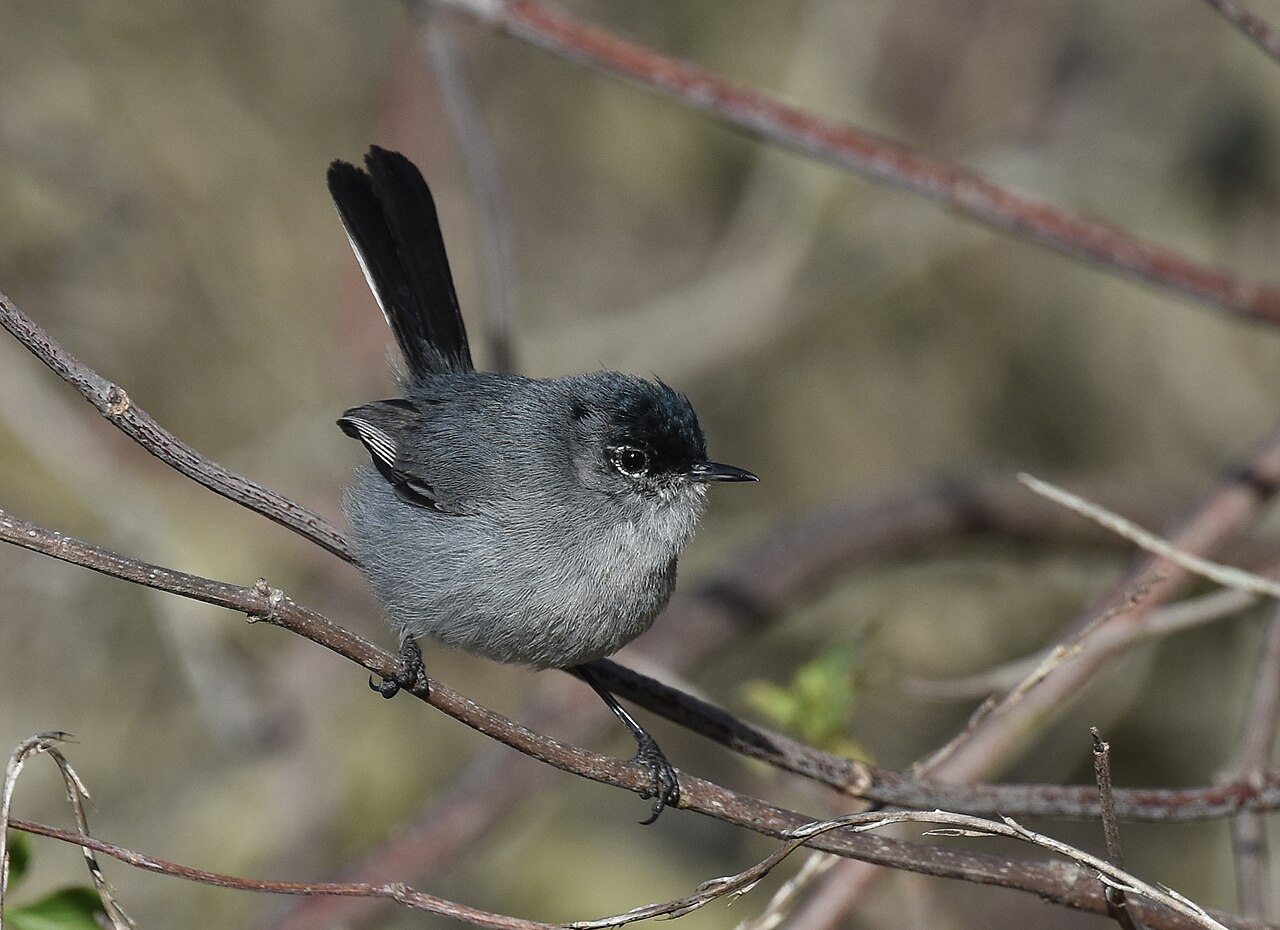
The California Gnatcatcher is a small, dark grey songbird with a long black tail, tied to the coastal sage scrub of southern California and the Baja California peninsula. It does not migrate and stays on the same small territory the year round; in the United States the coastal subspecies has been listed as federally threatened since 1993.
Voice
The characteristic sound is a nasal, drawn-out zeeeer that rises and falls and recalls the mewing of a kitten; it is often repeated two or three times and can be heard throughout the year. The song is a thin, hesitant series of the same nasal notes, softer and less structured than that of Blue-gray Gnatcatcher. Pairs keep in constant contact with short calls as they work through the scrub.
Recording: A Richardson — CC BY-NC-SA 4.0 · Mentone, San Bernardino County, California, United States · xeno-canto
Identification
Small and slim, dull grey above, dingy grey below with no white contrast, and with a long narrow tail usually held up or cocked to one side. Seen from below the tail is almost wholly black, with only narrow white tips to the outer feathers. In the breeding season the male has a black cap reaching below the eye; outside that season the cap is grey with a pale eye-ring. The female is blue-grey on the crown and slightly browner on the flanks. The bill is thin, straight and black.
Confusion species
Black-tailed Gnatcatcher is the closest match: it has whiter underparts, a clearly whiter outer tail, and lives in the deserts inland, where the coastal bird does not occur. Blue-gray Gnatcatcher is a paler blue-grey, with white underparts, a white eye-ring and a tail that looks mostly white from below, and never has a black cap. The underside of the tail decides it: on California Gnatcatcher it is black with only a minimal white tip.
Habitat
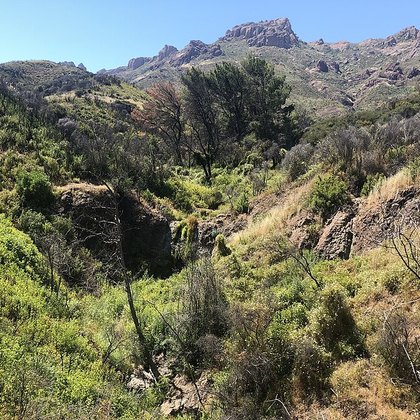
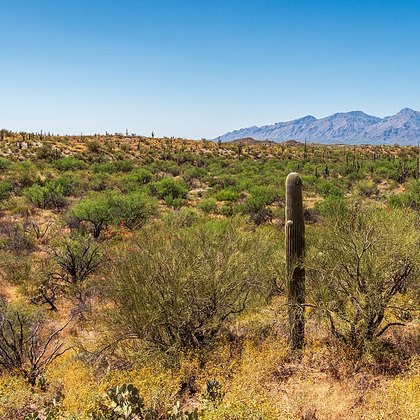
Coastal sage scrub on low slopes and terraces, with California sagebrush, white sage and black sage, generally below three hundred metres and on gently sloping or flat ground. It avoids tall closed chaparral (dense evergreen shrubland of dry hillsides), and returns to burnt scrub only once the shrubs have thickened again. In Baja California the habitat extends into drier desert scrub with ocotillo and cactus, as far as the south of the peninsula.
Where the bird is most often found, arranged by the USNVC — the vegetation classification of the United States and Canada — and CMECS for sea and coast.

Range and movements
A resident of the coastal belt of southern California, from Ventura County and the southern foot of the coast ranges through Los Angeles, Orange, Riverside and San Bernardino to San Diego County, and from there south over virtually the whole Baja California peninsula to the cape region. In California the range is cut through by housing and freeways and consists of dozens of separate blocks; Baja California holds most of the population, where the scrub is still largely continuous.
- Resident
- Breeding (summer)
- Winter
- Passage
- dark = core range, pale = thinly spread
Where and when to look
Look for it on a low sagebrush slope in San Diego or Orange County, early in the morning, and go by the mewing zeeeer; it is usually heard before it is seen. When you have a bird, check the underside of the tail rather than only the cap — outside the breeding season the male lacks the black, and the tail pattern is then the only hard character against Black-tailed Gnatcatcher.
Conservation
Worldwide the species is listed as of Least Concern (LC), since most of the range lies in Baja California. In California the picture is different: an estimated seventy to ninety per cent of the coastal sage scrub has been converted to housing, farmland and roads, and the coastal subspecies was listed as threatened under the Endangered Species Act in 1993. Petitions to remove that listing, arguing that the subspecies is not valid, have been rejected. Further pressures are fragmentation, fires too frequent for the scrub to recover into anything but grassland, and nest parasitism by Brown-headed Cowbird.
Scientific name
Polioptila californica | Brewster, 1881
Brewster described the species in 1881 as Polioptila californica, from a specimen collected near Riverside in California; as it still stands in the same genus, author and year go without parentheses. The genus Polioptila was introduced in 1855 by Philip Lutley Sclater, from Greek polios 'grey' and ptilon 'feather': 'with grey plumage'. The species name californica refers to where it was found. The English, Dutch and Spanish names all refer to California.