All species › Passerines › Gnatwrens and gnatcatchers › Black-tailed Gnatcatcher
Black-tailed Gnatcatcher | Polioptila melanura
Zwartstaartmuggenvanger | Perlita del desierto
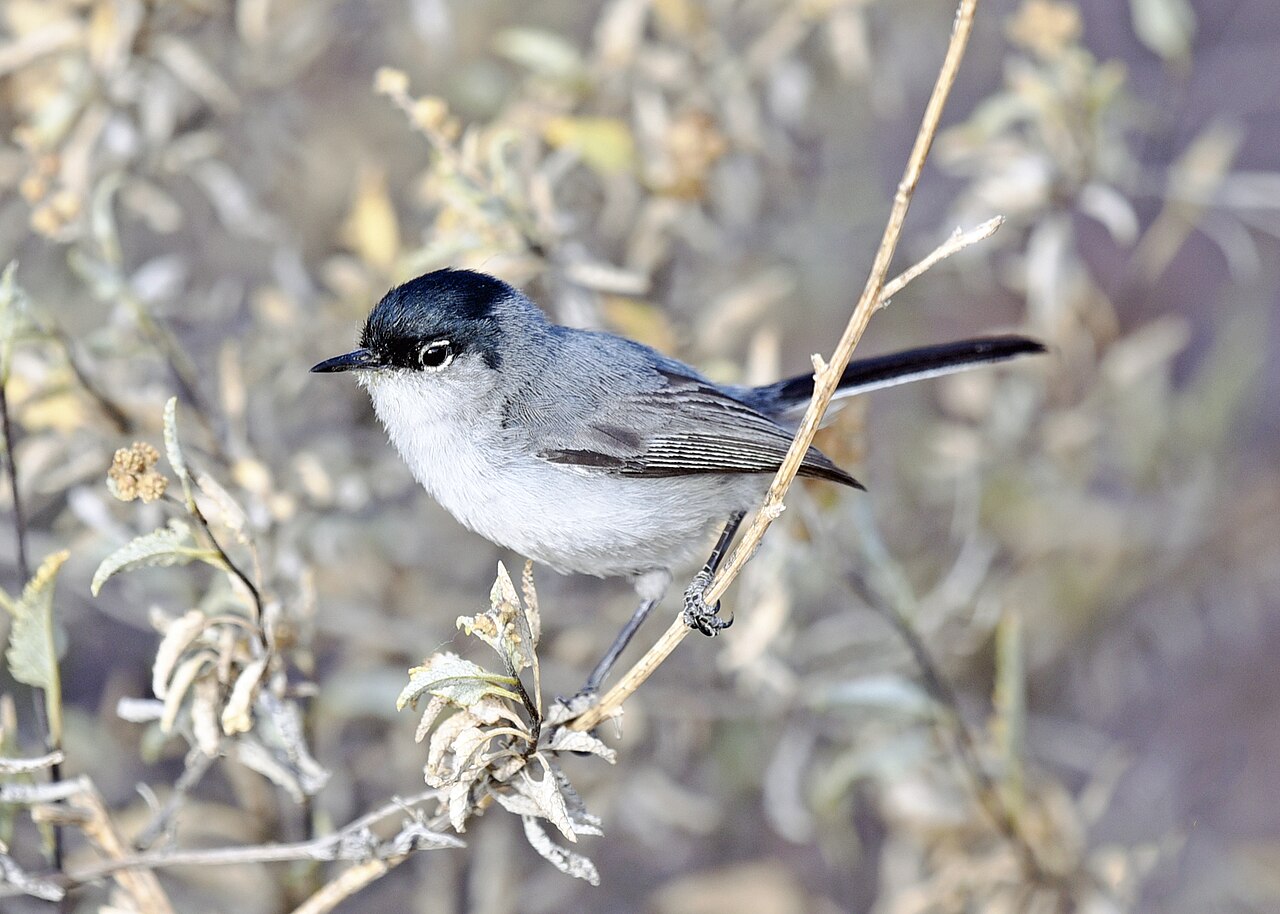
The Black-tailed Gnatcatcher is the gnatcatcher of the hot lowland desert: a grey bird of twelve centimetres that stays all year in the same thorn scrub, in a pair that stays together. It weighs about five grams and rarely drinks; it takes its water from what it catches. The long tail is flicked from side to side without pause, and it is that tail which names the bird: almost entirely black from below.
Voice
The usual call is a scraping, grating chee-chee-chee of two to four syllables, harder and drier than the mewing cheew of the Blue-gray Gnatcatcher. The male's song is a soft, hurried series of high notes that run into one another and seldom carries far; it is heard mostly from March to May. The two birds of a pair keep in touch with short calls as they work through the scrub, and that sound is usually the first sign that they are there. If a snake or a shrike comes near the nest, the call turns into a sustained rattle.
Recording: Barry Edmonston — CC BY-NC-SA 4.0 · Ímuris, Imuris Municipality, Sonora, Mexico · xeno-canto
Identification
From early spring into summer the male wears a black cap that runs down below the eye; outside that season he is grey like the female, betrayed at most by a single black feather on the crown. Female and winter birds are blue-grey to grey-brown above and dirty white below, with a thin white eye-ring. The tail is long and flicked from side to side without pause; from below it is almost entirely black, with white only at the tips of the outer feathers. In every plumage the bill is thin, straight and black, and the bird stays small and slender, with a rounded head. Young birds resemble the female but are browner on the back and flanks.
Confusion species
Blue-gray Gnatcatcher is the standing problem: its undertail is largely white, because the outer feathers are wholly white, and its call is a thin, mewing cheew. Where the two occur together the Blue-gray sits higher, in juniper and oak woodland, and the Black-tailed keeps to the low thorn scrub of the flats. On the coast of southern California the California Gnatcatcher (Polioptila californica) joins in: darker still beneath the tail, with a plaintive note like a kitten's. Verdin is as small but has a short tail and a needle-like bill, and Bushtit does have a long tail, but without black and white, and it travels in parties.
Habitat
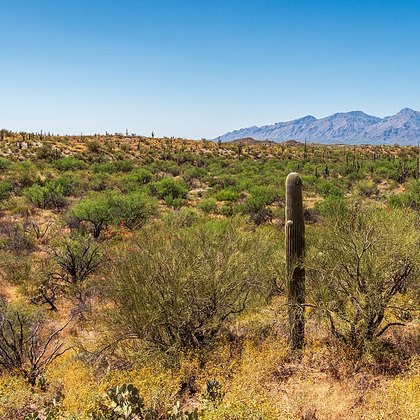
Low, dry scrub of the hot deserts: creosote bush, mesquite (a thorny pod-bearing shrub of the Southwest that forms dense thickets), catclaw and palo verde (a green-barked desert tree of the Southwest), most thickly settled along dry washes where the shrubs grow tallest. In southern Texas it uses the thorn scrub of the Rio Grande. It leaves bare flats without shrubs alone, and higher in the mountains, where juniper and oak begin, it stops. Unlike the Blue-gray Gnatcatcher it does not leave its ground: the same pair works a few hectares all year round.
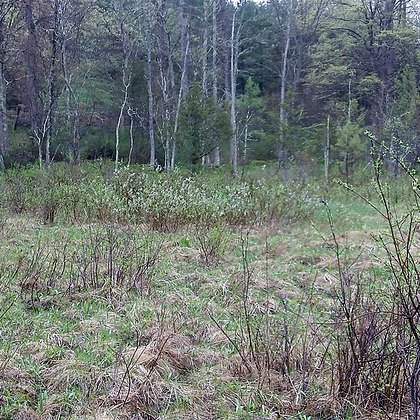
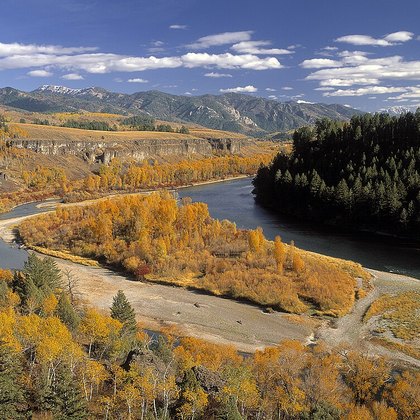
Where the bird is most often found, arranged by the USNVC — the vegetation classification of the United States and Canada — and CMECS for sea and coast.
Range and movements
Resident in the southwest: southeastern California, southern Nevada, Arizona, New Mexico and western and southern Texas, and south over the Baja California peninsula and the dry north of Mexico to Sinaloa, Zacatecas and San Luis Potosí. It does not migrate and barely wanders; outside that area it is rarely seen. In the Lower Rio Grande Valley the thorn scrub has largely been turned into farmland and it has gone locally. Where the scrub is left standing it holds on, including between the streets of the desert towns.
- Resident
- Breeding (summer)
- Winter
- Passage
- dark = core range, pale = thinly spread
Where and when to look
Walk a dry wash early in the morning and listen for the scraping chee-chee-chee; then stand still, because the pair often comes to look of its own accord. Look at the tail from below — that is the one mark which works in every plumage and every light. In winter Blue-gray Gnatcatchers drop down into the same low desert, so even then it is the undertail that decides, not the place.
Conservation
Least Concern (LC), and stable taken as a whole. Around the fast-growing cities of Arizona and California the low desert scrub disappears under building, and there it is losing ground; in the Lower Rio Grande Valley the same happens through conversion to farmland. Because it stays all year in the lowest and hottest desert and takes its water from its food, any further drying out of that country counts double for this bird.
Scientific name
Polioptila melanura | Lawrence, 1856
Lawrence described the species in 1856 as Polioptila melanura; author and year stand without parentheses, which means it is still in the genus in which it was described. The genus Polioptila had been introduced a year earlier by Sclater, from Greek polios, 'grey', and ptilon, 'feather'. melanura comes from melas, 'black', and oura, 'tail'. The type locality is given as 'Texas', later restricted to the valley of the Rio Grande.