All species › Passerines › Gnatwrens and gnatcatchers › Black-capped Gnatcatcher
Black-capped Gnatcatcher | Polioptila nigriceps
Zwartkapmuggenvanger | Perlita capirotada
The Black-capped Gnatcatcher is a small, blue-grey gnatcatcher of the thorn scrub and tropical deciduous forest of northwestern Mexico. Within the guide area it reaches only southern Arizona, where a pair has nested now and then in the border canyons since the 1980s.
Voice
The song is a long, irregular string of wheezy and squeaky notes, less sharply bounded than the short phrases of Blue-gray Gnatcatcher. The call is a nasal, mewing mew, usually repeated two to four times and falling in pitch — the best character in the field, since the plumage comes so close to that of its relatives.
Recording: Isain Contreras Rodríguez — CC BY-NC-SA 4.0 · Topolobampo, Ahome, Sinaloa, Mexico · xeno-canto
Identification
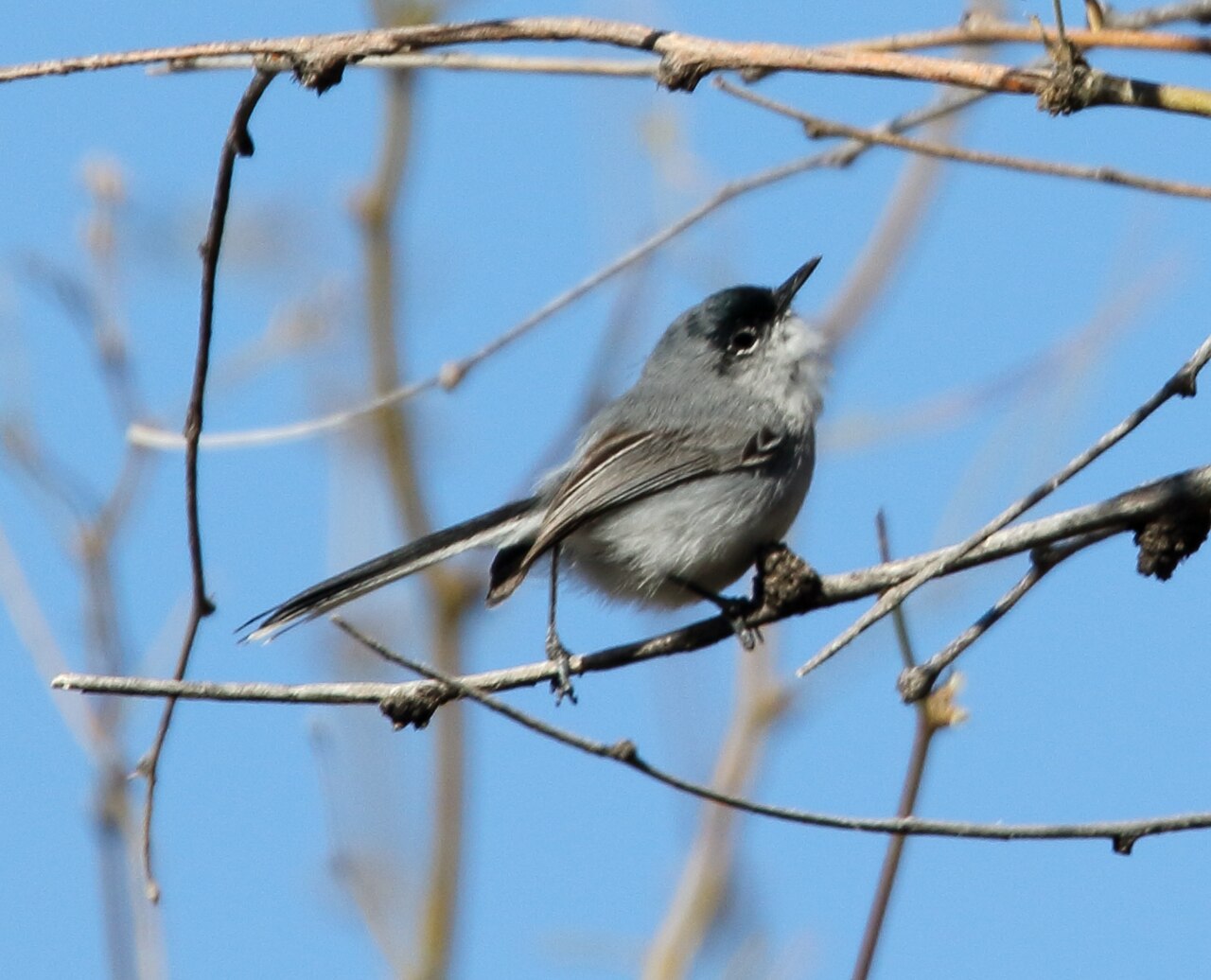
Blue-grey above and white below, with a thin straight bill and a long tail that is often held up. In the breeding season the male has a glossy black cap running back and down past the eye, further back than in its relatives; no white eye-ring shows then. From below the tail is largely white: the outer three pairs of feathers are almost wholly white, more white than in the related species. The female lacks the black cap and shows a thin, incomplete white eye-ring.
Confusion species
Blue-gray Gnatcatcher is the most similar: its male has only a black eyebrow stripe rather than a full cap, keeps its white eye-ring through the summer, and has a shorter bill. Black-capped Gnatcatcher has a longer bill, a longer tail and more white in the outer tail feathers. Black-tailed Gnatcatcher has a tail that is mostly black from below with narrow white bars, and a black cap that does not extend as far back. When in doubt, go by the call.
Habitat
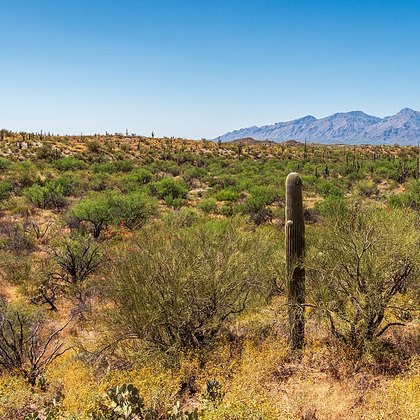
In the north, thorn scrub and mesquite thickets along dry washes and canyon bottoms; further south, tropical deciduous forest and thorn forest, mostly below five hundred metres. In Arizona this means dense growth of mesquite (a thorny pod-bearing shrub of the Southwest that forms dense thickets), hackberry and oak in canyons of the border ranges, a little higher than the species is used to in Mexico. It forages low to mid-height in the shrubbery, flicking the tail sideways and picking insects from the leaves.
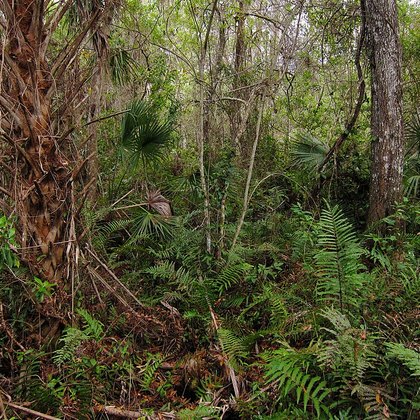
Where the bird is most often found, arranged by the USNVC — the vegetation classification of the United States and Canada — and CMECS for sea and coast.


Range and movements
The range covers the western slope of Mexico: the nominate form from central Sinaloa south through Nayarit and Jalisco to Colima, the form restricta from eastern Sonora through northern Sinaloa. In the United States the species has been known only since 1971 and nests irregularly in a few canyons of southeastern Arizona, among them Patagonia, Sonoita Creek and the Santa Rita and Atascosa mountains; this amounts to at most a few pairs a year, and not every year. Outside the breeding season part of the Mexican population wanders.
- Resident
- Winter
- Passage
- dark = core range, pale = thinly spread
Where and when to look
In Arizona, Patagonia in early spring gives the best chance: listen for the series of falling mewing notes and look for a male still in full black cap. Always view a candidate from below and from behind, so that you can judge the cap behind the eye and the broad white tail edges; a bird seen only in side view can usually not be separated from Blue-gray Gnatcatcher with certainty.
Conservation
The species is listed as Least Concern (LC): the Mexican range is large and numbers there are high. The dry deciduous forest of the western coastal plain is nonetheless in decline through conversion to cropland and pasture and through logging, and that change is not systematically tracked. The Arizona population is too small to carry weight of its own and depends entirely on supply from Sonora.
Scientific name
Polioptila nigriceps | Baird, 1864
Baird described the species in 1864 as Polioptila nigriceps, from a specimen taken at Mazatlán in Sinaloa; as it still stands in the same genus, author and year go without parentheses. The genus Polioptila was introduced in 1855 by Philip Lutley Sclater, from Greek polios 'grey' and ptilon 'feather'. The species name nigriceps is Latin: niger 'black' and -ceps 'headed', so 'black-headed' — the same character named by the English, Dutch and Spanish names.