All species › Ericales › New World pitcher plant family › Sarracenia psittacina
Sarracenia psittacina | Parrot pitcher plant
Papegaaientrompetbekerplant
The only pitcher plant that is two traps at once: a pitfall when the ground is dry and a lobster pot when the marsh floods. Its pitchers lie flat on the ground in a star, each ending in a swollen hood with a hole in the side — a parrot's head, hence the name.
Identification
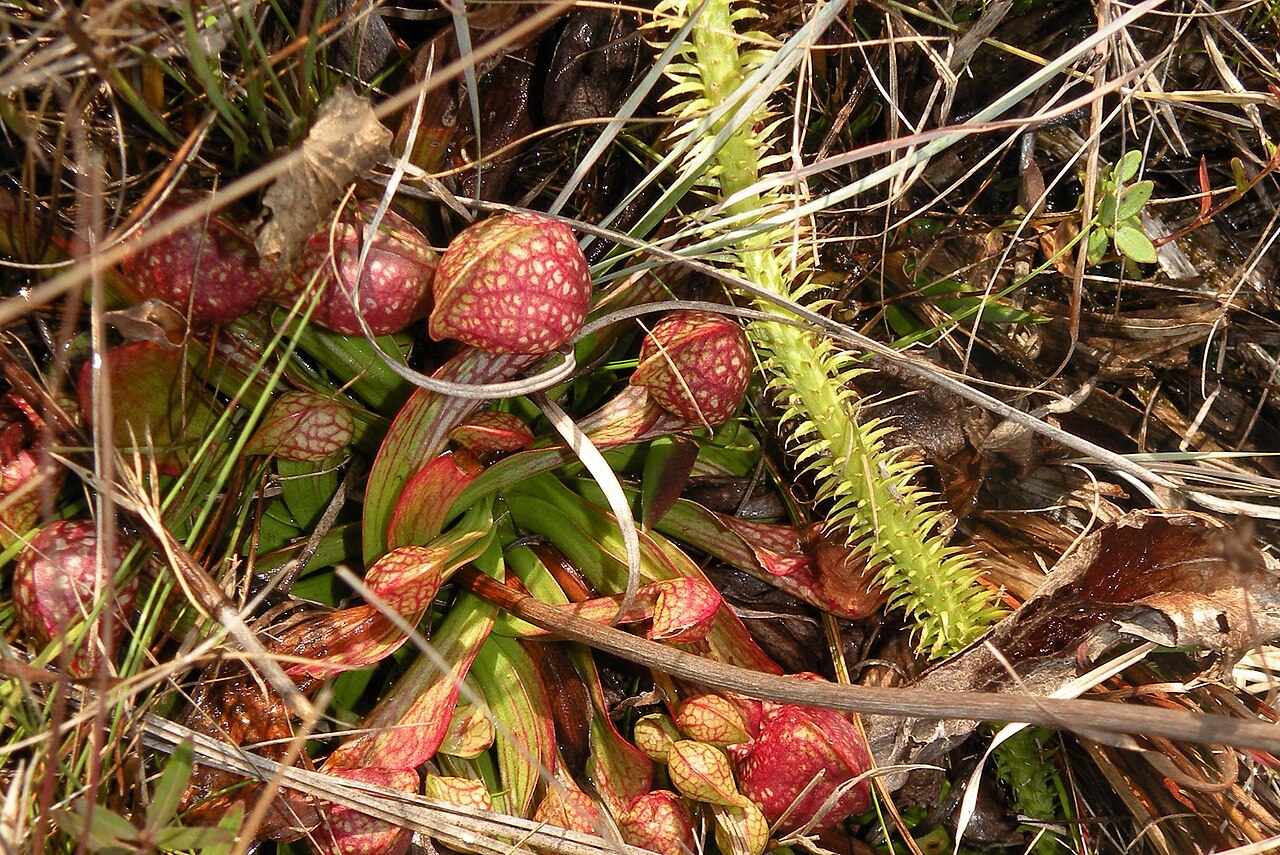
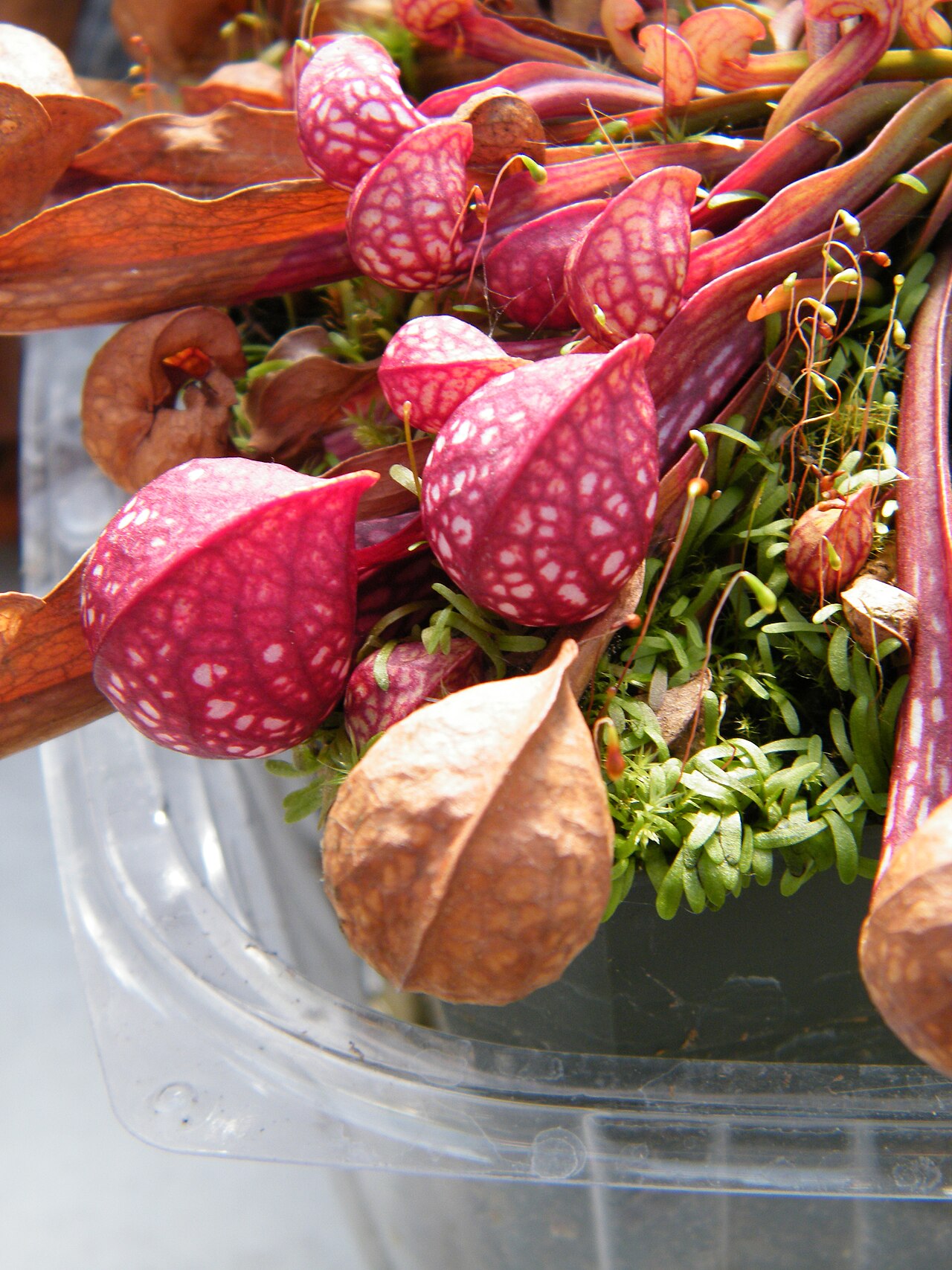
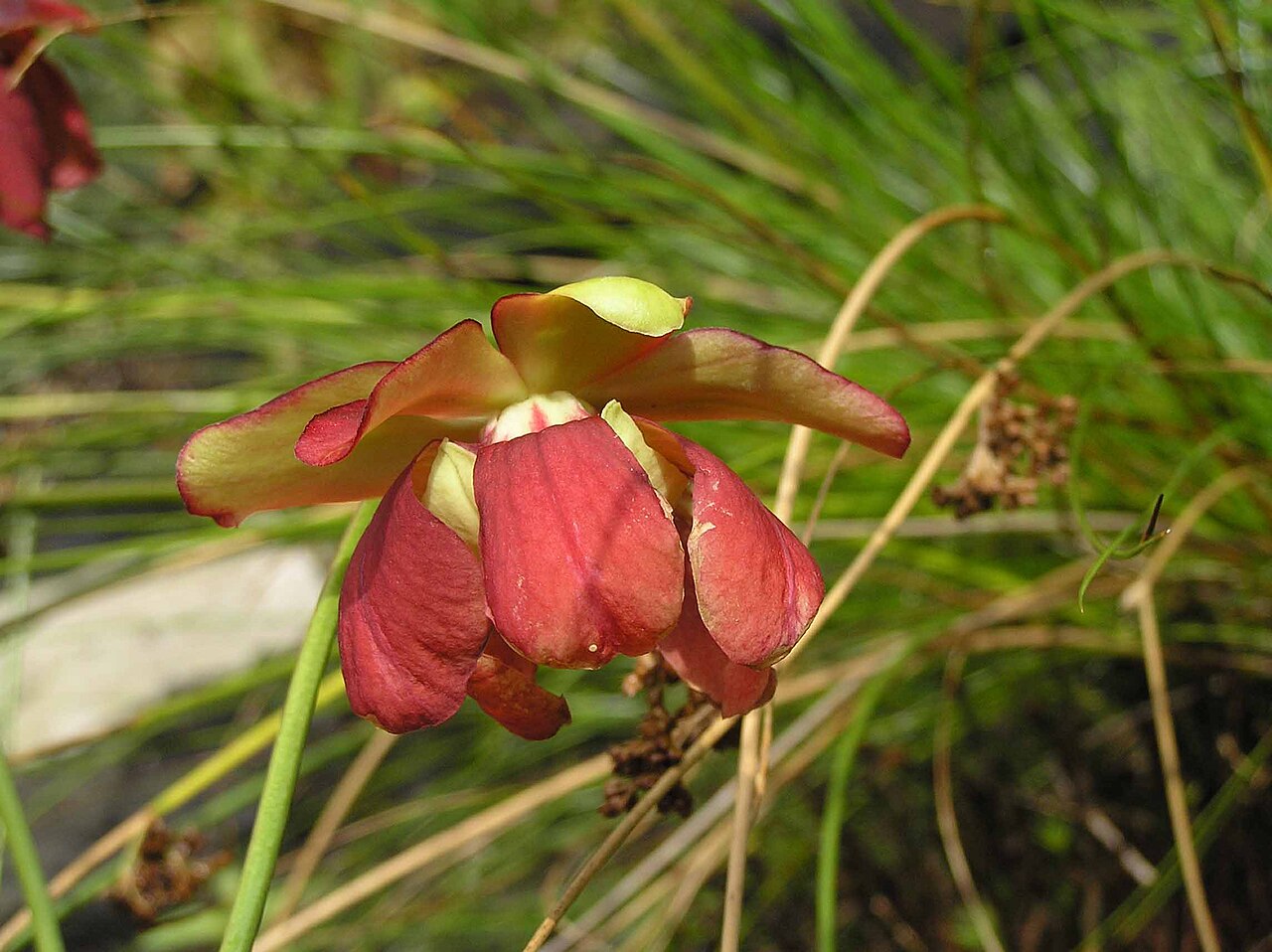
A flat rosette of pitchers 8 to 30 cm long radiating from the centre like the spokes of a wheel. Each pitcher is 1 to 4 cm wide, carries a broad, almost wing-like keel along the top, and ends in a closed, inflated hood the size of a thumb tip. That hood has only one opening: a slit-like hole in the side, facing the heart of the rosette. The hood is studded with white translucent windows (areoles) that let the light through. Colour green with red veining, flushing deep red in sun. In April and May a single nodding flower, dark red to purple, stands on a bare scape above the pitchers.
Similar species
No other Sarracenia has this closed hood with a side entrance. S. purpurea and S. rosea also lie down, but their pitcher gapes upward and holds water. S. minor does have white windows, but stands upright, its lid arching from above over an open mouth. Once you look for it the posture settles it: this is the only species whose pitchers lie flat on the moss with their heads pointing inward. Crosses are frequent: S. × formosa (with S. minor) and S. × wrigleyana (with S. leucophylla) have a half-raised pitcher with a half-closed hood — that intermediate shape is the mark of a hybrid.
The trap and how it works
Two traps in one leaf. Above water the pitcher works as a lobster pot, on the principle of the eel trap. An ant or beetle walks along the keel toward the nectar trail and creeps through the side hole into the hood. Inside it is not dark but bright: the white areoles admit daylight and look like ways out. The animal heads for them, meets the wall, and then takes the only route left open — down the tube. The whole interior is lined with long, stiff hairs angled inward and downward, interlocking like the funnel of a fish trap: forward is easy, back is impossible. The hairs grow finer and denser downward until the animal lands in the digestive fluid at the bottom. Then the second trap. The marshes this species inhabits flood regularly in winter and early spring, and the rosettes then stand wholly submerged for weeks. The pitchers keep working; only the prey changes. Small aquatic animals swim in through the side hole — water fleas and other crustaceans, water beetles, larvae, and by field observation tadpoles and very small fish as well. Under water the funnel hairs do exactly what they do in the air. That makes this the one carnivorous plant of North America that catches both on dry ground and submerged, and it explains why it takes the lowest, wettest ground in the marsh.
Habitat and ecology
The lowest, wettest ground of the coastal plain: margins of depression marshes and sinkhole ponds, wet savanna and wet flatwoods, seepage bog on sand and the banks of peat streams — always where water stands over the ground in winter. Acid, nutrient-poor, permanently soaked soil with sphagnum and sedges. It grows with S. rosea, S. leucophylla and S. flava, which take the slightly higher, drier ground. It too depends on regular fire.
Distribution and elevation
Endemic to the coastal plain along the Gulf of Mexico: southern Louisiana, Mississippi, Alabama, the Panhandle and northern Florida, and southern Georgia. Its range therefore lies almost entirely within that of S. leucophylla and S. rosea, but reaches further west, into Louisiana. Outside North America it is nowhere naturalised.
- Recorded (quarter-degree cells)
Forms and variation
Besides the ordinary plant there are anthocyanin-free ones: wholly yellow-green pitchers without red veining, and yellow flowers, known wild from a few sites. Variation in size between populations is considerable — plants from the Okefenokee country are much larger than those of the Panhandle — but it is not captured in recognised varieties. What you will meet in the field are the crosses, and here they are numerous: S. × formosa with S. minor, S. × wrigleyana with S. leucophylla, S. × courtii with S. rosea and S. × gilpinii with S. rubra. They show in the half-raised pitchers and in a hood that does not quite close the mouth. At many mixed sites the hybrids outnumber the pure plants of either parent; a plant with intermediate characters is almost never a special form and almost always a cross.
Where and when to see it
April and May, when the dark red flowers rise above the rosettes — the pitchers themselves lie in the moss and are hard to find without them. Go after a winter burn, when the grass is short, and make for the lowest ground on the savanna; if your boots fill, you are in the right place. Do not lift a rosette; kneel and look into the side hole: against the light you will see the white windows glow and the rank of hairs standing in the tube. At sites that flood in winter the plant is not to be seen at all in that season.
Conservation status
Least Concern on the Red List: within its range the species is still widespread and locally abundant. But this is the same shrinking landscape as for the other Gulf coast pitcher plants — wet savanna turned to pine plantation, drained, or no longer burnt — and the lowest, wettest ground this species occupies is exactly what suffers from drainage and from closing scrub. Digging for the trade affects the whole genus. As a Sarracenia it falls under CITES Appendix II.
Scientific name
Sarracenia psittacina | Michaux, 1803
André Michaux described the species in 1803. No precise type locality was given; the species occurs naturally in the coastal plain of the south-eastern United States, from Georgia to Louisiana. The species epithet psittacina is Latin for 'parrot-like', referring to the curved, parrot-beak-shaped hood above the pitcher's opening.
World Checklist of Vascular Plants (WCVP), via Plants of the World Online (POWO), Royal Botanic Gardens, Kew.
Natural hybrids of this genus
These ten species can cross with one another. See the nineteen named natural hybrids of Sarracenia, with photographs where available.