All species › Ericales › New World pitcher plant family › Sarracenia leucophylla
Sarracenia leucophylla | White-topped pitcher plant
Witte trompetbekerplant
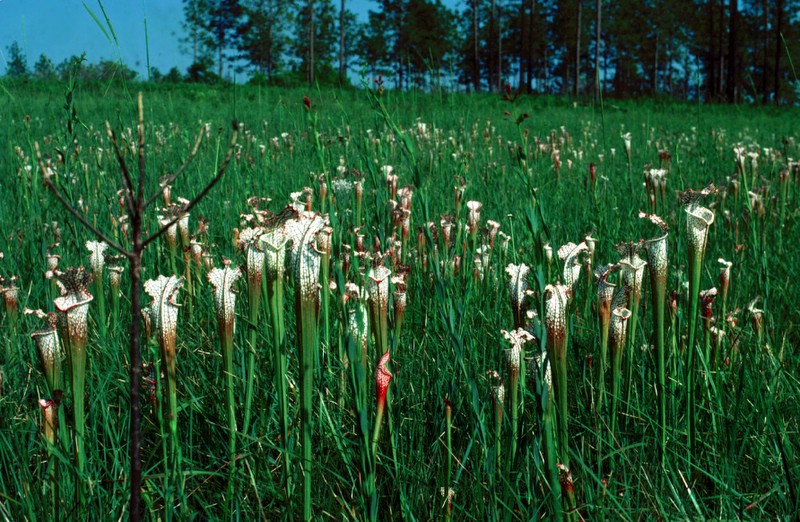
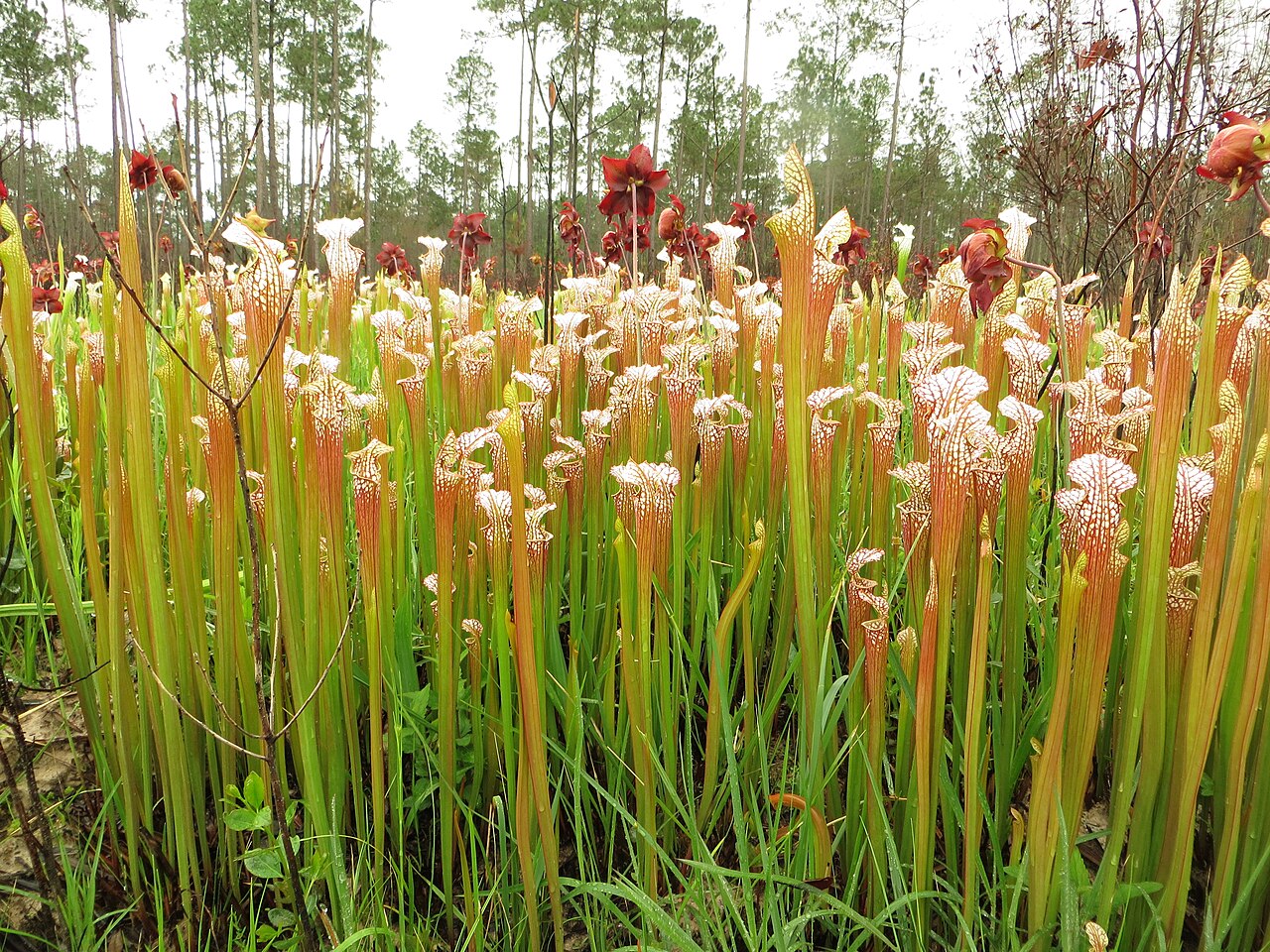
The most conspicuous plant of the Gulf coast savanna, and the only one with a white top: the upper third of the pitcher is bright white, shot through with green and red veins, as though light were passing through it. In October, when the autumn pitchers stand at their tallest, a savanna full of leucophylla shows from a hundred metres away.
Identification
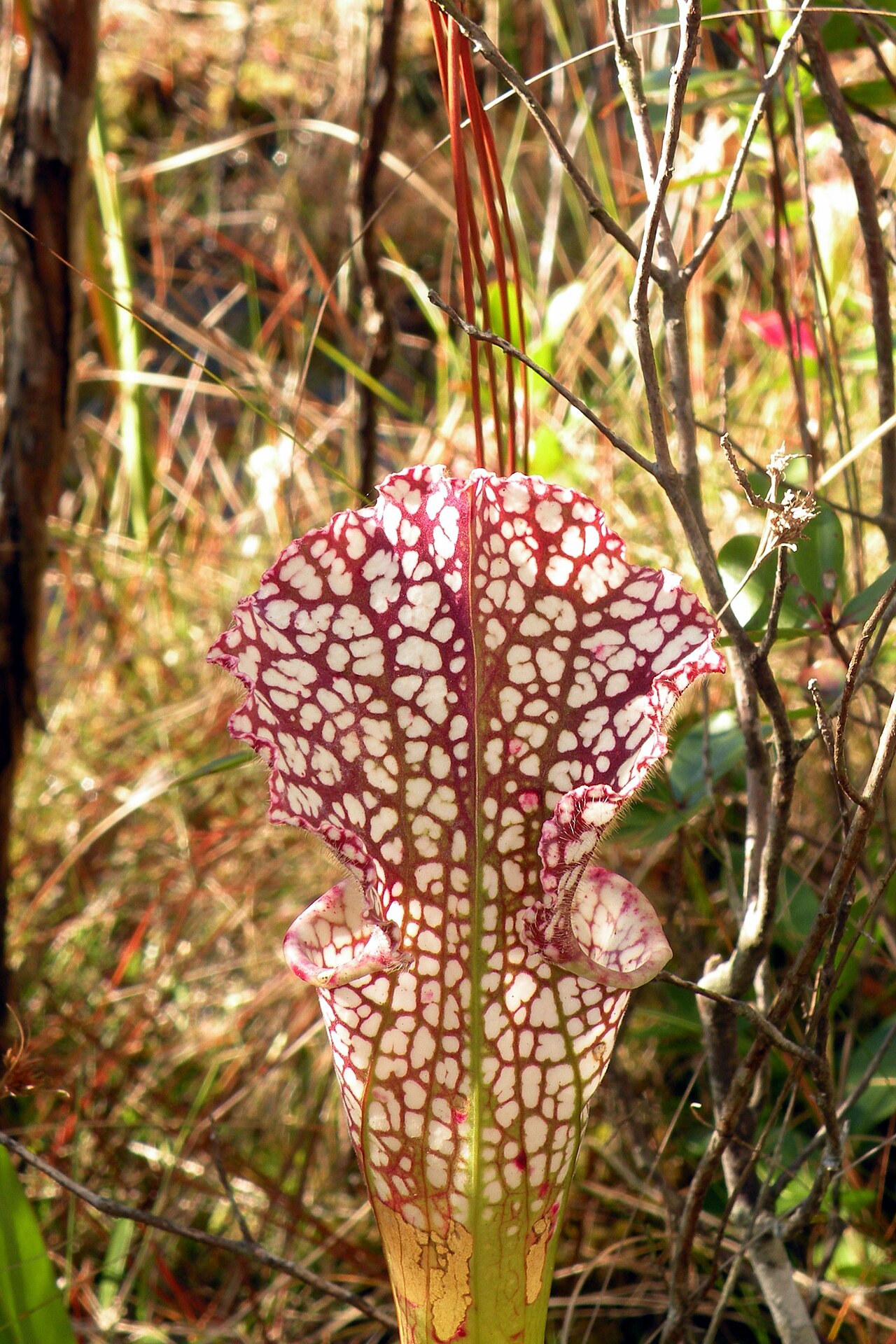
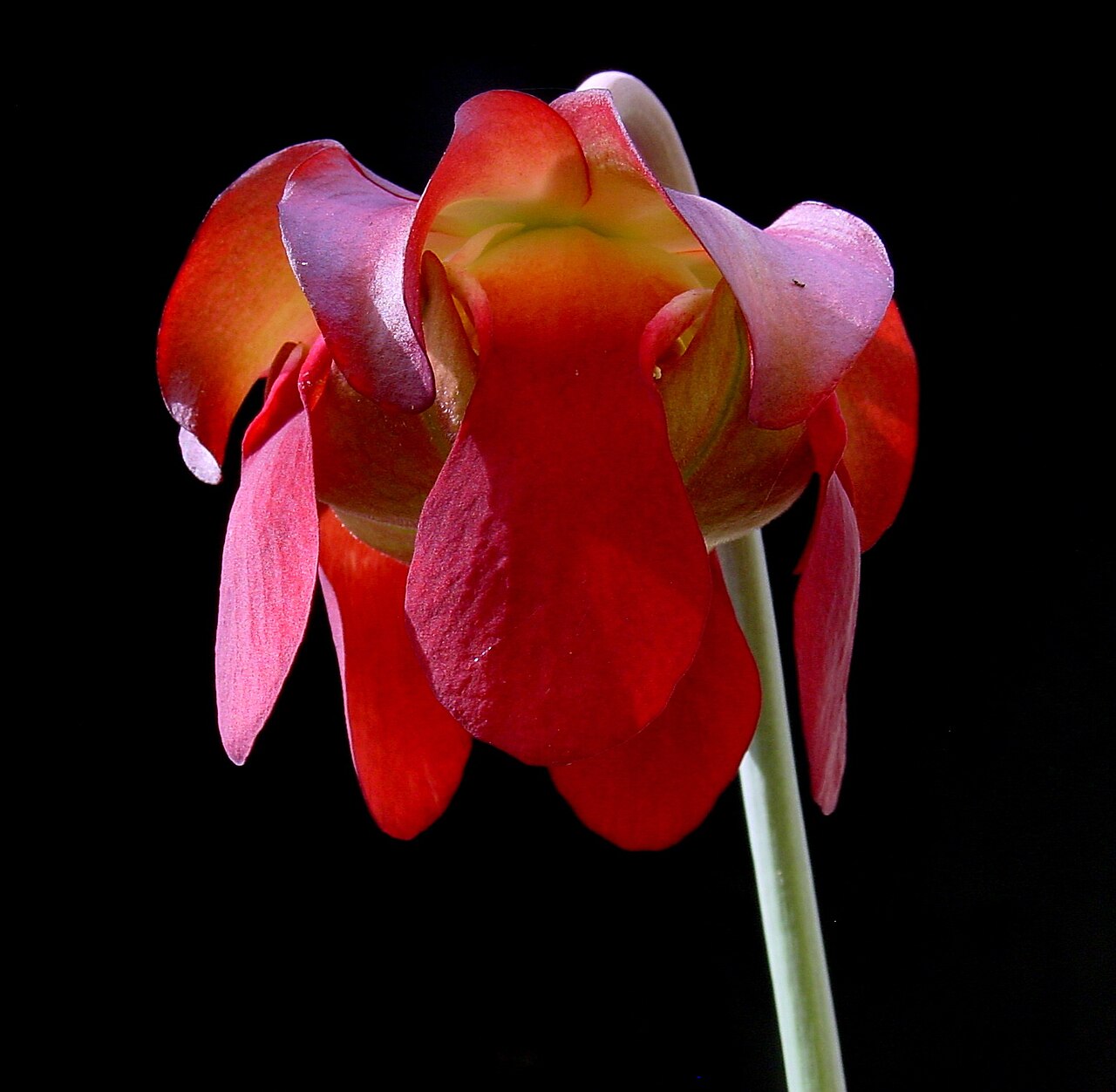
Erect, slender trumpets 40 to 70 cm tall with a narrow wing. Green below, but from about two-thirds of the way up turning abruptly white, with a network of green and red veins across that white field; the lid stands upright, round to ovate, with a wavy margin and the same white patterning. The mouth is wide and its rim rolled inward. The plant makes two flushes of pitchers: a shorter one in spring, and after summer a second that is taller, whiter and firmer and stands into the winter. The flower comes before the spring pitchers: nodding on a bare scape, crimson to dark purple-red, and distinctly fragrant.
Similar species
The white top makes the species all but unmistakable in the field; no other Sarracenia has so large a white area. S. minor also has white windows, but they sit only on the back of the pitcher, under a lid that arches over the mouth, and the plant is far smaller. S. alata can have a pale, faintly translucent head, but it grows west of the Mississippi and never turns so white. The real difficulty is the hybrids: S. × moorei (with S. flava) is tall with a yellow-white head and yellow flowers, S. × excellens (with S. minor) has a lid leaning half over the mouth, S. × mitchelliana (with S. rosea) is shorter and stouter. A white plant whose lid tips forward, or whose flower is yellow, is a cross.
The trap and how it works
A passive pitfall, and by field counts the most effective catcher in the genus. The white field works as a lure: light passing through it draws flying insects toward the mouth, where the inrolled rim secretes nectar. Whatever steps on the slippery rim falls into the tube. Its wall is waxy above, denying any foothold, and densely set below with downward-pointing hairs that allow movement in one direction only. At the bottom the plant's own enzymes digest the catch. The tall autumn pitchers take so much — moths, flies, wasps, beetles — that they sometimes topple under the weight. Unlike S. purpurea the pitcher holds no rainwater: the lid stands over it like a roof.
Habitat and ecology
Wet longleaf pine savanna and wet flatwoods of the Gulf coastal plain, seepage slopes on sand and the margins of depression marshes, and in many places the wet ditches along sand roads. Acid, permanently wet, nutrient-poor ground in full sun. Fire is decisive: the autumn flush is tallest and whitest on ground burnt during the growing season, and without fire the species disappears under advancing scrub.
Distribution and elevation
Endemic to a narrow strip along the Gulf of Mexico: the Florida Panhandle, southern Alabama, south-eastern Mississippi and the extreme south-west of Georgia. That is one of the smallest ranges among the upright pitcher plants. Beyond it the species holds on at a few sites where it was planted, in Virginia and in Washington state; in the northern coastal plain, in the Carolinas, it is not native.
- Recorded (quarter-degree cells)
Forms and variation
In the wild two colour forms matter in the field. The ordinary plant has red flowers and red veining across the white field. Alongside it stands an anthocyanin-free form, called f. viridescens in the literature: no red at all, so yellow-green flowers and a pitcher veined white on green. That form occurs wild at a handful of sites in Alabama and Florida and is rare there. All the names in quotation marks that circulate in the trade around such white plants are cultivars and have no place in this guide. Beyond that the species is a willing crosser: S. × moorei with S. flava, S. × excellens with S. minor, S. × wrigleyana with S. psittacina, S. × mitchelliana with S. rosea and S. × areolata with S. alata. Where several species stand together the crosses sometimes outnumber the pure plants; what looks halfway between two species usually is halfway.
Where and when to see it
Two moments. Late March and April for the flowering: dark red nodding flowers over short grass. And late September to November for the autumn pitchers, when the white field is at its brightest and the rest of the savanna has gone brown — that is the sight people travel to the Gulf coast for. Go to public land managed with fire; the Apalachicola National Forest in the Panhandle and the savanna preserves of southern Alabama hold large populations along trails and road verges. Do not pick pitchers: cutting them for the florist trade is one of the reasons the species is declining.
Conservation status
Vulnerable (VU) on the Red List. Its habitat — wet savanna on the Gulf coast — has largely been converted to pine plantation, subdivided or drained, and part of what remains is deteriorating because it is no longer burnt. On top of that this particular species is in demand: the white pitchers are cut on a large scale for the cut-flower trade, and wild plants are dug for collectors. As a Sarracenia it falls under CITES Appendix II. Recovery depends above all on returning fire to the savanna and protecting the remaining seepage slopes.
Scientific name
Sarracenia leucophylla | Rafinesque, 1817
Constantine Samuel Rafinesque described the species in 1817. No precise type locality was given; the species occurs naturally along the Gulf Coast, from western Florida to Mississippi. The species epithet leucophylla is Greek for 'white leaf', from leukos ('white') and phyllon ('leaf'), referring to the white, red-veined upper part of the pitcher.
World Checklist of Vascular Plants (WCVP), via Plants of the World Online (POWO), Royal Botanic Gardens, Kew.
Natural hybrids of this genus
These ten species can cross with one another. See the nineteen named natural hybrids of Sarracenia, with photographs where available.