All species › Lamiales › Bladderwort family › Pinguicula robertiana
Pinguicula robertiana
A butterwort with grass-like leaves: in the rains Pinguicula robertiana produces limp, linear summer leaves more than twenty centimetres long that hang from the limestone like green ribbons. The species was described in 2018 from the surroundings of Xilitla in San Luis Potosí, a district of cloud forest, caves and limestone crevices on the eastern edge of the Sierra Madre Oriental.
Identification
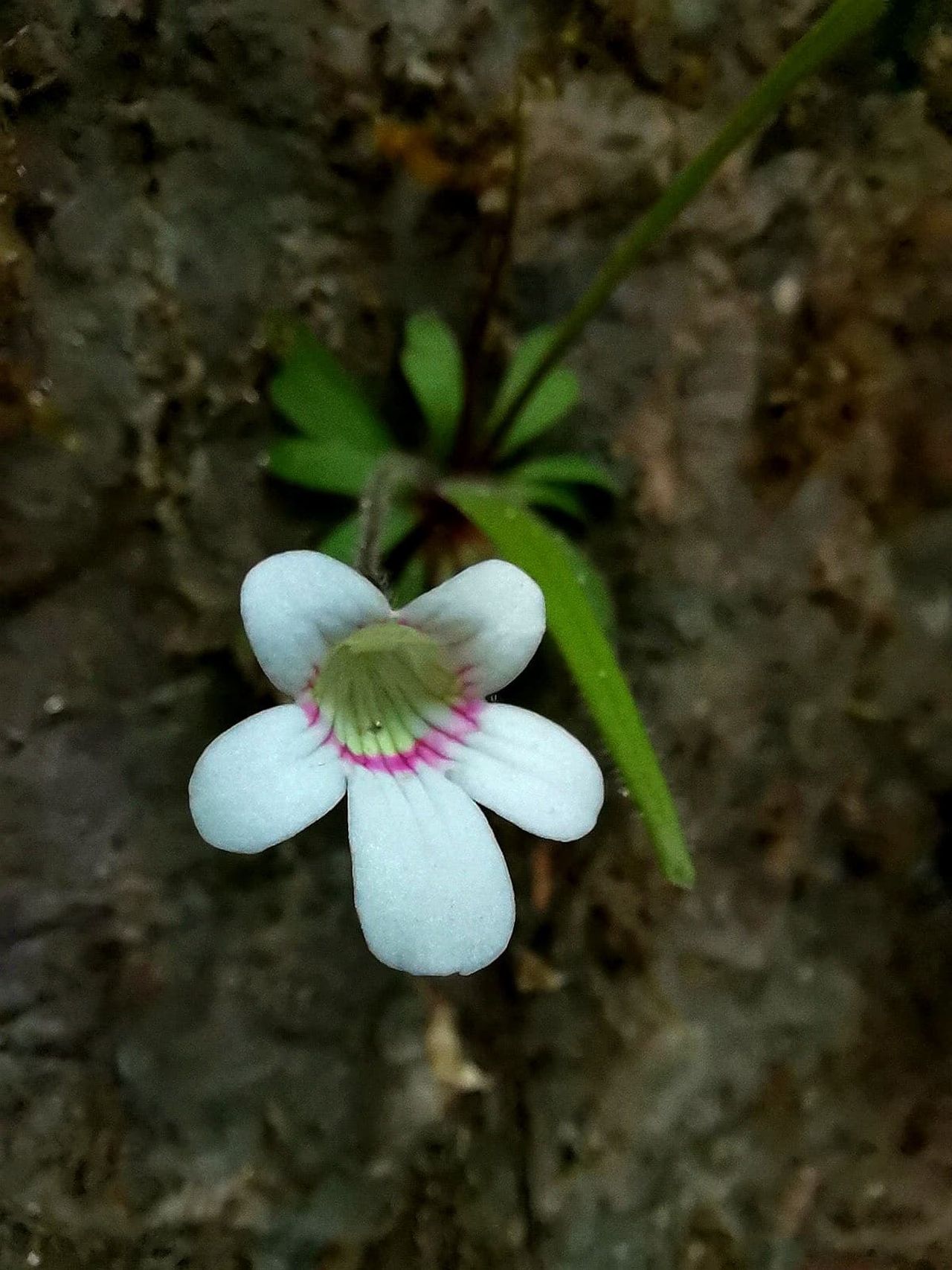
The winter rosette is epigeal and loose in build, with 10 to 20 thin, spathulate leaves 15 to 50 mm long and 3 to 6 mm wide. In the summer rosette something else happens: 6 to 12(20) thin, linear leaves appear, 70 to 230 mm long and only 2 to 5 mm wide — a leaf shape suggesting grass or a small chive and unusual in the genus. There are 1 to 3 scapes 40 to 70(100) mm tall. The flower measures 15 to 25 mm including the spur and is white, sometimes with lilac markings; upper and lower lips carry lobes 3 to 6 mm long, and the spur is cylindrical, green and 3 to 6(8) mm long. Flowering runs from November to March.
Similar species
The protologue sets the species against Pinguicula heterophylla. Two characters separate them sharply. The winter rosette of P. robertiana is epigeal and loose, while that of P. heterophylla is hypogeal and compactly bulb-shaped. And the summer leaves here are of one type — linear — where P. heterophylla produces three different leaf types together. Both characters can be seen with the naked eye, provided you look at the right season. Large purple-flowered species of the district are excluded at once on colour and spur length.
The trap and how it works
The long narrow summer leaves together make a surprisingly large catching surface, spread over long ribbons rather than broad discs. They carry the usual two-part glandular coating: stalked glands with a sticky droplet and sessile glands releasing digestive enzymes as soon as prey lies on the leaf, after which the margin rolls slightly over the catch. The ribbon form has an advantage on a vertical limestone wall: hanging leaves shed water at once and so stay sticky even in rain. Here the catch consists of midges and other small two-winged flies emerging from the caves and crevices.
Habitat and ecology
Limestone rock and the walls of caves and overhangs in the bosque mesófilo de montaña, between 1600 and 2000 m. The plants sit in crevices and on ledges of limestone (R2) where water seeps down the face or drips from an overhang (R1), in the shade of the cloud forest (B1). The cave walls of the Xilitla country are a special habitat: just inside a cave mouth the air is permanently damp and the light subdued, and plants can grow there that outside would lose out to competition or drought. That the species flowers in the winter months fits this shaded, humid regime.
Distribution and elevation
Endemic to the Mexican state of San Luis Potosí, in the municipality of Xilitla on the eastern edge of the Sierra Madre Oriental — in agreement with the entry in our species list. The known range is small and tied to the limestone massifs of that district. The Huasteca Potosina, in which Xilitla lies, is a karst landscape of countless caves, dolines and limestone walls, many of them botanically unexplored; for a species described only in 2018 and growing on so specific a site, more localities in the surrounding karst are quite conceivable.
- Recorded (one-degree cells)
Forms and variation
No wild varieties have been described. Striking, though, is the enormous variation in summer leaf length, from seven to twenty-three centimetres — more than a threefold spread within one species. That range almost certainly tracks the site: plants in a deep, permanently wet cave crevice can afford long thin leaves, while those on an exposed ledge stay short. Such differences are not forms but phenotypic response. No natural hybrids are reported.
Where and when to see it
Go between December and February, in the middle of the flowering period. Seek out the limestone faces, cave mouths and overhangs in the cloud forest around Xilitla between sixteen hundred and two thousand metres, and look just inside the shade line of an overhang: that is the zone where this species belongs. The long hanging ribbon leaves are recognisable from a distance and resemble nothing else in the area. The white flowers sit on short scapes close to the rosette. Enter cave mouths carefully and leave the plants alone; the vegetation of such walls is extremely fragile.
Conservation status
The species has not been assessed for the global IUCN Red List and is not listed in CITES. What is known is limited: a species described in 2018 with a small range in one municipality, tied to limestone faces and cave mouths. That habitat is partly protected by its inaccessibility, but the Xilitla district is at the same time a tourist destination with sharply rising visitor numbers at exactly the caves and waterfalls where the species may grow. Logging and conversion press on the surrounding cloud forest, and coffee growing is widespread here. A category is missing because the assessment has never been made.
Scientific name
Pinguicula robertiana | Zamudio & Hernández-Rendón, 2018
Described by Sergio Zamudio and J. Hernández Rendón in 2018, in Phytoneuron 2018-14, based on material collected on 11 March 2014. The type locality lies in the Mexican state of San Luis Potosí, Xilitla municipality. The species name is dedicated to Roberto Pedraza Ruiz, a nature photographer, who first discovered one of this new species' populations.
World Checklist of Vascular Plants (WCVP), via Plants of the World Online (POWO), Royal Botanic Gardens, Kew.