All species › Lamiales › Bladderwort family › Pinguicula rzedowskiana
Pinguicula rzedowskiana
Named for Jerzy Rzedowski, the botanist whose Flora del Bajío and work on the Mexican flora laid the ground on which many of the species in this guide could be described. Pinguicula rzedowskiana itself is a plant of dripping limestone faces in the mountains of Querétaro, with pendulous summer leaves up to thirty centimetres long and a striking red-purple flower.
Identification
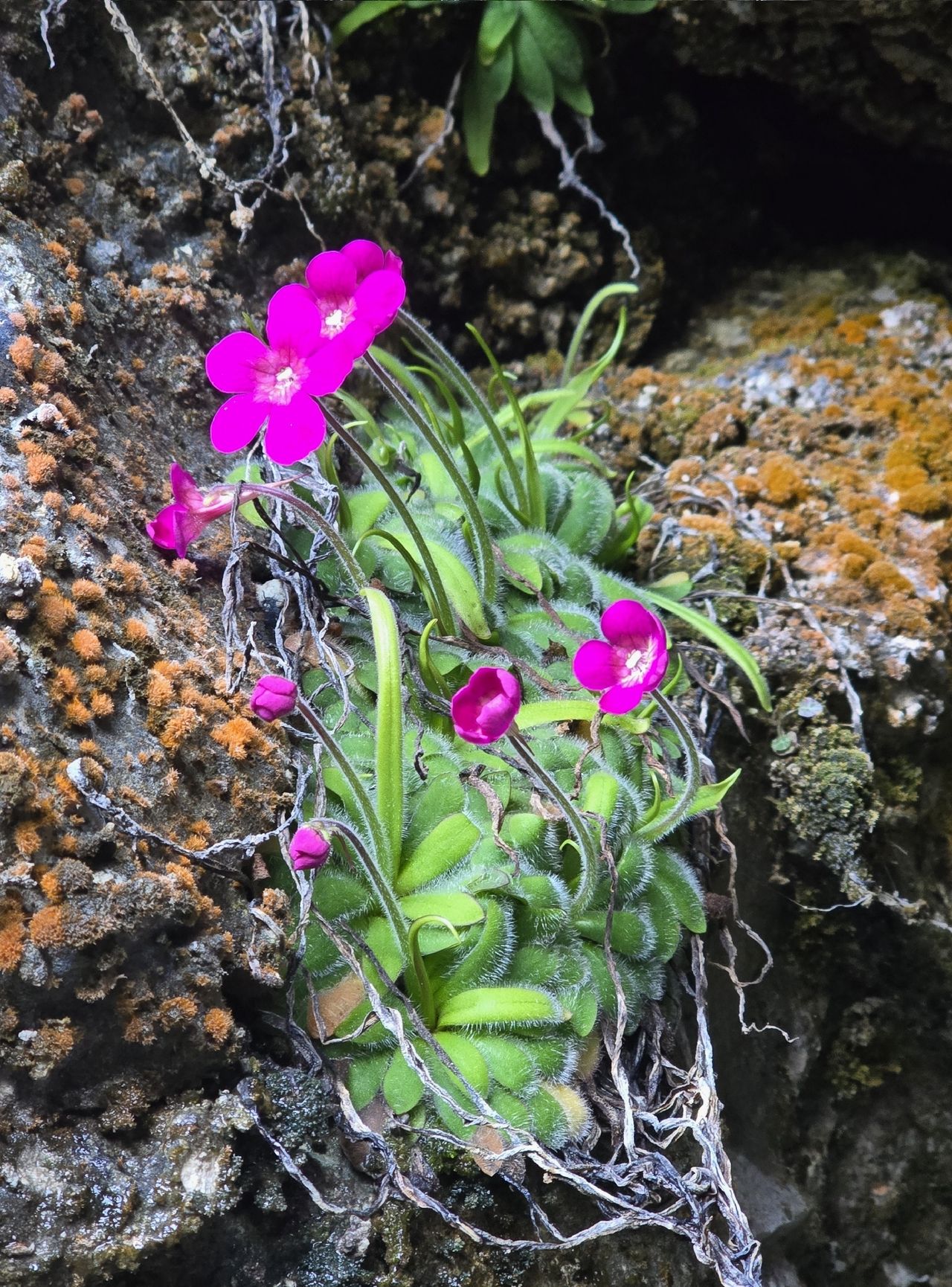
The winter rosette is epigeal and loose in build, with 10 to 20(25) membranous to slightly fleshy spathulate leaves 25 to 60 mm long and 3 to 6 mm wide. In summer 5 to 15 thin, pendulous, linear leaves appear, 50 to 300 mm long and 2 to 8 mm wide, hanging down the rock face like ribbons. Scapes reach 70 to 140 mm. The flower is red-purple and measures 20 to 27 mm including the spur; the upper lip carries lobes 4 to 8 mm long, the lower lip 6 to 10 mm, and the spur is purple and 4 to 8 mm long. Flowering falls in two short periods: October and April, at the start and the end of the dry season.
Similar species
The protologue compares the species with Pinguicula calderoniae. The distinction lies in the winter rosette: in P. rzedowskiana it is epigeal and loose, built of membranous to slightly fleshy spathulate leaves, whereas P. calderoniae has a hypogeal, compact bulb-like rosette of thick obtrullate leaves. Pinguicula robertiana, also with linear summer leaves and a loose epigeal winter rosette, grows in the same kind of country; it has a white flower against the red-purple of our species, and occurs in San Luis Potosí. Flower colour and state together settle the case.
The trap and how it works
The hanging ribbon leaves are the trapping organs. They carry stalked glands with a clear sticky droplet and, between them, sessile glands that release digestive enzymes only once prey lies on the leaf; the margin then bends slightly over the catch. Thirty centimetres of leaf provides plenty of surface where horizontal space is lacking — on a vertical limestone face you cannot spread out, but you can hang down. An added advantage: water seeping over the face runs straight off hanging leaves instead of washing the catch away. The catch consists of midges and other small flying insects from the forest.
Habitat and ecology
Limestone outcrops with seeping water, in pine forest with cloud-forest elements, between 1950 and 2100 m. The plants sit on the face itself, in crevices and on ledges where water runs continuously over the limestone (R1, R2), in the half shade of the forest (B5). The regime is twofold: a wet summer in which the long trapping leaves are formed, and a drier winter half-year in which the plant falls back on the loose rosette of short leaves. That flowering falls in October and April, on either side of that dry period, is typical of the limestone butterworts of the Sierra Gorda.
Distribution and elevation
Endemic to the Mexican state of Querétaro, in the municipality of Jalpan in the Sierra Gorda — in agreement with the entry in our species list. The Sierra Gorda is among the richest butterwort country in Mexico: the limestone range is full of faces, canyons and cuttings, each with its own microclimate, and several species have been described from it in recent decades. The known range of this species is small, but most of the Sierra Gorda falls within a biosphere reserve, which matters for its prospects.
- Recorded (one-degree cells)
Forms and variation
No wild varieties have been described. The variation in leaf length is large — five to thirty centimetres — and for this species that is more than a detail: on a wet shaded face with a permanent water supply the leaves grow to their full length, while plants on an exposed ledge stop at a fraction of it. Seeing two such plants side by side, one might take them for different species. That is a useful reminder that leaf length is no reliable identification character in Mexican butterworts. No natural hybrids are reported.
Where and when to see it
Go in October or April, because flowering falls in two short windows and outside them the plant is much harder to find. Search along limestone faces and cuttings in the pine forest of the Sierra Gorda around two thousand metres, and watch for wet streaks on the rock — exactly where water runs continuously, the long ribbon leaves hang. The red-purple flowers on seven- to fourteen-centimetre scapes show from ten metres away. Do not climb the faces and collect nothing; in a reserve that is in any case not permitted.
Conservation status
The species has not been assessed for the global IUCN Red List and is not listed in CITES. What is known: a species described in 2018 with a small range in the Sierra Gorda of Querétaro, tied to limestone faces with permanently seeping water. In its favour, the area lies largely within the Sierra Gorda biosphere reserve, where active conservation work is done. Less favourable are the building and widening of mountain roads, which strike precisely the wet limestone faces, and the tapping of springs. What holds for all recently described Mexican butterworts holds here too: fame in the plant world attracts collectors. A category is missing only because the assessment has not been carried out.
Scientific name
Pinguicula rzedowskiana | Zamudio & Juarez, 2018
Described by Sergio Zamudio and D. Juárez in 2018, in Phytoneuron 2018-14, based on material collected on 13 October 2011. The type locality lies in the Mexican state of Querétaro, Jalpan municipality. The species name honours the Polish-Mexican botanist Jerzy Rzedowski Rotter, "in recognition of the time and effort he dedicated to the study of the Mexican flora", according to the original description.
World Checklist of Vascular Plants (WCVP), via Plants of the World Online (POWO), Royal Botanic Gardens, Kew.