All species › Caryophyllales › Sundew family › Drosera ordensis
Drosera ordensis
Drosera ordensis is a member of the D. petiolaris complex: a rosette of broad, silvery-sheened petioles, each ending in a red, sticky blade. The name refers to the Ord River in the north-eastern Kimberley, the area where the species occurs, on the border of Western Australia and the Northern Territory.
Identification
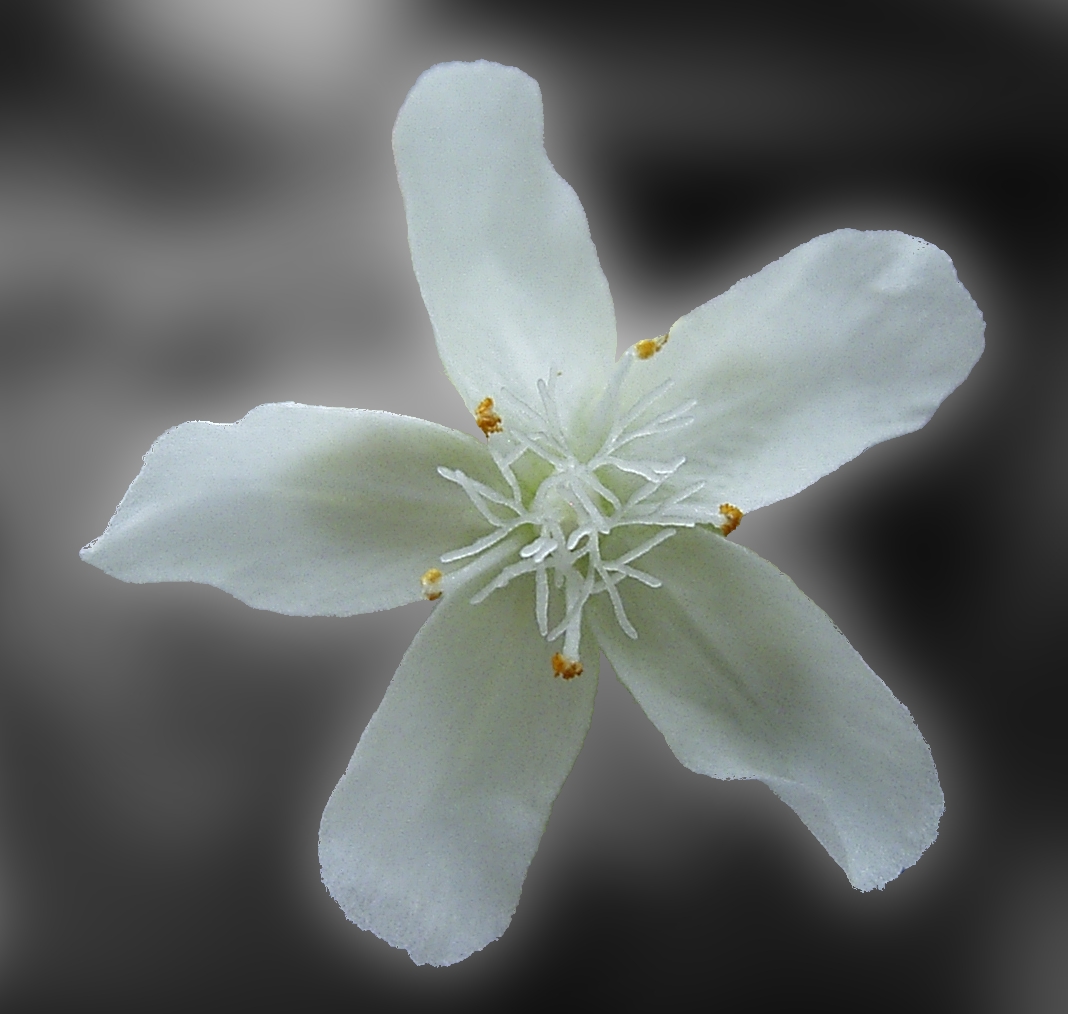
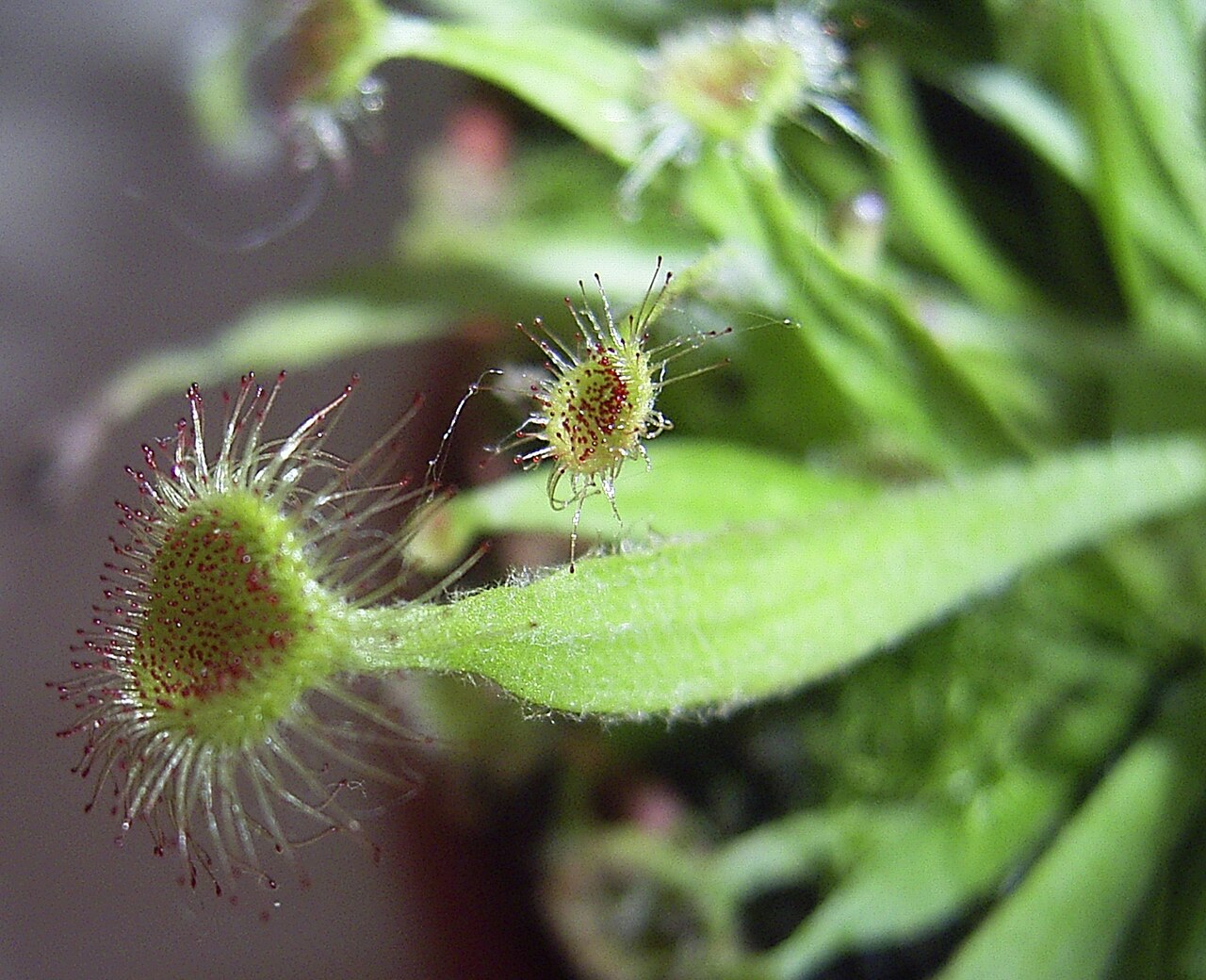
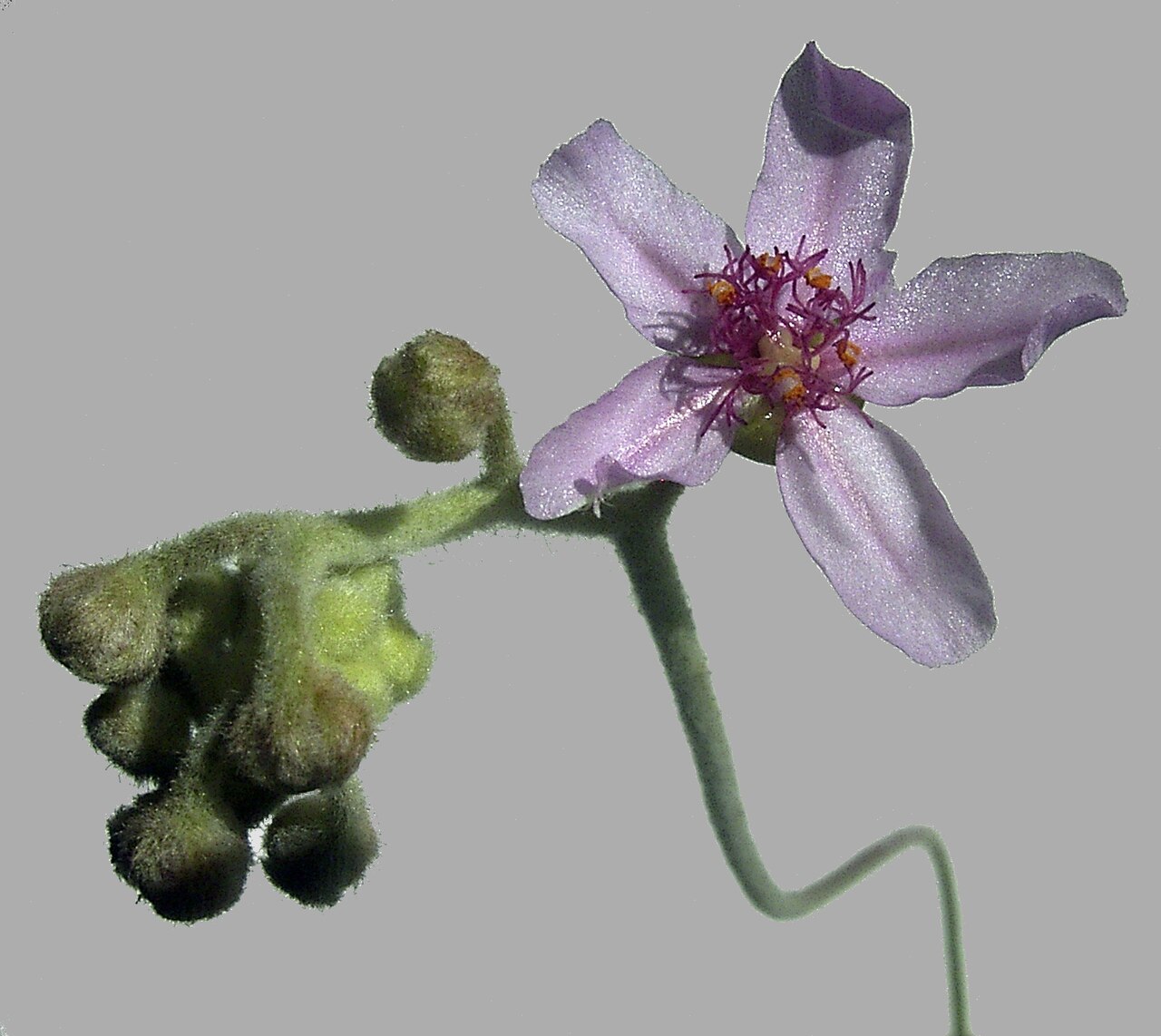
A perennial, stemless rosette, usually about 8 cm across but up to 20 cm in large plants. The petioles are broad and densely covered in silvery hairs, so that from a distance the rosette glows greyish-white. At the end of each stalk is a round trapping blade with glandular tentacles. In the dry season the plant makes smaller, dormant leaves protected from desiccation by their hairs. The five-parted flowers are pink to almost white, about 1.5 cm across, and borne in crowded racemes that open from the bottom up.
Similar species
The silvery, broad petioles make it fairly easy to recognise within the complex. Drosera derbyensis, also hairy, has narrower stalks with woolly rather than silvery-sheened hairs, white flowers and grows in the western Kimberley. D. dilatatopetiolaris also has broadened stalks, but they are green and far less hairy. D. petiolaris and D. fulva have narrower, less conspicuously hairy stalks.
The trap and how it works
An active flypaper trap. The round blades at the ends of the stalks carry glandular tentacles that catch small arthropods in sticky mucilage; the tentacles bend towards the prey and after digestion the glands absorb the nutrients. The silvery hairs on the stalks play no part in trapping and serve as protection against drying out and strong sun.
Habitat and ecology
Sandy soil near sandstone outcrops (D2) in savanna and open woodland (B6), in places that become wet in the rainy season (W7). The species often grows among wild Sorghum grasses. The climate is semi-arid to tropical, with a marked dry season in which the plant retreats into smaller, hairy leaves.
Distribution and elevation
The far north-east of Western Australia, around Kununurra, and the adjoining Keep River National Park in the Northern Territory. The species is thus not confined to the Kimberley, as the range description suggests, but reaches just across the border into the Northern Territory. Altitudinal limits are not published in the sources consulted; the elevation field is left empty.
- Recorded (quarter-degree cells)
Forms and variation
No varieties are recognised. The species varies mainly in size: most rosettes stay around 8 cm, but under favourable conditions they reach 20 cm across. Flower colour runs from bright pink to almost white. The species was described by Allen Lowrie as part of his revision of the D. petiolaris complex.
Where and when to see it
Search in the wet season, December to April, on sandy ground at the foot of sandstone outcrops around Kununurra and in Keep River National Park. The silver rosettes are easy to see among grass and rocks, especially against the light. The wet season is hot and roads may be impassable: check park access beforehand and carry plenty of water.
Conservation status
On the IUCN Red List the species is Least Concern (LC); it is not listed in CITES. Part of the range lies in Keep River National Park. Around Kununurra the expansion of irrigated agriculture and building are possible local threats, as are changes in fire regime and the spread of invasive grasses.
Scientific name
Drosera ordensis | Lowrie, 1994
Drosera ordensis was described in 1994 by Allen Lowrie, in the journal Nuytsia, volume 9, issue 3, page 365 (the journal of the Western Australian Herbarium). The type specimen was collected by Allen Lowrie on 1 April 1988 at Weaber Plains Road, 7.6 km north of Hidden Valley Caravan Park near Kununurra, in the East Kimberley region of Western Australia, on sandy soils derived from sandstone. The species had first been observed in 1951, but was only formally described on the basis of this later-collected material. The epithet ordensis is a toponym: it refers to the Ord River in northern Australia, in the region where the species occurs (around Kununurra in Western Australia and the adjoining Northern Territory).
World Checklist of Vascular Plants (WCVP), via Plants of the World Online (POWO), Royal Botanic Gardens, Kew.