All species › Caryophyllales › Sundew family › Drosera derbyensis
Drosera derbyensis
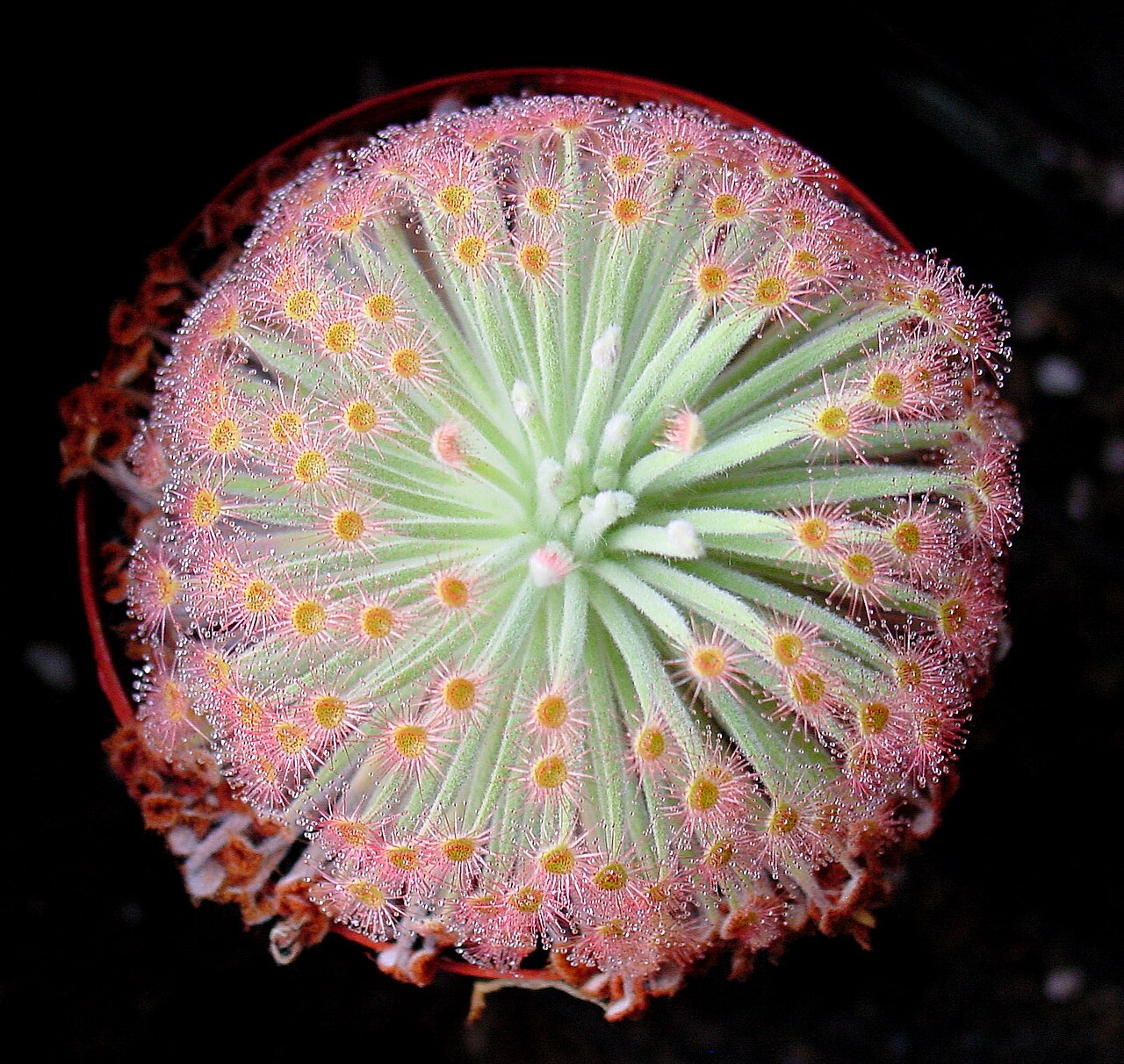
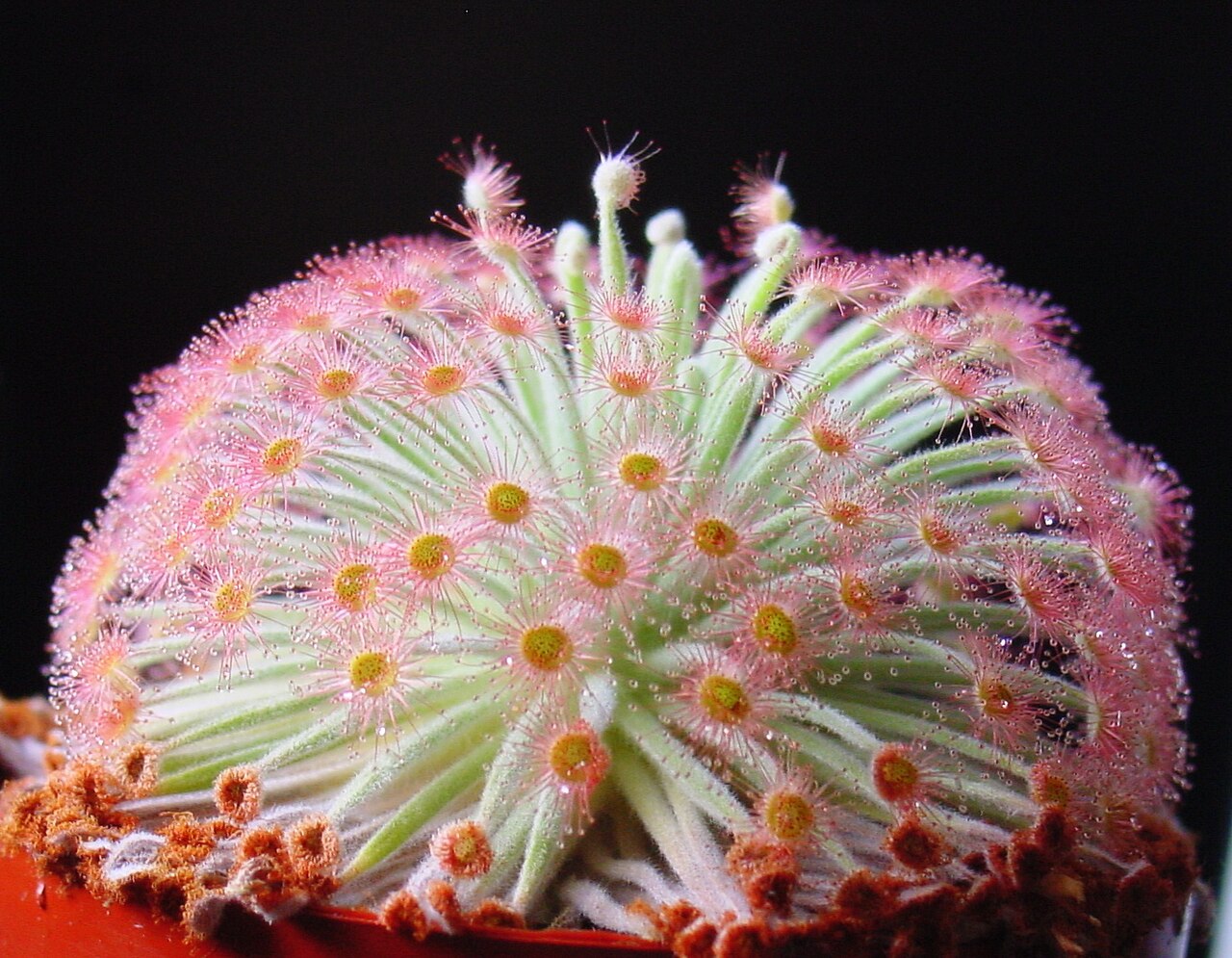
Drosera derbyensis is named after the town of Derby on the western edge of the Kimberley, where the species was first noticed near the famous hollow baobab known as the Boab Prison Tree. It is a member of the D. petiolaris complex distinguished by white, woolly hairs on its petioles and scapes — probably a protection against drying out in the long dry season.
Identification
A perennial rosette of erect to semi-erect leaves. The petioles are narrow, 0.8 to 1.0 mm wide at the base and widening towards the tip to 1.3 to 1.7 mm; they carry a round trapping blade only 2 to 3 mm across. Petioles and scapes are covered with white woolly hairs, giving the plant a greyish appearance. Each rosette produces one to four scapes 25 to 35 cm long, each with 30 to 50 white flowers.
Similar species
Within the D. petiolaris complex it mainly resembles other hairy species. Drosera ordensis has broad, densely silvery-hairy petioles and pink to almost white flowers and grows further east; D. petiolaris is less woolly and has a different distribution pattern; D. lanata is also strongly woolly. Reliable identification requires hairs, flower colour and locality together.
The trap and how it works
An active flypaper trap. The small round blades at the ends of the stalks carry glandular tentacles with sticky mucilage in which small insects are caught; the tentacles then bend towards the prey. The woolly hairs play no part in trapping, but mainly protect the young leaves and growing point from drying out.
Habitat and ecology
Sandy soil in floodways and drainage lines that are wet in the rainy season (W7), and sandy patches near rock outcrops in savanna country (B6, D1). The sites dry out strongly in the long dry season, to which the plant is adapted with its hairs and smaller dry-season leaves.
Distribution and elevation
Endemic to Western Australia, in the western Kimberley, from Derby to Beverley Springs. Altitudinal limits are not published in the sources consulted; the elevation field is left empty.
- Recorded (quarter-degree cells)
Forms and variation
No varieties are recognised. The species was described in 1996 by Allen Lowrie, in the same period in which he split a series of species from the D. petiolaris complex. Older collections from around Derby may therefore be filed under D. petiolaris or other names.
Where and when to see it
Search at the end of the wet season and the start of the dry, March to June, when the tall scapes with white flowers rise above the sand. The grey, woolly rosettes are easiest to find among grass with low, slanting light. Around Derby some sites lie close to settlement; keep to paths and respect closed land.
Conservation status
On the IUCN Red List the species is Least Concern (LC); it is not listed in CITES. The range is relatively small but lies mostly in little-developed country. Possible threats are the spread of building and infrastructure around Derby, changes in fire regime and the spread of invasive grasses.
Scientific name
Drosera derbyensis | Lowrie, 1996
Described by Allen Lowrie in 1996, in Nuytsia, volume 11, no. 1, p. 63 — the same publication as D. darwinensis. Silent Grove camping area, Kimberley region, Western Australia, collected on 5 June 1995. Named after Derby, Western Australia, near where Lowrie first observed the species in 1988.
World Checklist of Vascular Plants (WCVP), via Plants of the World Online (POWO), Royal Botanic Gardens, Kew.