All species › Caryophyllales › Sundew family › Drosera dichrosepala
Drosera dichrosepala
The rusty sundew is one of the classic pygmy sundews: Nikolai Turczaninow described it as early as 1854 from early collections in the colony. The name dichrosepala means 'with two-coloured sepals', and that is exactly what to look for with a hand lens.
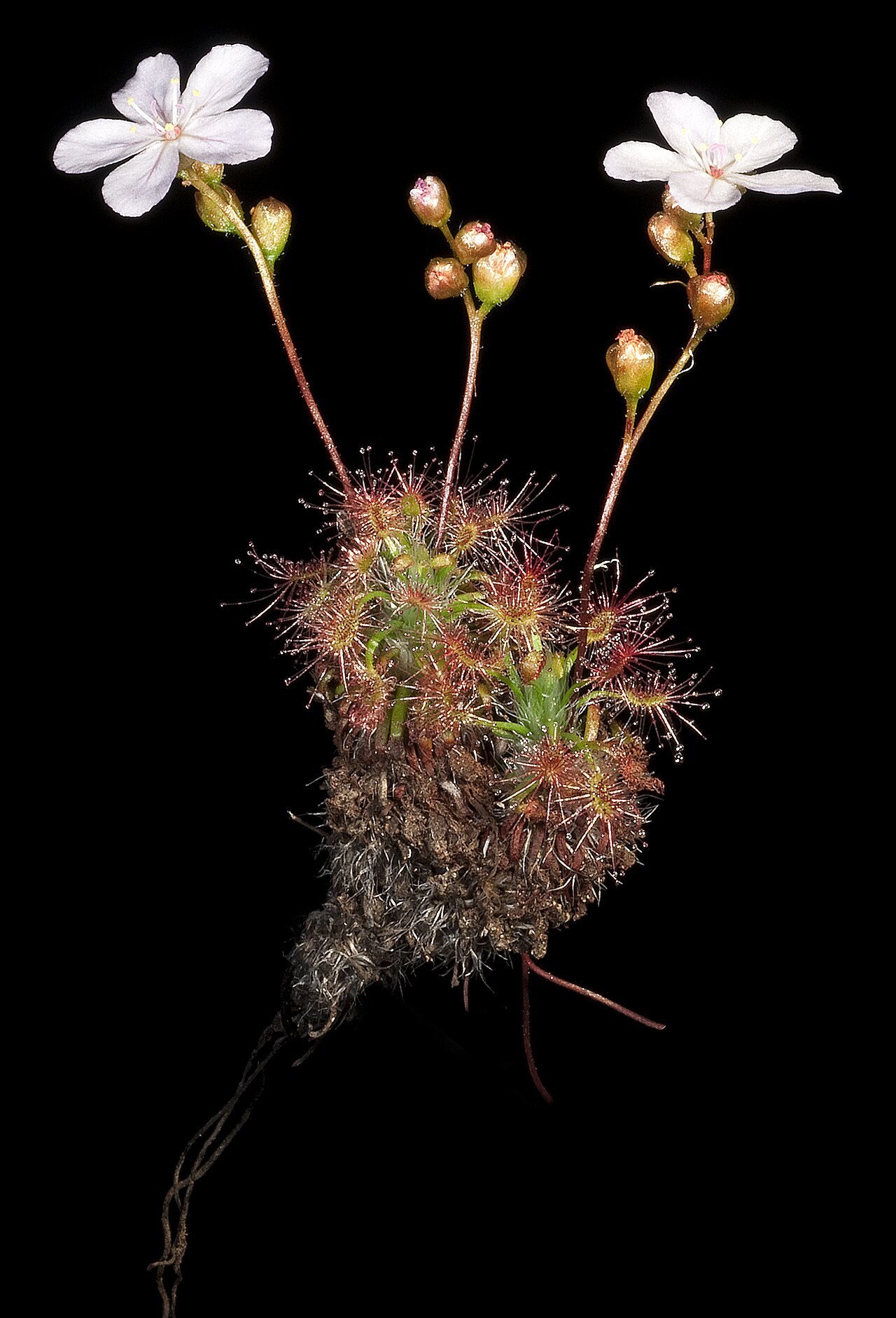
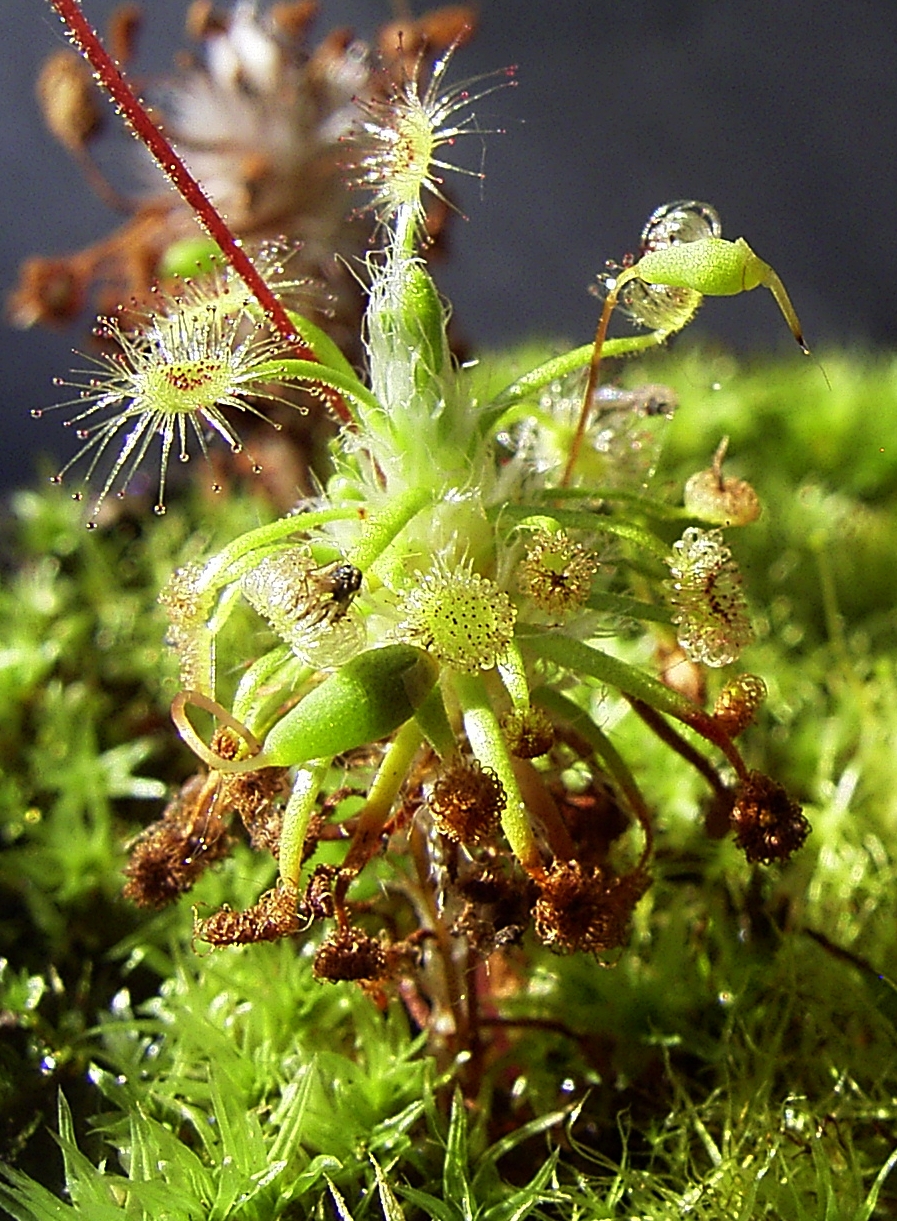
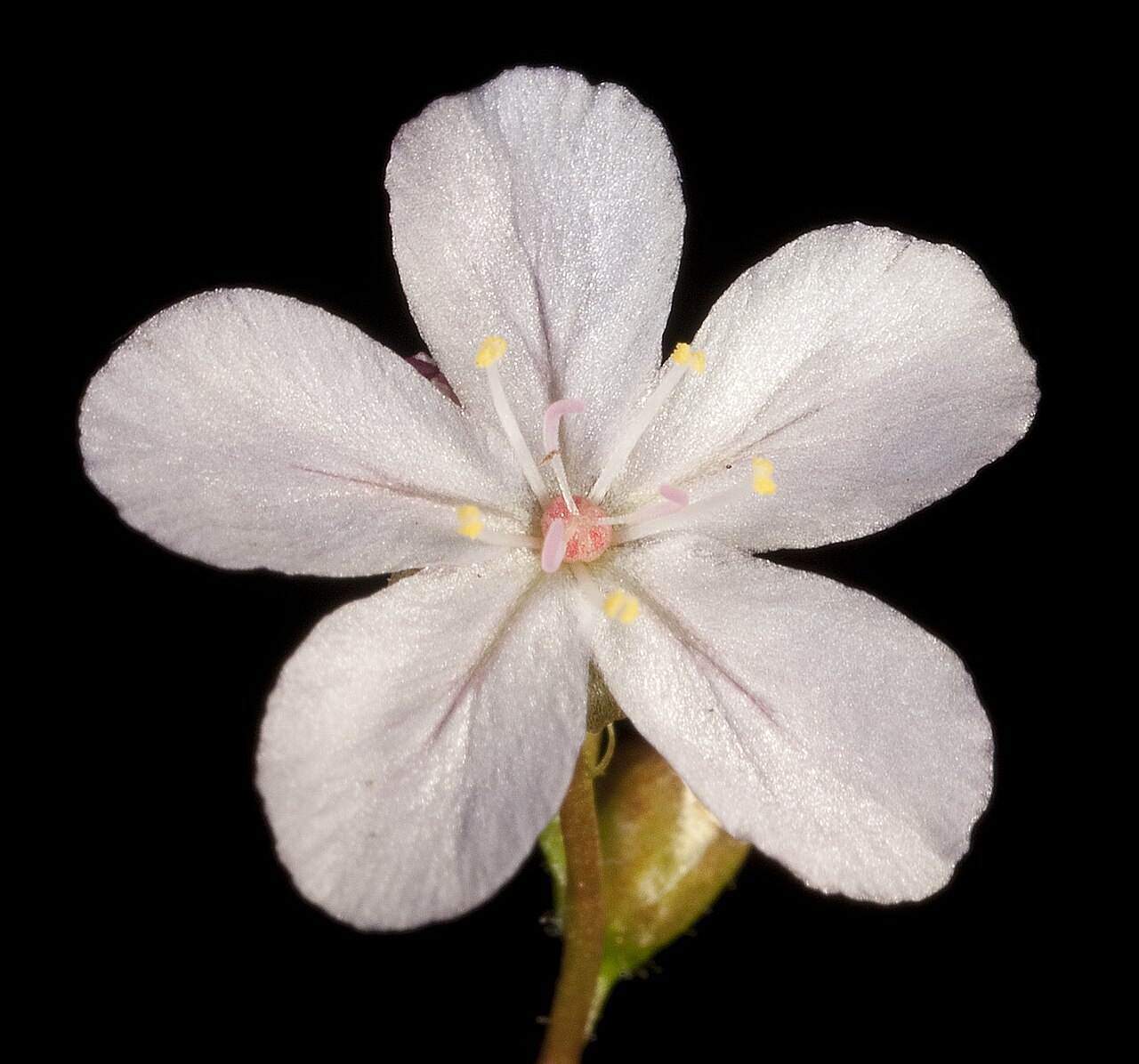
Identification
A perennial, fibrous-rooted pygmy sundew with a small rosette no more than 1.5 cm across; with its flowering stem the plant reaches 4 cm. At its heart stands the cone of silvery stipules that protects the plant as a resting bud in summer. The flowers are white to pink and appear in September and October. The feature giving the species its name is the sepals, which show two colours. Precise leaf measurements were not available in the accessible sources.
Similar species
The closest relative is Drosera enodes, treated by Schlauer as a subspecies of D. dichrosepala and elsewhere as a species; D. enodes grows on wet, peaty soil and at swamp margins, while D. dichrosepala grows on drier sand and laterite. Other white- or pink-flowered pygmy sundews, such as Drosera closterostigma and Drosera eneabba, are told by stigma shape, stipules and calyx. The two-coloured sepals are the most practical feature.
The trap and how it works
An active flypaper trap. The small leaves bear stalked glands with droplets of glue in which small animals such as springtails, mites and minute flies are caught. The tentacles then bend towards the prey and secrete digestive enzymes. The rusty colour alluded to in the English name comes from the red glands and the reddened leaves in sunlight.
Habitat and ecology
White to grey or red-brown sand and rocky laterite (FloraBase), in open heath and open woodland of the interior (D1, D3). The ground is moist in winter; in summer it dries out and the plant rests.
Distribution and elevation
Endemic to the south-west of Western Australia. FloraBase lists the Avon Wheatbelt and Jarrah Forest bioregions. Because the species is listed as endangered on the IUCN Red List, this guide gives no more precise localities.
- Recorded (one-degree cells)
Forms and variation
Two taxa are placed under the name: subsp. dichrosepala and subsp. enodes. The latter was described as a species by Marchant and Lowrie in 1992 and reduced to a subspecies by Schlauer; FloraBase carries both views. An older name, Drosera scorpioides var. brevipes, is a synonym. Like all pygmy sundews the species forms gemmae in autumn.
Where and when to see it
Search in September and October in open patches of sand or lateritic gravel in the jarrah forest and Wheatbelt reserves. Bring a hand lens for the sepals. Because the species is endangered, the rule applies doubly here: keep to paths, collect nothing and do not share location data publicly.
Conservation status
The IUCN assesses the species as Endangered (EN). Remarkably, FloraBase lists it as not threatened in Western Australia; the two assessments therefore disagree, possibly because they use different species concepts (with or without D. enodes). Not in CITES. Threats to this kind of habitat in the south-west include clearing, gravel and bauxite extraction and changes in fire regime.
Scientific name
Drosera dichrosepala | Turczaninow, 1854
Described by Nikolai Turczaninow in 1854 (sometimes cited as published in 1855), in Bulletin de la Société Impériale des Naturalistes de Moscou, volume 27, no. 2, p. 343. The precise type locality could not be established. The species occurs in south-western Australia, north of Albany, around Mount Barker. From the Greek dis ("two") and chroia ("colour") plus the Latin sepalum ("sepal") — refers to the plant's two-coloured sepals.
World Checklist of Vascular Plants (WCVP), via Plants of the World Online (POWO), Royal Botanic Gardens, Kew.