All species › Caryophyllales › Sundew family › Drosera orbiculata
Drosera orbiculata
A small rosette-forming tuberous sundew with a very restricted range north of Perth. The name orbiculata refers to the round shape of the leaf blade. Allen Lowrie and Neville Marchant described the species in 1992, in the series of publications in which they delimited a large number of south-west Australian sundews for the first time or anew.
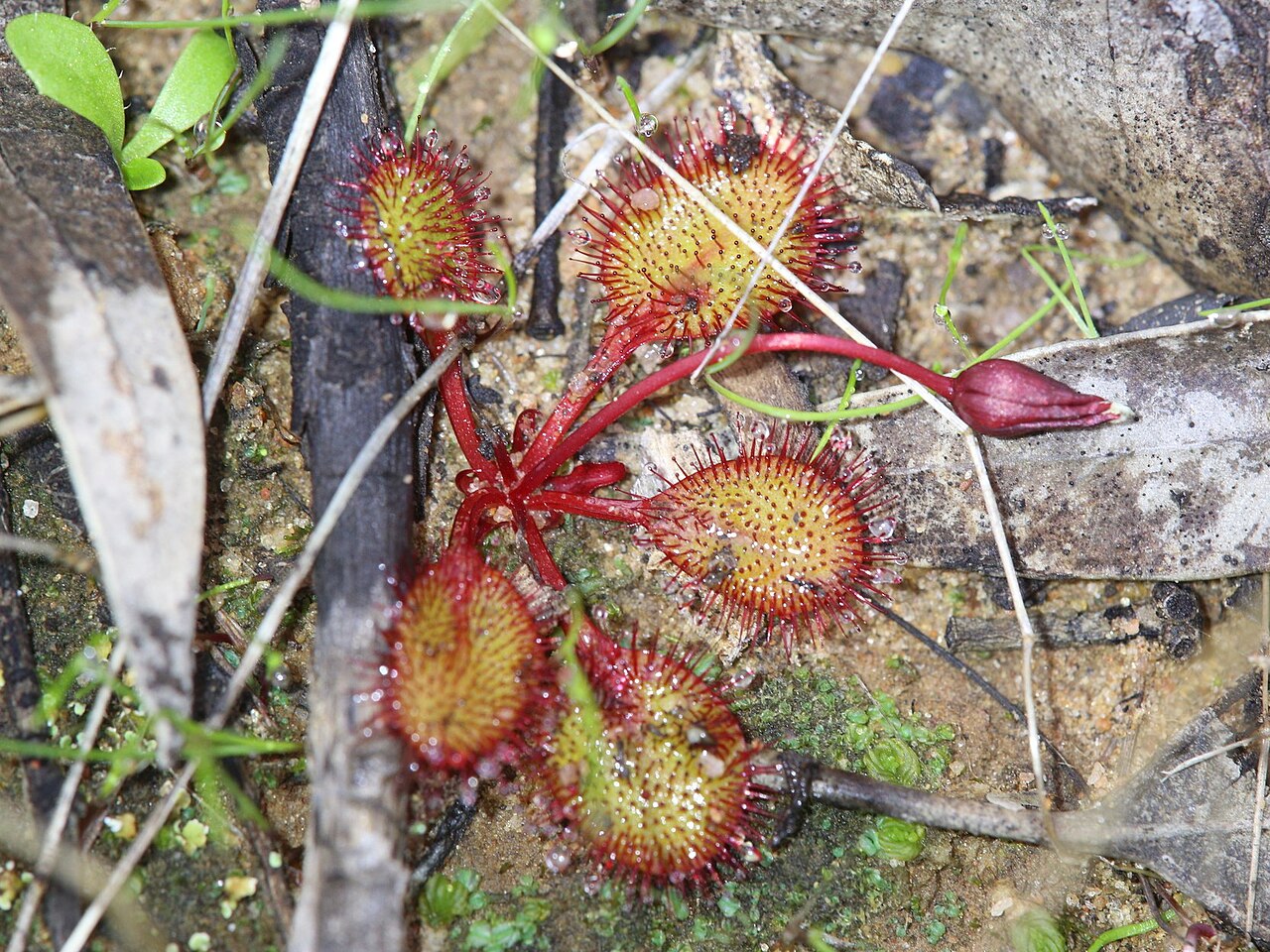
Identification
A perennial with an underground tuber and a flat rosette about 1.5 cm across, far smaller than well-known rosette-forming tuberous sundews such as Drosera erythrorhiza. The leaf blades are round, which gave the species its name. We did not find flower colour, flowering time or further measurements in any source consulted; those fields are left empty.
Similar species
The species is regarded as related to Drosera rosulata, another small rosette-forming tuberous sundew from the south-west. Other members of section Erythrorhiza, such as D. macrophylla, D. erythrorhiza and D. lowriei, are larger or have a different leaf shape. A small rosette with round blades in a wet hollow north of Perth is the best clue.
The trap and how it works
An active flypaper trap. The upper surface of the flat-lying round leaves carries stalked glands with sticky droplets that catch crawling and low-flying insects such as ants, springtails and small flies. After a catch the tentacles bend towards the prey and digestive enzymes are secreted. The reserves go to the tuber, which is formed anew each year.
Habitat and ecology
Sandy clay in hollows and drainage washes that are wet in winter (W7, D1). The plant grows in the wet winter, flowers and withdraws into its tuber in the dry summer.
Distribution and elevation
Endemic to south-west Australia, known from a very small area north of Perth, in the Gillingarra district.
- Recorded (one-degree cells)
Forms and variation
No subspecies or varieties have been described. The species belongs to section Erythrorhiza, the rosette-forming tuberous sundews, within subgenus Ergaleium.
Where and when to see it
Rosette-forming tuberous sundews are above ground in winter, roughly from June to September. A rosette a centimetre and a half across in a wet hollow is found only by searching the ground systematically. Because the range is so small: look, photograph, and leave the site undisturbed.
Conservation status
On the global IUCN Red List the species is listed as Vulnerable (VU). It is not listed in CITES. So small a range makes the species sensitive to any change: clearing, alterations to the drainage of hollows and roadworks. Uncertainty: we could not check flower colour, flowering time or the Western Australian conservation status in a source.
Scientific name
Drosera orbiculata | Marchant & Lowrie, 1992
Drosera orbiculata was formally described in 1992 by Neville Marchant and Allen Lowrie, in Kew Bulletin, volume 47, issue 2, page 319. The type was collected by Allen Lowrie on 10 June 1986 in the Victoria Plains district of Western Australia, near Gillingarra (about 1.3 km north of it), not far from Perth. The plant grew there on sandy clay soil in winter-wet depressions and washes. The type specimen is held at the PERTH herbarium (PERTH 2344963). The epithet orbiculata comes from the Latin orbiculatus, "rounded, disc-shaped." It is a descriptive name: the species was so named for the nearly circular shape of its leaf blade.
World Checklist of Vascular Plants (WCVP), via Plants of the World Online (POWO), Royal Botanic Gardens, Kew.