All species › Caryophyllales › Sundew family › Drosera oreopodion
Drosera oreopodion
One of the smallest carnivorous plants known, and one of the rarest sundews in Australia. Drosera oreopodion was unknown until 1987, when Allen Lowrie found the plant; in June 1992 Neville Marchant and Lowrie formally described it. The name comes from the Greek for 'foot of the mountain', after the foothills of the Darling Range where the species grows.
Identification
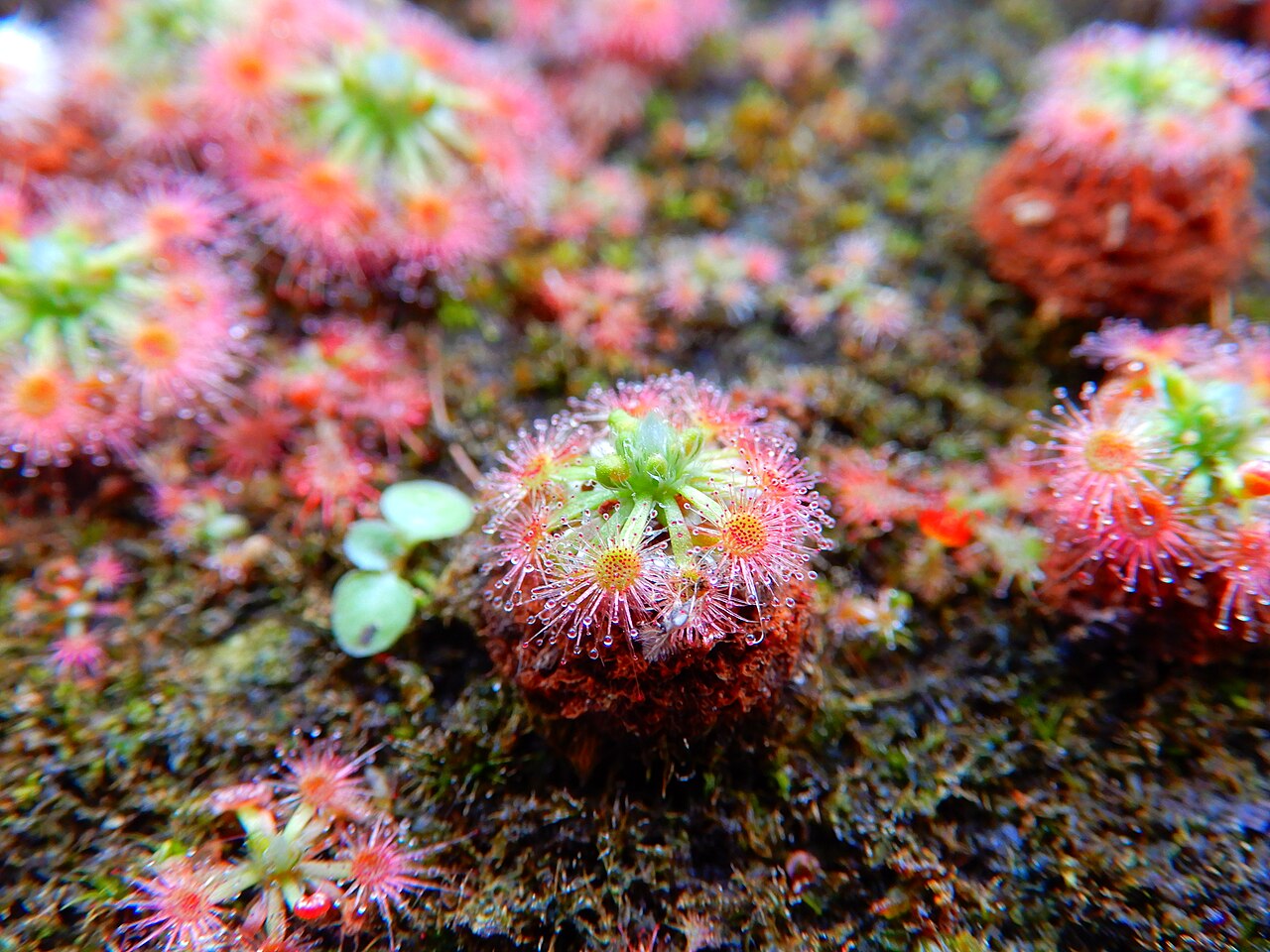
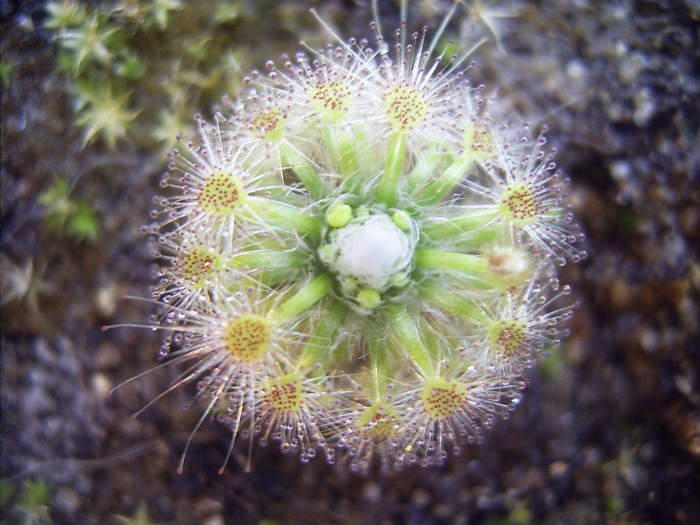
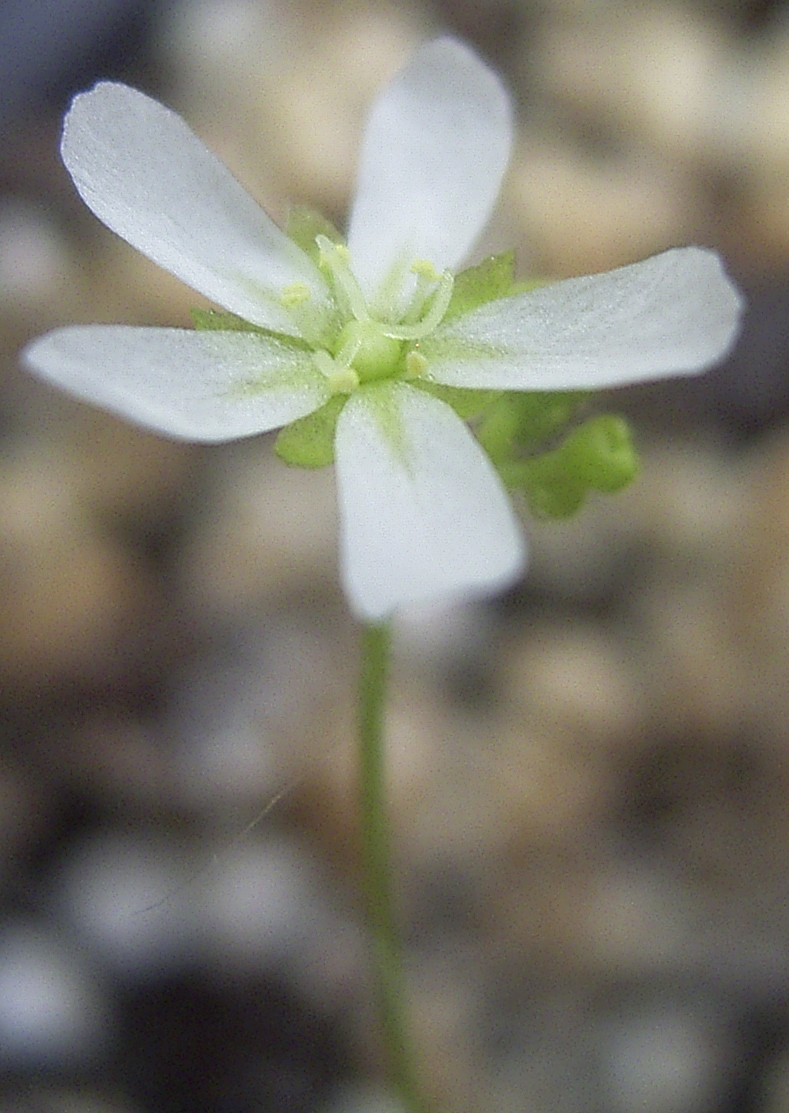
A pygmy sundew of extremely small dimensions. The leaves are about 5.5 mm long, with a round, sticky blade only 1.5 mm wide. The inflorescence is very thin, almost hair-like, and about 3.5 cm tall. Like all pygmy sundews the plant has a tuft of stipules at the heart of the rosette. We did not find flower colour or flowering time in any source consulted.
Similar species
Because of its minute size the species can only be confused with other very small pygmy sundews, such as Drosera occidentalis of the coastal-plain wetlands and D. pygmaea. The hair-thin inflorescence and the habitat in the Darling Range foothills are clues; certainty requires a specialist.
The trap and how it works
An active flypaper trap on the smallest conceivable scale. The blade of a millimetre and a half carries a few stalked glands with a sticky droplet, enough to hold springtails, mites and other micro-arthropods. After a catch the tentacles bend towards the prey and it is digested.
Habitat and ecology
We were unable to consult a detailed habitat description. The Darling Range foothills consist largely of lateritic soils with places that are wet in winter, and the codes follow that general picture (D3, W7). Like all pygmy sundews the plant grows in the wet winter and rests in summer.
Distribution and elevation
Endemic to south-west Australia, in the foothills of the Darling Range. Because of its critically endangered status we give no more precise localities.
- Recorded (one-degree cells)
Forms and variation
No subspecies or varieties have been described.
Where and when to see it
This is not a species to go looking for. The known sites are extremely fragile, and a plant a few millimetres across is easily trampled by someone searching for it. Anyone who wants to see more is better served by the publications and photographs of Western Australian botanists and by organised excursions of conservation groups.
Conservation status
On the global IUCN Red List the species is listed as Critically Endangered (CR). It is not listed in CITES. The Darling Range foothills lie on the edge of the Perth metropolitan area, where clearing, building, gravel extraction, weeds and an altered fire regime put the laterite flora under pressure. For a species known from so few places, a single intervention can be decisive. Uncertainty: we could not check flower colour, flowering time or the exact number of sites in a source.
Scientific name
Drosera oreopodion | Marchant & Lowrie, 1992
Drosera oreopodion was described in 1992 by Neville Marchant and Allen Lowrie, in Kew Bulletin, volume 47, issue 2, page 326. The type was collected by Allen Lowrie on 19 October 1987 near Serpentine-Jarrahdale, in the Darling Range of Western Australia, at the foot of the range, in clayey sand mixed with laterite pebbles, in low heathland. The specimen (field number 87/032) is held at the PERTH herbarium under number PERTH 2344793. The epithet oreopodion is compounded from Greek oros ("mountain") and podion ("little foot"), and literally means "foot of the mountain." It is a descriptive, quasi-toponymic epithet: the species occurs at the foot of the Darling Range, including near Armadale and Pinjarra in Western Australia.
World Checklist of Vascular Plants (WCVP), via Plants of the World Online (POWO), Royal Botanic Gardens, Kew.