All species › Caryophyllales › Sundew family › Drosera hirticalyx
Drosera hirticalyx
The sundew with the hairy calyx, for that is what the name means. Drosera hirticalyx was described in 1995 by the Venezuelan botanist Rodrigo Duno de Stefano and the British botanist Alastair Culham, who around the same time also described Drosera yutajensis from the tepuis. It is a species of the highlands of the Guiana Shield, which the 2022 Brazilian synopsis also includes for Brazil.
Identification
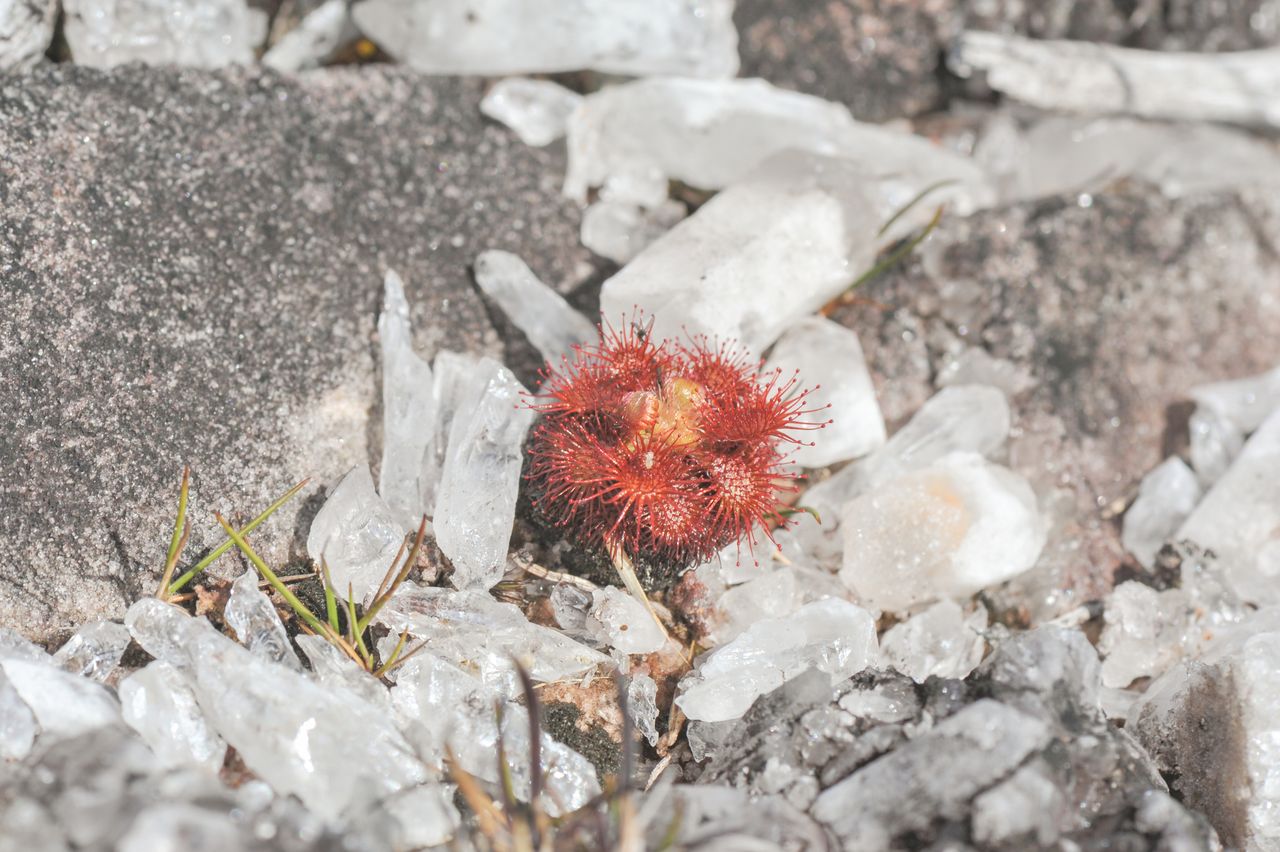
A perennial rosette plant of the table mountains, with leaves densely set with tentacles. The distinguishing character lies in the flower: the sepals are conspicuously hairy, which separates the species from most other Guiana sundews. Measurements and a confirmed flower colour could not be checked in the available sources; the size fields are left empty.
Similar species
Drosera roraimae is the best-known tepui sundew and grows in the same kind of landscape; it has long petioles with a narrow blade. Drosera arenicola, Drosera solaris and Drosera kaieteurensis are other highland species. The hairy calyx is the best character but needs a hand lens and a flowering plant; without flowers the species can scarcely be recognised with certainty.
The trap and how it works
An active flypaper trap. The tentacles on the leaves catch small insects, which are then enclosed and digested by the surrounding tentacles. In the cool, wet climate of the tepuis gnats and springtails are the main prey.
Habitat and ecology
The cool, wet highlands of the Guiana Shield: open places on sandstone, bog-moss cushions and boggy ground in low vegetation, and the edges of dwarf and cloud forest (R5, W1, B4). Further data on elevation and soil could not be checked.
Distribution and elevation
The Guiana Shield in north-eastern South America, with records from Venezuela, Guyana and northern Brazil. Its inclusion in the Brazilian synopsis confirms occurrence in Brazil; the exact distribution across the table mountains could not be checked here.
- Recorded (one-degree cells)
Forms and variation
No varieties are recognised. The species is one of the few Guiana sundews described in the last decades of the twentieth century, a period when molecular work on the genus was getting under way; Culham was involved in early DNA studies of relationships within Drosera.
Where and when to see it
A species for members of tepui expeditions. With every flowering sundew, photograph the calyx close up, preferably with a macro lens or hand lens: the hairs are the decisive character. Note elevation and habitat and do not step on the peat cushions.
Conservation status
Not assessed for the global IUCN Red List and not listed in CITES. The sites lie on hard-to-reach table mountains, largely in protected areas. Climate change is the greatest long-term risk; nothing is known about numbers or trends.
Scientific name
Drosera hirticalyx | Duno & Culham, 1995
Described by R. Duno & Culham in 1995, in Novon, volume 5, p. 241. Venezuela, Amazonas State, Atabapo district, Cerro Marahuaca-Huha, an almost flat, treeless summit with exposed stones, at 2580 m elevation. Collected on 31 January 1982; holotype at NY, isotype at VEN. From the Latin hirtus ("shaggy-haired") and calyx — "hairy calyx", probably referring to a distinctive hairy calyx feature distinguishing it from related species.
World Checklist of Vascular Plants (WCVP), via Plants of the World Online (POWO), Royal Botanic Gardens, Kew.