All species › Caryophyllales › Sundew family › Drosera hirtella
Drosera hirtella
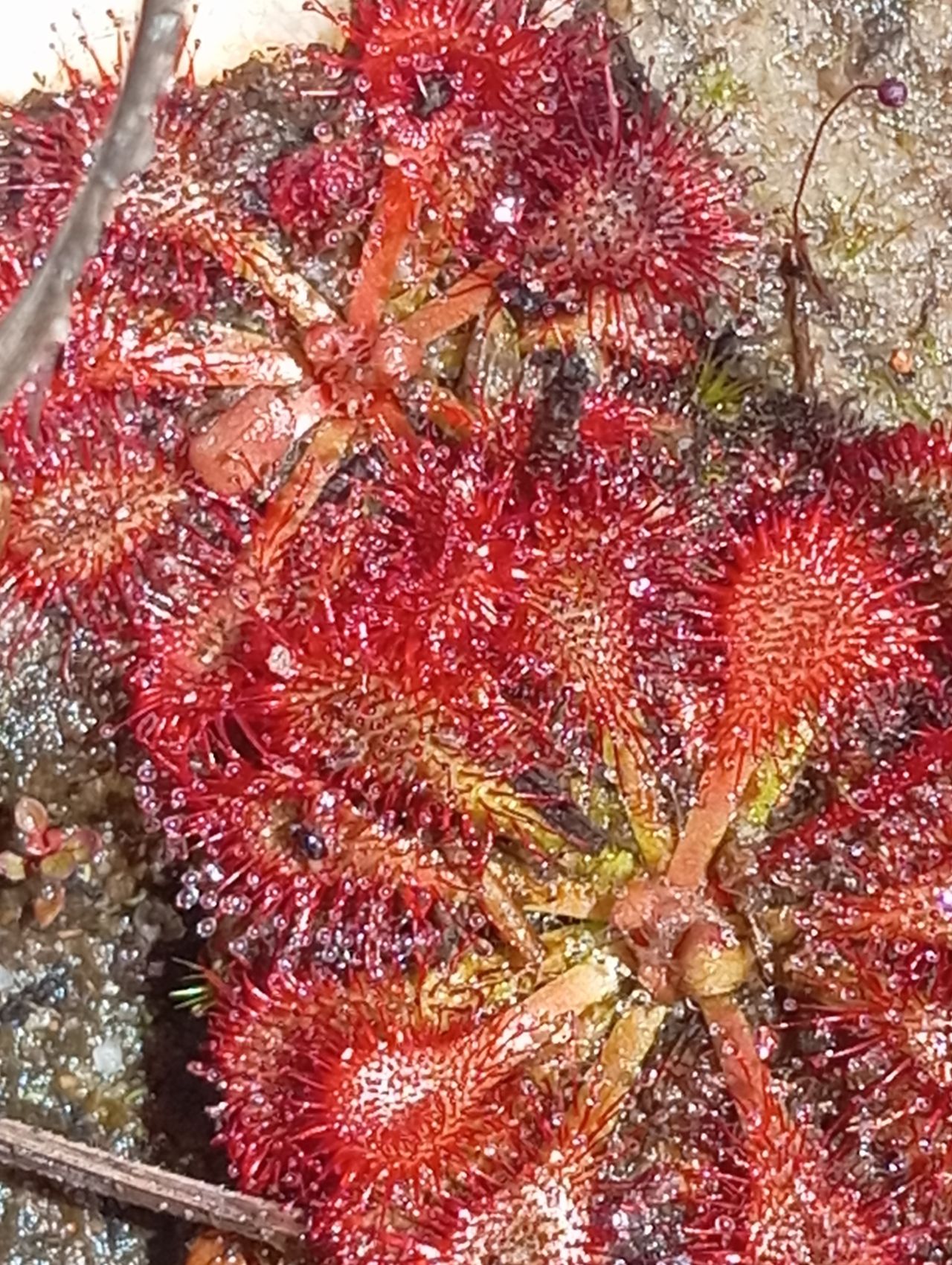
A hairy sundew of the Brazilian cerrado. Drosera hirtella was described by Saint-Hilaire in 1826 and long had a variety lutescens, which the 2022 Brazilian synopsis split off as the separate species Drosera lutescens. What now falls under D. hirtella is therefore more sharply defined, with a simple field character: a red scape with red, non-glandular hairs.
Identification
A perennial rosette plant with densely glandular leaves and conspicuous hairs. The best character is the scape: red and covered with red hairs lacking a gland head. The synopsis distinguishes two forms within the species, a typical form and a western form, which differ in habit. Measurements and a confirmed flower colour could not be checked here; the size fields are left empty.
Similar species
The main confusion species is Drosera lutescens, a variety of this species until 2022. The two can grow right next to each other; photographs in the synopsis show flowering plants of both side by side in shade, with the difference in hairs and scape colour clearly visible. Other cerrado species such as Drosera communis and Drosera grantsaui lack the conspicuous red hairs on the scape.
The trap and how it works
An active flypaper trap. The tentacles on the blade catch small insects, after which the surrounding tentacles bend towards the prey. The non-glandular hairs on the scape have no trapping role; they may protect the inflorescence against crawling insects or drying out.
Habitat and ecology
Wet and seasonally wet places in the cerrado: boggy grasslands, seepage zones along streams, the edges of veredas and open patches of savanna that are soaked in the rainy season (B6, W4, W7). The plant can also grow in light shade, as the photographs in the synopsis show.
Distribution and elevation
Central Brazil, in the cerrado region; the distribution of the species in the narrow sense, after the split of D. lutescens, is mapped in the 2022 synopsis but could not be checked in detail here. As far as known endemic to Brazil.
- Recorded (quarter-degree cells)
Forms and variation
No formal varieties are recognised any more; the former var. lutescens has become a species of its own. The synopsis does describe two informal morphotypes, a typical form and a western form. Older literature and cultivated plants under the name D. hirtella may therefore also concern D. lutescens.
Where and when to see it
In the wet season search the wet hollows of the cerrado. With every hairy sundew, look at the scape: red with red hairs points to D. hirtella. Where both species grow together is the best chance to see the differences for yourself.
Conservation status
Not assessed for the global IUCN Red List and not listed in CITES. The cerrado is disappearing fast through conversion to farmland and pasture, and wet hollows are being drained; this also affects the sites of this species. Because of the recent redefinition its true rarity is not yet well known.
Scientific name
Drosera hirtella | Saint-Hilaire, 1824
Described by Auguste de Saint-Hilaire in 1824, in "Histoire des Plantes les plus Remarquables du Brésil et du Paraguay", p. 262-263. Brazil: near the village of Formigas, in the deserted western part of Minas Gerais province ("Certão"), and in the Serra dos Pirineus mountains, Goiás province. The lectotype (designated by M.D. Corrêa & T.R.S. Silva) is the Serra dos Pirineus collection, held in Paris (P). A Latin diminutive of hirtus ("shaggy-haired") — "somewhat shaggy-haired", a descriptive name not literally confirmed in a source.
World Checklist of Vascular Plants (WCVP), via Plants of the World Online (POWO), Royal Botanic Gardens, Kew.