All species › Caryophyllales › Sundew family › Drosera hookeri
Drosera hookeri
Drosera hookeri is a small, bright yellow-green tuberous sundew of the D. peltata complex of south-eastern Australia. Joseph Dalton Hooker had already distinguished the plant in 1848 under the name D. foliosa, but that name was already in use for another species and was therefore illegitimate. In 2010 Gibson, Conn and Conran gave the species a new name in Hooker's honour. In English it is called the 'grassland sundew', after its habitat.
Identification
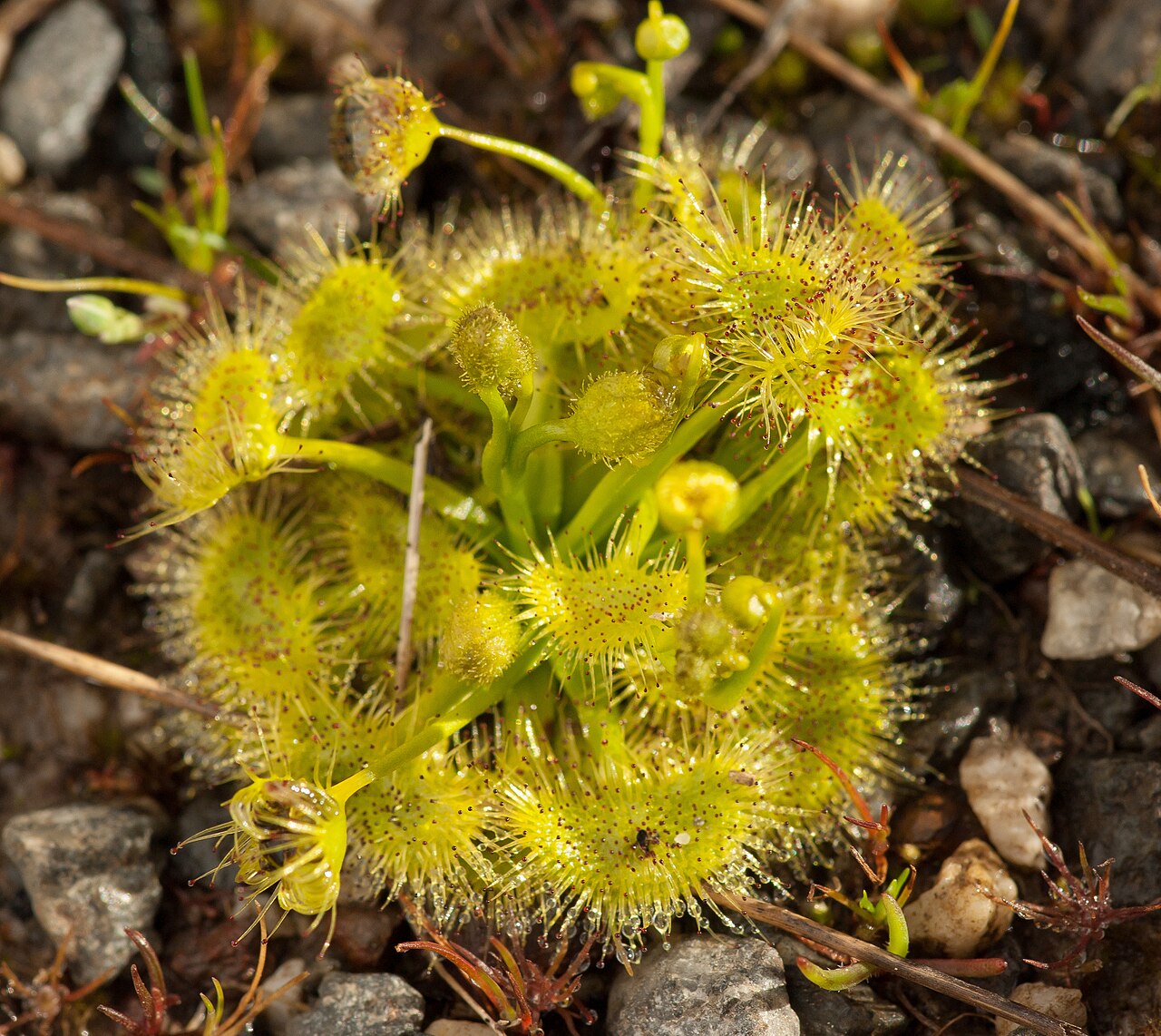
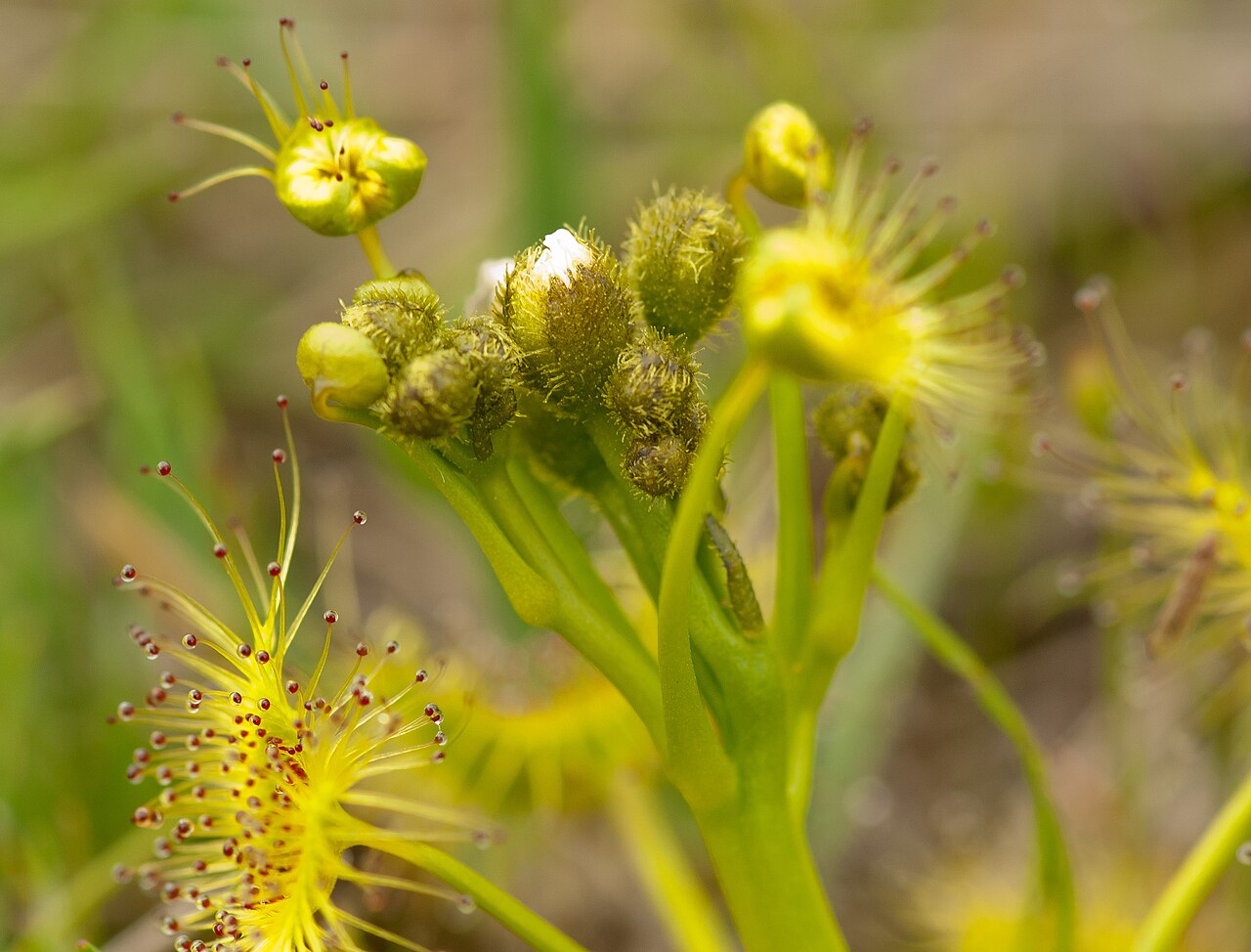
A small perennial 5 to 10 cm tall that grows in winter from a white tuber lying 2 to 5 cm below the surface. The whole plant is yellow-green to distinctly yellow, even in full sun. There is a well-developed rosette of crescent-shaped leaves on the ground, and several repeatedly branched stems often arise from the base, carrying peltate, crescent-shaped trapping leaves. The white flowers appear close to the basal rosette; the petals are 4 to 4.5 mm long and the sepals carry only short, sparse hairs. The seeds are cylindrical, 0.6 to 0.7 mm long.
Similar species
Within the complex Drosera gunniana is the main look-alike: it is larger (8 to 30 cm or more), usually has one dominant main stem, pink to red tubers, densely hairy sepals with hairs over 0.8 mm and larger pink or white petals 5 to 8 mm long. D. peltata in the strict sense is slender, reddish and has densely hairy calyces; D. auriculata has glabrous sepals. The bright yellow-green colour and the low habit, branched from the base, are good field characters.
The trap and how it works
An active flypaper trap. The peltate leaves along the stems and the crescent-shaped rosette leaves carry tentacles that catch small insects in sticky mucilage; the marginal tentacles bend towards the prey, after which the shorter central tentacles digest it. Because of the low habit, the catch consists mainly of crawling and low-flying insects among the grass.
Habitat and ecology
Grassland and grassy woodland that is wet in winter and dries out in summer (W7, B6), on the coast, on the tablelands and inland. According to De Salas it grows mainly in damp, open grassland, whereas D. gunniana favours heathy and grassy woodland. The plant survives the dry summer as a tuber and often grows alongside other species of the complex.
Distribution and elevation
South-eastern Australia: Tasmania (where the type comes from), Victoria and South Australia, and according to some sources also New South Wales. Sources conflict about New Zealand. Gibson and colleagues included plants from northern New Zealand in this species, but according to the New Zealand Plant Conservation Network these have belonged to D. gunniana since 2018. The 'and New Zealand' in the range description is therefore uncertain. Altitudinal limits are not precisely published; the elevation field is left empty.
- Recorded (quarter-degree cells)
Forms and variation
Growers in Victoria distinguish a lower form branched from the base and a taller form with a single green stem. That taller form may fall (partly) within D. gunniana as delimited in 2018. The sources do not yet agree on the exact boundary between the two species. Anyone using older records should bear in mind that 'D. hookeri' from before 2018 sometimes also includes D. gunniana.
Where and when to see it
Search in the Australian spring in damp, open grassland and grassy woodland, for example in central Victoria and Tasmania. The bright yellow to yellow-green plants stand out among the grass precisely because of their colour. Take a hand lens to examine the calyx. Do not dig up tubers; they lie surprisingly deep and the plant needs them to get through the summer.
Conservation status
On the IUCN Red List the species is Least Concern (LC); it is not listed in CITES. That assessment probably follows the pre-2018 delimitation, which included plants of D. gunniana. Native grasslands and grassy woodlands are among the most reduced ecosystems of south-eastern Australia, so the species is locally vulnerable to conversion to farmland, building and invasive grasses.
Scientific name
Drosera hookeri | Gibson, Conn & Conran, 2010
Described by R.P. Gibson, B.J. Conn & Conran in 2010, in Journal of the Adelaide Botanic Garden, volume 24, p. 41 (20 December 2010) — a replacement name: the taxon had already been recognised in 1848 by Joseph Dalton Hooker as "Drosera foliosa Hook.f. ex Planch.", but that name was invalid (a later homonym of D. foliosa Elliott, 1824), requiring a new name. Holotype collected in Tasmania; the species overall occurs across south-eastern Australia (Victoria, New South Wales, South Australia) and New Zealand, within the D. peltata complex. Named in honour of Joseph Dalton Hooker, who first recognised the taxon.
World Checklist of Vascular Plants (WCVP), via Plants of the World Online (POWO), Royal Botanic Gardens, Kew.