All species › Hedgehogs, shrews and moles › Shrews › Water shrew
Water shrew | Neomys fodiens
Waterspitsmuis | Musgaño Patiblanco
The Water Shrew is the largest shrew in north-west Europe and hunts underwater. It dives for water slaters, freshwater shrimps, caddis larvae and small snails, and subdues larger prey with venomous saliva. The animal itself is seldom seen; along clean banks it leaves droppings and feeding sites with empty snail shells, and in practice the species is recorded mainly from those signs and from owl pellets.
Tracks
The signs are small but characteristic. The droppings are 3 to 10 mm long, dark brown to black, and full of shiny fragments of aquatic insects and crustaceans; they are left on stones and roots at the water's edge and under overhanging banks. At regular feeding sites just above the waterline lie empty snail shells, opened caddis cases and the remains of water slaters; with small fish sometimes only the head and eyes are eaten. Footprints of fore and hind feet measure up to about 14 mm and show only in fine silt. Surveys rely on bait tubes: short lengths of pipe with bait laid along the bank and checked for droppings after a few days; this is the method of the national water shrew survey in Britain. The droppings cannot be separated reliably by eye from those of the other Neomys species and of the Pyrenean Desman; where these species occur together, as in northern Spain, DNA analysis is needed. In owl pellets of Barn and Long-eared Owls the lower jaws with red-brown tooth tips are recognisable and, by their size and the height of the ascending ramus, separable from those of the smaller Neomys species; in Cabrera's Water Shrew that height usually stays below 4.8 mm.
Identification
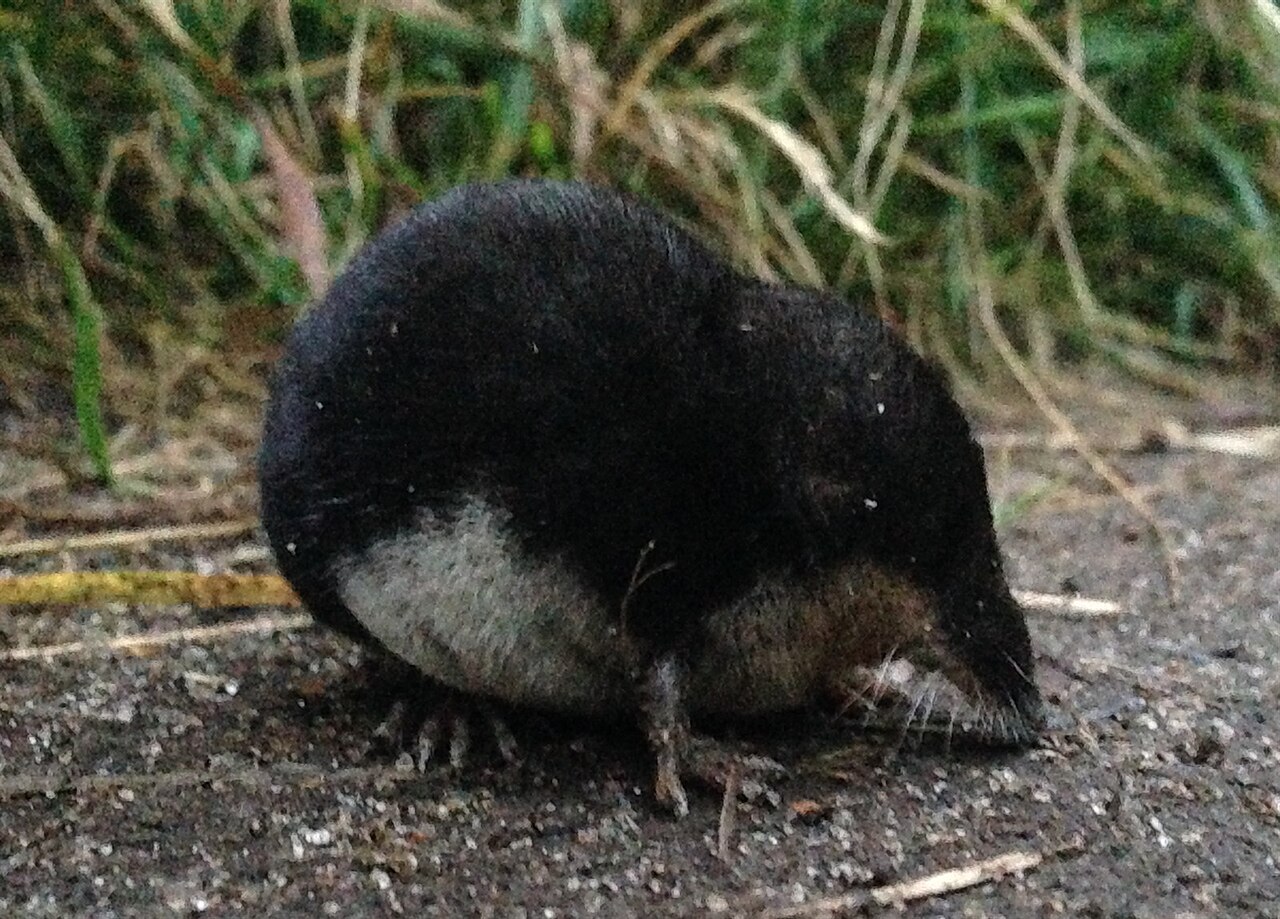
A large, stocky shrew with a black to blackish-brown back and a sharply demarcated white, grey or yellowish belly, the boundary running as a straight line along the flank. Animals with dark or mottled undersides also occur, so colour alone is not decisive. The decisive characters are on the feet and tail: fringes of stiff white hairs along the hind feet and toes, which enlarge the swimming surface of the foot, and a keel of stiff silvery-white hairs along the whole underside of the tail, which stabilises the course when swimming. The tail is bicoloured and reaches about two-thirds of head-body length or more. The ears are small, nearly hidden in the fur and closed by skin flaps underwater; there is often a small white spot by the eye or ear. The tooth tips are red-brown, as in all red-toothed shrews. Underwater the animal looks silvery because of the air trapped in its fur. Head-body 7 to 10.5 cm, tail 4.5 to 7.7 cm, weight 9 to 25 g.
Similar species
The most difficult confusions are the Mediterranean Water Shrew (Neomys milleri), over much of Europe, and in the Iberian Peninsula Cabrera's Water Shrew (Neomys anomalus). Both are smaller, with shorter fringes on the feet and a tail keel that is weak or confined to the rear part of the tail. Separation rests on measurements in the hand: in the Water Shrew the hind foot is 16 to 21 mm, in Cabrera's Water Shrew the foot is smaller, and in the Mediterranean Water Shrew the hind foot is under 16.5 mm and the tail under 55 mm. Because the keel can wear away and coat colour varies in all three, an animal seen only in water or vegetation cannot be named with certainty where the species overlap. In Britain and the Netherlands only the Water Shrew is known, so there any shrew swimming and diving in a stream is this species; in central and southern Spain, outside the range of the Water Shrew, any Neomys is Cabrera's Water Shrew. The Common Shrew (Sorex araneus) is smaller, three-toned and has no swimming fringes; the white-toothed shrews of the genus Crocidura have white teeth, prominent ears and long scattered hairs on the tail. The Pyrenean Desman is much larger and has a mobile snout. A swimming rodent such as a water vole or brown rat is far bigger, blunt-snouted and rides high in the water, whereas a Water Shrew lies low and dives with a jerk.
Habitat
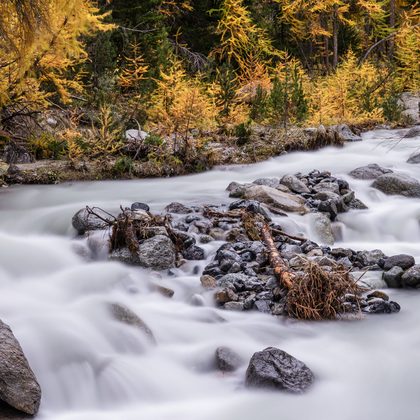
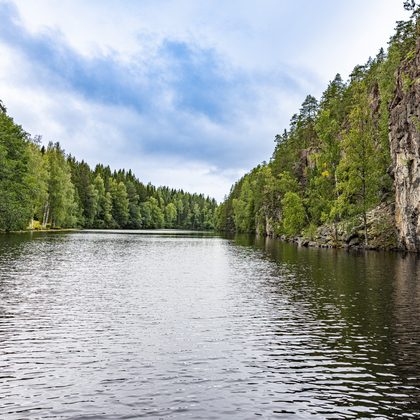
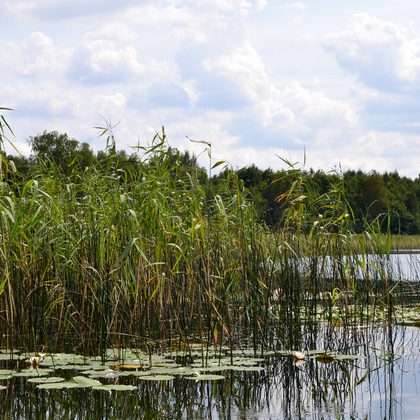
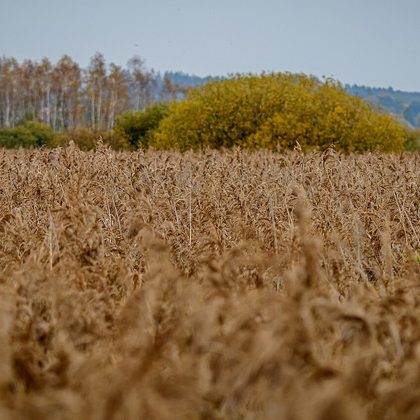
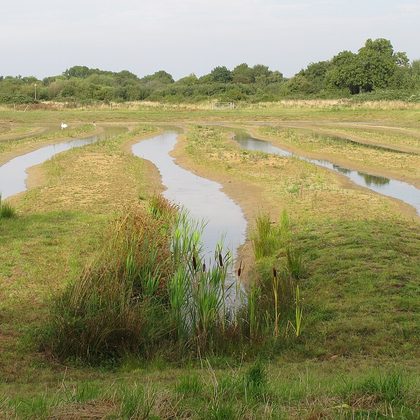
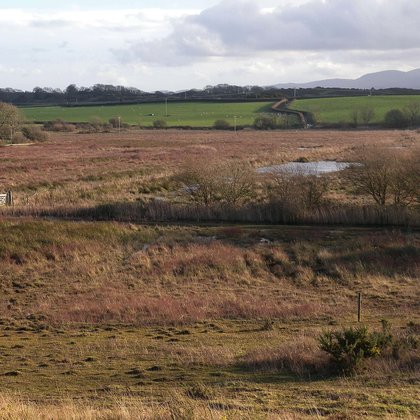
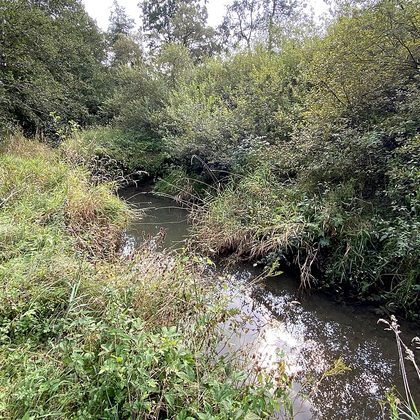
The Water Shrew lives by clean, slow-flowing to still water with a rough, well-vegetated bank: streams, rivers with quiet backwaters, ditches, ponds, lakes, watercress beds, reed and sedge fen and wet grassland. Typical features are a sandy or stony bed, undercut banks with exposed roots and plenty of freshwater shrimps, water slaters and insect larvae. In the uplands it lives along cold, fast mountain streams. Outside the breeding season animals are also trapped some way from water, in damp woodland, rough grassland and neglected gardens. Dense conifer plantations and heavily fertilised, closely mown banks are avoided.
Where the animal is most at home, classified with EUNIS — the European standard for habitats.
Distribution
The Water Shrew occurs from Britain and the north of the Iberian Peninsula through almost all of Europe and Siberia to the Pacific, and north beyond the Arctic Circle in Scandinavia. It is absent from Ireland, the Isle of Man, Iceland and most Mediterranean islands. In the Iberian Peninsula it lives only in the north, mainly in the Cantabrian Mountains, the Pyrenees and their foothills, as the subspecies N. f. niethammeri, whose taxonomic rank is disputed and which may merit species status; there it shares rivers with Cabrera's Water Shrew and the Pyrenean Desman. In Britain it is widespread but patchy in England, Wales and Scotland, including a number of islands; British animals have been described as the subspecies N. f. bicolor. In France, Germany and Scandinavia it is common and more continuously distributed. In the Netherlands the distribution is highly fragmented: the largest concentrations are in the wetter parts of Friesland and Overijssel, with others in stream and river valleys in the east and south, in seepage areas, on Texel and on the islands of Zeeland. In Belgium the species occurs locally, tied to clean stream valleys and marshes.
- Native
- dark = core range, pale = thinly spread
Way of life
The Water Shrew is active round the clock in eight to eleven bouts of about an hour and a half, with peaks after sunset and before sunrise. It hunts on land and in water; dives usually last 2 to 10 seconds, rarely more than half a minute, at depths of 30 cm to 2 m. Because the air in its fur makes it buoyant, it has to drive itself to the bottom with strong strokes of the hind feet. The food is water slaters, freshwater shrimps, caddis and midge larvae, water snails and beetles, supplemented by earthworms and terrestrial insects and occasionally by small fish, tadpoles and small amphibians; each day it eats roughly half to all of its own body weight. The saliva is venomous and paralysing, allowing it to overpower prey of similar size. Breeding runs from April to September, with two or three litters a year of three to eight young after a gestation of 20 to 24 days, in a nest in a bank hole or among tree roots. Animals live 14 to 19 months. Outside the breeding season it is solitary; home ranges cover some tens to a few hundred square metres and shift with the water level.
Where and when to look
The best chance of a sighting is at dusk beside a clear stream or a well-vegetated ditch, sitting still with a view over shallow water: a swimming Water Shrew shows as a small, silvery body that dives repeatedly and leaves a trail of bubbles. By day stones, roots and overhanging banks can be searched for feeding sites with empty snail shells and for droppings. A method without trapping is the bait tube: a length of pipe a few centimetres across with a few mealworms, left for a week at the water's edge and then checked for droppings. Where several Neomys species occur, as in northern Spain, droppings are kept for DNA analysis. Live-trapping shrews requires an exemption in the Netherlands and a licence in Britain, among other countries. Barn Owl pellets collected near river valleys also yield jaws with which old sites can be confirmed.
Conservation status
Least Concern globally (LC, 2016), with a large range and a broadly stable population. Local declines do occur, and their causes are known: canalisation and hard revetment of streams and banks, intensive mowing and clearing of ditch sides, drainage, and water pollution, which affects the species' food first. The Water Shrew is therefore regarded as an indicator of clean, structurally varied water. In the Iberian Peninsula, where it shares its habitat with the Pyrenean Desman, the same pressures apply as to that species: water abstraction, reservoirs and loss of riparian vegetation. On the Dutch Red List of 2020 it is listed as not threatened, after being classed as Vulnerable in 1994 and 2009; it is protected in the Netherlands under the Environment and Planning Act and in Britain against killing and taking under Schedule 6 of the Wildlife and Countryside Act. It is listed on Appendix III of the Bern Convention, and several other countries, including Latvia and a number of Russian regions, include it on regional Red Lists.
Scientific name
Neomys fodiens | (Pennant, 1771)
Pennant described the species in 1771 as Sorex fodiens; because it was later moved to another genus, the author and year stand in brackets. Neomys is Greek, from neos, 'new', and mys, 'mouse'. fodiens is Latin for 'digging', the present participle of fodere, 'to dig', after the burrows the animal makes in the bank. The specimen the first description was based on came from Germany, Berlin.