All species › Hedgehogs, shrews and moles › Shrews › Mediterranean Water Shrew
Mediterranean Water Shrew | Neomys milleri
Millers waterspitsmuis | Musgaño de Miller
The Mediterranean Water Shrew is the smaller, less water-bound relative of the Water Shrew. Until 2015 it was treated together with the Iberian animals as Neomys anomalus; a multilocus DNA study then showed that the Iberian and the remaining European populations are two separate species that diverged about 400,000 years ago. The name milleri, given by Mottaz in 1907 to animals from Chesières in the Vaud Alps, passed to the species of most of Europe. In older literature, field guides and atlases it therefore appears as N. anomalus, often as Miller's Water Shrew.
No photograph of a living wild animal of this species with a suitable Creative Commons licence exists. Do you have one that meets the rules? Send it in.
Tracks
No sign belongs to this species alone. The droppings are small, black and packed with shiny chitin fragments, left on stones and roots at the bank and under cover in wet vegetation; by eye they cannot be told from those of the Water Shrew. The same applies to feeding sites with empty snail shells and to the tiny prints in silt. The species is therefore recorded mainly by live-trapping with measurement of hind foot and tail, by DNA analysis of droppings from bait tubes, and by dissecting owl pellets: the lower jaw has red-brown tooth tips like that of the Water Shrew but is smaller with a lower ascending ramus, so that a trained eye can separate the two in pellet material.
Identification
A medium-sized shrew, clearly smaller than the Water Shrew, with a blackish-grey to blackish-brown back and a pale, greyish-white belly, usually sharply demarcated. The tooth tips are red-brown. Its adaptations to water are weaker than in the Water Shrew: the hair fringes along the hind feet are shorter, and the keel of stiff hairs under the tail is poorly developed or absent. The ears are small and hidden in the fur. Head-body 6.4 to 7.5 cm, tail 4.3 to 5.3 cm, hind foot 14.5 to 16.4 mm, weight 9 to 15 g. These measurements come from Austrian animals, which belong to this species; the Iberian sister species has a longer tail and larger hind feet.
Similar species
The only serious confusion is with the Water Shrew (Neomys fodiens), which occurs throughout almost all of this species' range. In the field the two cannot be separated reliably. In the hand the working thresholds are a hind foot under 16.5 mm and a tail under 55 mm for the Mediterranean Water Shrew; the Water Shrew has a hind foot of 16 to 21 mm and a tail that can exceed 7 cm. The tail keel is unreliable, because in older Water Shrews it can wear away. Coat colour decides nothing: both species can have a white or a dark belly. In north-east Iberia it meets Cabrera's Water Shrew (Neomys anomalus), from which it cannot be told externally; there only DNA decides. Smaller shrews such as the Common Shrew lack swimming fringes and have a three-toned coat; the Crocidura shrews have white teeth and prominent ears. There is no Neomys other than the Water Shrew in Britain.
Habitat
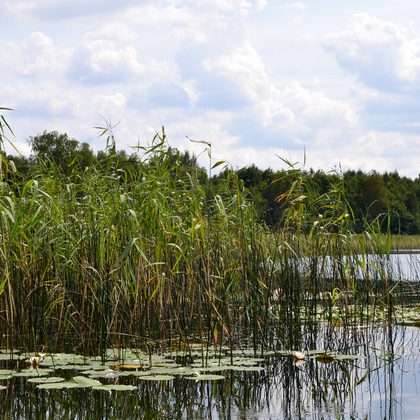
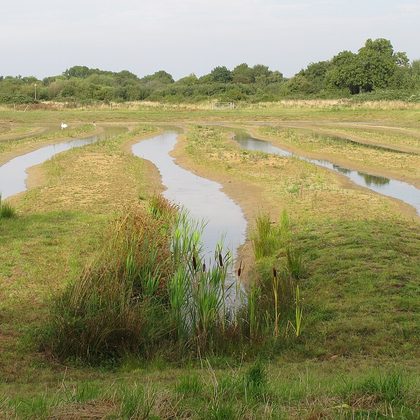
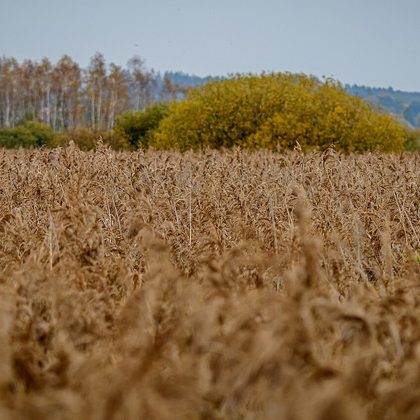
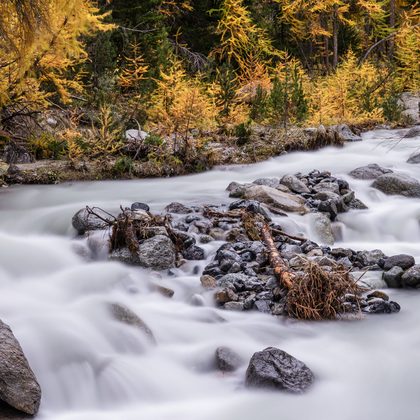
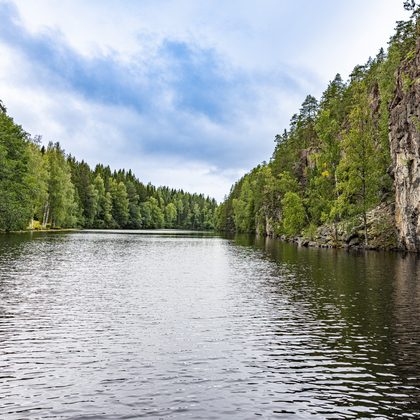
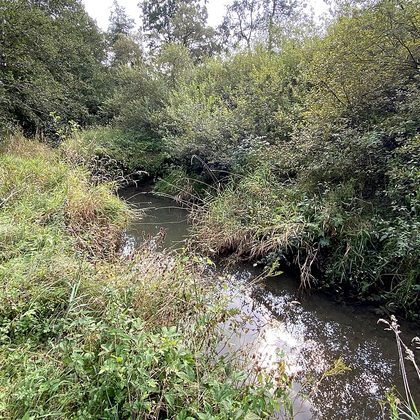
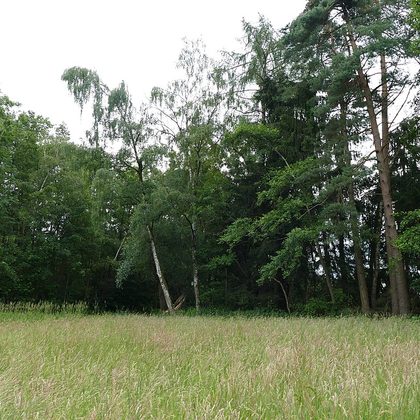
Banks of nutrient-rich waters with continuous cover of herbs and shrubs: small streams, ditches, moats, pond margins, marshes, wet hay meadows and alder carr. It is the least water-bound Neomys and is also caught some way from open water, in damp tall-herb vegetation, wet pasture and even irrigated gardens. Where it shares an area with the Water Shrew it takes the quieter, slower or still stretches, while the Water Shrew occupies the faster streams and open banks. It occurs from lowland into the mountains, to 1850 m in Austria and to about 2100 m elsewhere, but its centre of gravity is the lowlands and hills.
Where the animal is most at home, classified with EUNIS — the European standard for habitats.
Distribution
Much of continental Europe, from north-east Iberia and France east through central and eastern Europe to Russia and Ukraine, and south across the Balkans and Greece to Turkey and Iran. It is absent from Britain and Ireland and from Scandinavia, and thinly spread on the north-west European plain; in the Low Countries it is known from southern Belgium and Luxembourg. In southern Germany and Switzerland its range is fragmented; in Austria it occurs in every province. Because the name N. anomalus covered the Iberian animals too until 2015, older maps must be read region by region: everything outside Iberia, and part of Catalonia, belongs to this species.
- Native
- dark = core range, pale = thinly spread
Way of life
Mainly nocturnal, and shyer and less aggressive than the Water Shrew. Its food is more terrestrial than aquatic: earthworms, spiders, beetles and their larvae, insect larvae and snails, supplemented by aquatic insects and crustaceans. It is socially tolerant: animals live in small, open groups without a clear hierarchy and with little fighting, unlike most shrews. Breeding runs from May to September; a female has two or three litters a year of usually seven to twelve young after a gestation of about three weeks. Spring young become independent within a few weeks. There is no hibernation; in winter the animals stay active under the snow and in the litter layer.
Where and when to look
A Mediterranean Water Shrew cannot be identified by sight, and a record without a measurement or a sample remains 'water shrew sp.'. To prove the species there are three routes: owl pellets from barn owls hunting over wet grassland and stream valleys, with the small Neomys jaws among them; bait tubes with mealworms along a vegetated ditch, with the droppings collected for DNA analysis; and live-trapping with measurement of hind foot and tail, which in most countries requires a licence. When choosing sites, the rough, quiet margins of marshes and wet woodland are more promising than the clear streams where the Water Shrew hunts.
Conservation status
Least Concern (2023); the species was assessed separately for the first time after the split of N. anomalus. That verdict conceals that it is regarded as scarce in much of its range and that its distribution is fragmented. Threats are the drainage of wet grassland and marsh, the straightening and hard revetment of streams, the loss of rough bank vegetation and water pollution. It is protected in Ukraine and in several Russian regions, and several central European countries include it on their national Red Lists. Knowledge lags behind: because older data are filed under N. anomalus and the species cannot be told from the Water Shrew in the field, every map rests on trapping, pellets and DNA.
Scientific name
Neomys milleri | Mottaz, 1907
Mottaz described the species in 1907 and placed it straight away in the genus where it still stands. Neomys is Greek, from neos, 'new', and mys, 'mouse'. milleri honours the American mammalogist Gerrit Smith Miller Jr. (1869–1956), author of the Catalogue of the Mammals of Western Europe. The specimen the first description was based on came from Switzerland, Alpes Vaudoises.