All species › Rodents › Blind mole-rats › North Serbian Blind Mole-rat
North Serbian Blind Mole-rat | Nannospalax montanosyrmiensis
Nannospalax montanosyrmiensis | Nannospalax montanosyrmiensis
Nannospalax montanosyrmiensis, the North Serbian Blind Mole-rat, is probably the most threatened blind mole-rat in Europe and one of the most threatened mammals of the Balkans. The species lives on the Fruška Gora in Serbian Vojvodina and at a few sites on both sides of the Hungarian-Serbian border. Savić and Soldatović described the taxon in 1974, named after the hill where the animals were first karyotyped; the Mammal Diversity Database has treated it as a species since 2024. In Serbian it is called vojvođanski slepo kuče, in Hungarian délvidéki földikutya. Externally it cannot be distinguished from the related species, and the number of remaining animals is estimated at a few hundred at most.
No photograph of a living wild animal of this species with a suitable Creative Commons licence exists. Do you have one that meets the rules? Send it in.
Tracks
For most observers earth mounds are all that can be seen of this species, and in Serbia and Hungary they form the basis of surveys. They are broad, low mounds of coarse clods without a visible tunnel opening (the tunnel is sealed from inside), running through the grass in a meandering line twenty to thirty metres apart and following the main tunnel. The tunnels are five to seven centimetres wide; when confirming a colony researchers look for the smooth, inwardly compacted tunnel wall, gnawed roots and store chambers. A molehill is smaller, higher, finer-grained and comes from a vertical shaft; in Hungarian fieldwork a mound only counts as a mole-rat's at a base diameter of more than sixty centimetres. A mound identifies the genus, not the species: a mole-rat mound on the Fruška Gora is almost certainly of this species, but that follows from the locality, not from the mound.
Identification
As in all blind mole-rats: a neckless, cylindrical burrower with a broad, flat, wedge-shaped head, a bare triangular nose pad and a bristly pale fringe running back from it. The fur is velvety and lies in any direction, brownish grey with a yellow or rufous tinge and a greyer belly; the yellow to orange incisors protrude in front of the lips. There are no ear pinnae, no visible eyes and no external tail. No body measurements have been published for this species; those of the Lesser Blind Mole-rat are not adopted. The species character is karyological: 2n = 54 chromosomes with a fundamental number NF = 86, which distinguishes it from N. monticola (54/84) and from the syrmiensis form of the Srem plain (54/90), which replaces it in the lowland.
Similar species
No external character separates this species from the related species. The forms of the leucodon complex differ in chromosome number, fundamental number and DNA; crossing experiments between forms produced no embryos, and their species status rests on that. Here chromosome number is not sufficient either, because N. monticola and N. serbicus also have 54 chromosomes; only the fundamental number separates them. In the field locality is therefore the only information, and the range is small: the Fruška Gora and adjoining Vojvodina, plus the border area at Kelebia and Ásotthalom. Further north and east the range of N. hungaricus begins; the Srem plain held syrmiensis; the mountains to the south hold N. montanoserbicus. On site only the mole (smaller, spade-shaped forefeet, short tail) and the Water Vole (ears, eyes and a long tail) can be excluded. A record is entered as 'blind mole-rat', with coordinates; the species requires a karyotype.
Habitat
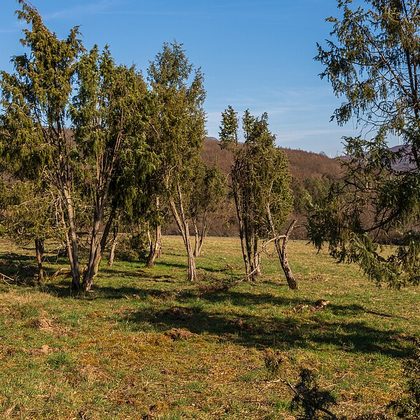
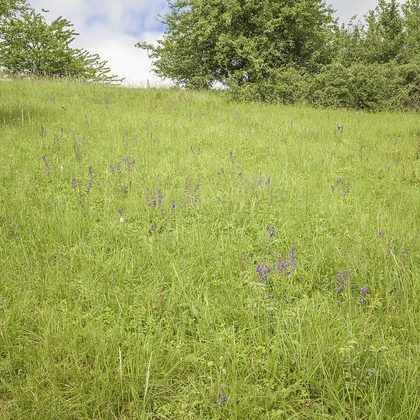
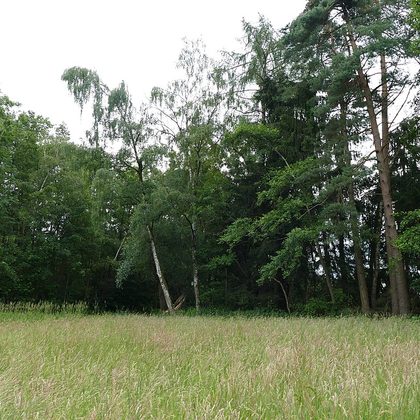
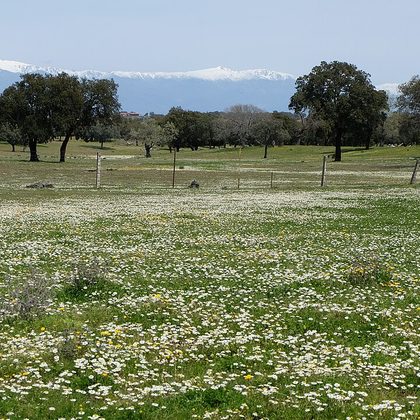
Steppe-like grassland, mountain steppe and sand steppe on deep, loose, well-drained soil; wet and marshy ground is avoided. In practice this means the southern and eastern slopes of the Fruška Gora, loess hillocks, road verges, orchard margins, fallow corners and old pasture, and the sand steppe of the Hungarian-Serbian border area. Despite the prefix montano- in the name, it is not a mountain animal: the Fruška Gora is a low range of hills nowhere higher than about 540 metres, and the sites at Kelebia and Ásotthalom lie in the lowland sand steppe.
Where the animal is most at home, classified with EUNIS — the European standard for habitats.
Distribution
One of the smallest ranges of any European mammal: the Fruška Gora and its immediate surroundings in Serbian Vojvodina, plus a few sites in southern Hungary at Kelebia and Ásotthalom, and possibly in Bosnia and Herzegovina and Croatia. The type locality is the Fruška Gora. The limits are poorly known: at every new site animals must be trapped and karyotyped to establish the species, which for an animal that almost never comes above ground and is strictly protected requires much effort. Blind mole-rats are absent from western and northern Europe and from the Iberian Peninsula.
Way of life
As far as known, like that of the related species: solitary, active around the clock with most digging at the beginning and end of the day, without hibernation or winter dormancy; the winter is bridged with store chambers of bulbs, tubers and roots. One animal occupies and defends one burrow system; conspecifics are tolerated only in the mating season, at the end of winter. After a gestation of about thirty days two to four young are born in March or April; females first breed in their second year. This low reproductive rate determines the vulnerability of this species: with a population of at most a few hundred animals on a few square kilometres, a lost colony can hardly be restored. Predators are Red Fox, Polecat, Stoat, feral dogs and cats, and owls.
Where and when to look
The animal itself is almost never seen. Signs can be searched for in March or April at the southern foot of the Fruška Gora, along grassland edges and old orchards, where a line of low mounds indicates a colony; fresh, dark, coarsely clodded soil means the system is occupied. Keep your distance, do not enter protected ground without permission, dig nothing up and leave the mounds intact; with a species of so few animals, disturbance of a colony has consequences. Report finds to Serbian or Hungarian conservation organisations: in this species new sites are still being discovered by observers.
Conservation status
Not evaluated by the IUCN. The Red List recognises only the collective species Nannospalax leucodon, assessed as Least Concern; that assessment does not apply to this species. The only separate assessment is that of Csorba and colleagues in 2015, who classed montanosyrmiensis as Critically Endangered: an extent of occurrence of at most a hundred square kilometres, an area of occupancy of less than ten, three known localities, and a demonstrable decline in both the animals and their habitat. A Serbian review in 2022 arrived at Endangered to Critically Endangered. The causes are urbanisation, large-scale agriculture, road construction, the burning of vegetation and control as an agricultural pest. Taxonomy also affects protection: as long as these animals are officially regarded as a chromosomal form of a species not threatened, they fall outside the scope of conservation instruments.
Scientific name
Nannospalax montanosyrmiensis | (Savić & Soldatović, 1974)
Savić & Soldatović described the species in 1974 as Spalax montanosyrmiensis; because it was later moved to another genus, the author and year stand in brackets. Nannospalax joins Greek nannos, 'dwarf', to Spalax: the small blind mole-rat. montanosyrmiensis means 'of the uplands of Syrmia', Serbian Srem between the Danube and the Sava, named after the Roman city of Sirmium; the upland is the Fruška Gora. The specimen the first description was based on came from Serbia, Fruška gora.