All species › Rodents › Blind mole-rats › Central Serbian Blind Mole-rat
Central Serbian Blind Mole-rat | Nannospalax montanoserbicus
Nannospalax montanoserbicus | Nannospalax montanoserbicus
Nannospalax montanoserbicus, the Central Serbian Blind Mole-rat, is the blind mole-rat of the Serbian and Montenegrin mountain pastures. Savić and Soldatović described the taxon in 1974 from animals from Zlatibor. The range consists of a series of isolated mountain pastures above about seven hundred metres, each with its own population and separated from the next by forest or valley, without exchange of animals. In this isolation chromosomal forms arose that no longer interbreed; for this reason the Mammal Diversity Database has treated them as separate species since 2024.
No photograph of a living wild animal of this species with a suitable Creative Commons licence exists. Do you have one that meets the rules? Send it in.
Tracks
Fieldwork concerns earth mounds in mountain pastures, which are locally numerous. They are broad, low mounds of coarse clods without a visible opening, in a meandering line twenty to thirty metres apart along the main tunnel, which with side tunnels can be tens of metres to nearly two hundred metres long. The tunnels are five to seven centimetres in diameter; the shallow feeding tunnels lie at fifteen to twenty-five centimetres, the grass-lined nest chamber deeper. On high, closely grazed pastures the distinction from the mole is important and sometimes difficult: a molehill is smaller, higher, much finer-grained and comes from a vertical shaft, whereas a mole-rat mound spreads broadly and in Hungarian fieldwork only counts at a base diameter of more than sixty centimetres. There are also gnawed rhizomes and bulbs in the tunnel, small patches where a plant has been pulled down from below, and skull remains in pellets of Eagle Owl and Barn Owl. A mound proves the genus; the species follows from altitude and locality.
Identification
Externally like the other blind mole-rats: cylindrical and neckless, with a broad, flat head, a large bare nose pad, a bristly pale fringe running back from the nose and velvety brownish-grey fur with a yellow or rufous tinge. The yellow to orange incisors protrude in front of the lips, so that the animals can bite into the soil with the mouth closed. Ear pinnae are absent, the eyes are millimetre-sized lenses beneath a closed fold of skin, and there is no external tail. No head-body lengths, tail lengths or weights have been published for this species; those of the Lesser Blind Mole-rat are not adopted. The species is defined by the karyogram: 2n = 56 chromosomes, with a fundamental number given in the literature as 80 or 82, and a small metacentric autosome pair shared with the other forms of what Savić called the Yugoslav branch.
Similar species
A living blind mole-rat cannot be assigned to a species by its appearance. The forms are practically identical in fur, size, head shape and tooth colour, and the differences fall within the variation of each form. Chromosome number is not always decisive either: this species has 2n = 56, like the Lesser Blind Mole-rat and the Greek form epiroticus; only the fundamental number separates them. In the field altitude and locality are therefore the only clues: mountain grassland above about seven hundred metres in central and western Serbia, Montenegro, Kosovo and northern Albania. Vojvodina holds N. montanosyrmiensis (on the Fruška Gora and in the sand steppe near Subotica) and N. hungaricus, in the valleys to the east N. serbicus and to the west, in Bosnia, N. monticola. What can be separated are the mole (smaller, spade-shaped forefeet, short tail) and the Water Vole (normal ears and eyes, tail about a third of body length). A blind mole-rat on a verge is recorded as 'blind mole-rat', without a species name.
Habitat
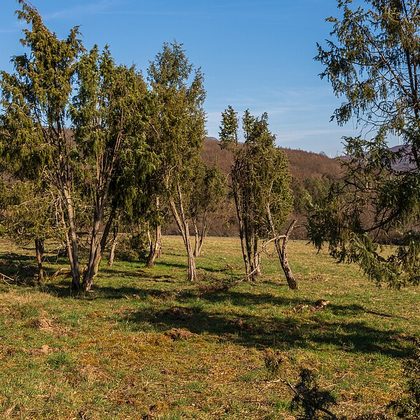
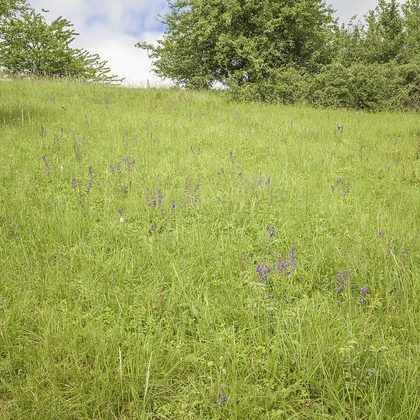
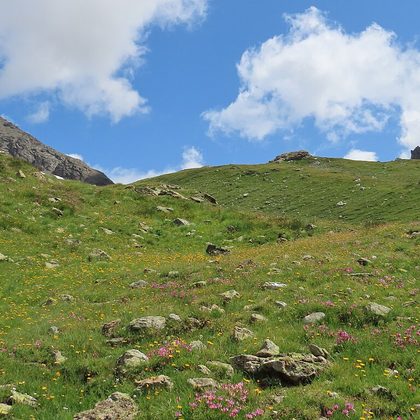
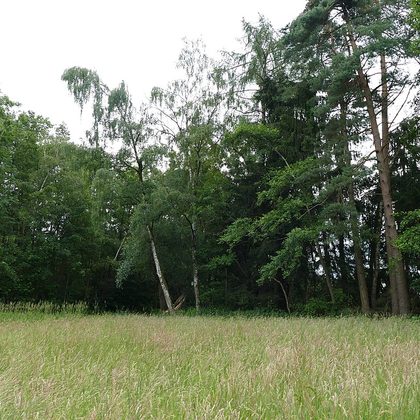
Mountain pastures, hay meadows and dry grassland on karst plateaus and ridges of the central Balkans, generally above seven hundred metres, on deep, loose soil between rocks. The species lives on sheep pastures, unmown margins and grassland patches within montane forest; closed woodland, rock and wet ground are avoided. Suitable terrain lies fragmented between forest and valleys, so that each population is isolated. This isolation explains the origin of the species.
Where the animal is most at home, classified with EUNIS — the European standard for habitats.
Distribution
The mountains of central and western Serbia, with Zlatibor as the type locality, and further Montenegro, Kosovo and northern Albania, and possibly eastern Bosnia and Herzegovina. The range is fragmented into isolated mountain areas, and the limits are unknown: establishing them requires trapping and karyotyping, which have been carried out only to a limited extent since the original work of Savić and Soldatović. Maps from before 2024 show this area, together with much of the Balkans, under the name Nannospalax leucodon. Blind mole-rats are absent from western and northern Europe and from the Iberian Peninsula.
Way of life
Little has been recorded for this species separately; the following applies to the complex. The animals live strictly underground and solitarily, are active around the clock with most digging at the beginning and end of the day, and do not hibernate: in the mountain winter, under a thick snow cover, they live on store chambers of bulbs, tubers and rhizomes laid down in autumn. One burrow system is the territory of one animal, which tolerates no conspecifics outside the mating season at the end of winter. After a gestation of about thirty days two to four young are born, usually in March or April; females first breed in their second year. At these altitudes digging is strongly seasonal: most fresh mounds appear in late spring, when the ground thaws. Predators are Red Fox, Stoat, Polecat, shepherd dogs and Eagle Owl.
Where and when to look
In May or June, as soon as the snow has gone and the grass is still short, visit the mountain pastures of Zlatibor, Golija or Tara and search open meadows for a line of low, broad mounds running through the grass tens of metres apart; fresh mounds are dark and coarsely clodded. The animal itself hardly ever comes above ground. Waiting a few metres from a fresh mound, it is sometimes possible to see new soil being pushed out from inside. Record coordinates and altitude, as in this group locality is the only identification character, and otherwise leave the mounds undisturbed.
Conservation status
Not evaluated by the IUCN. The Red List recognises only Nannospalax leucodon as a whole and assesses it as Least Concern; that assessment says nothing about this species. The Serbian review of 2022 did not include it among the acutely threatened forms, but explicitly named it as a species requiring monitoring. The species lives in a series of small, mutually isolated mountain populations, any one of which can disappear without this being noticed or replenished from elsewhere. The threats are those of Balkan mountain pasture: the decline of extensive sheep farming, which lets pastures become overgrown with scrub and forest, and also grassland conversion, road construction, ski development and the burning of vegetation. As long as these animals are officially regarded as a chromosomal form of a species not threatened, they appear on no protection list.
Scientific name
Nannospalax montanoserbicus | (Savić & Soldatović, 1974)
Savić & Soldatović described the species in 1974 as Spalax montanoserbicus; because it was later moved to another genus, the author and year stand in brackets. Nannospalax joins Greek nannos, 'dwarf', to Spalax: the small blind mole-rat. montanoserbicus means 'Serbian of the uplands', from Latin montanus, 'of the mountains', and serbicus; Savić and Soldatović described the animal from Zlatibor. The specimen the first description was based on came from Serbia, Zlatibor.