All species › Rodents › Blind mole-rats › Montane Blind Mole-rat
Montane Blind Mole-rat | Nannospalax monticola
Nannospalax monticola | Nannospalax monticola
Nannospalax monticola, the Montane Blind Mole-rat, is the blind mole-rat of the Kupreško Polje, the high karst plain in central Bosnia from which Nehring described the species in 1898. The name monticola was used for more than a century as a collective name for the blind mole-rats south of the Danube, and hellenicus, insularis and serbicus were originally described as its subspecies. Since the reclassification of the group by the Mammal Diversity Database in 2024, N. monticola has been restricted to the Dinaric uplands of Bosnia and Herzegovina and Croatia.
No photograph of a living wild animal of this species with a suitable Creative Commons licence exists. Do you have one that meets the rules? Send it in.
Tracks
On the karst plains the earth mounds are the sign; they are easy to find because the poljes are flat and closely grazed. They are broad, low, coarsely clodded mounds without an opening, in a meandering line twenty to thirty metres apart along the main tunnel, which with side tunnels can be nearly two hundred metres long and cover several hundred square metres. The tunnels are five to seven centimetres wide; the feeding tunnels are shallow, the grass-lined nest chamber and store chambers deeper. The distinction from the mole, which occurs on the same meadows, is of practical importance here: molehills are smaller, higher and much finer-grained and come from a vertical shaft, whereas a mole-rat mound spreads broadly and under the Hungarian field protocol only counts at a base diameter of more than sixty centimetres. There are also gnawed rhizomes and bulbs in opened tunnels, and skulls in pellets of Barn Owl, Little Owl and Eagle Owl; in this upland country pellets are often the only material evidence.
Identification
A blind mole-rat of the usual build: cylindrical, neckless and heavily built in front, with a broad, flat, wedge-shaped head, a large bare triangular nose pad and a bristly pale fringe running back from the nose to about halfway to the ear region. The fur is velvety, brownish grey with a yellow or rufous tinge; the incisors are yellow to orange and protrude in front of the lips. Ear pinnae, visible eyes and an external tail are absent. No separate head-body lengths, tail lengths or weights have been published for this species; those of the Lesser Blind Mole-rat are not adopted. The identifying character is the karyotype: 2n = 54 chromosomes with a fundamental number NF = 84, measured on animals from the Kupreško Polje.
Similar species
This species cannot be recognised externally. It shares its chromosome number of 54 with N. montanosyrmiensis and N. serbicus; only the fundamental number (84 against 86 and 98) separates them, and this is determined not in the field but under a microscope on a stained bone-marrow preparation. Appearance, size, coat colour and head shape give no indication. In the field locality is decisive: the Dinaric uplands of Bosnia and Herzegovina, with the Kupreško Polje as the core area. To the east lie the mountains of N. montanoserbicus, to the north the Vojvodina with N. montanosyrmiensis and N. hungaricus, to the south-east the valleys of N. serbicus. The mole (half the size, spade-shaped forefeet, short tail) and the Water Vole (normal ears, eyes and a long tail) can be excluded with certainty. A blind mole-rat in a Bosnian polje is recorded as 'blind mole-rat', with the locality.
Habitat
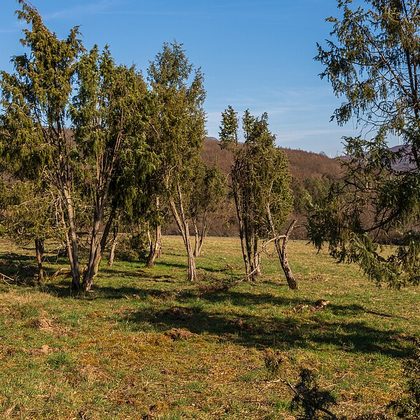
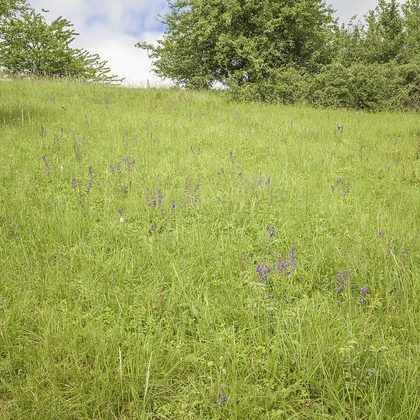
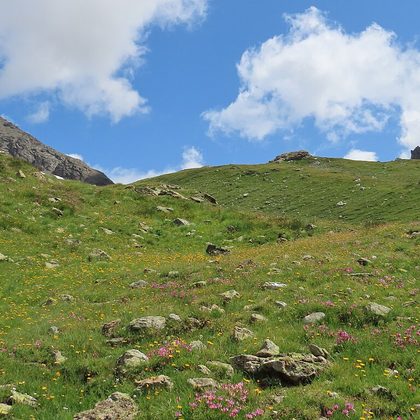
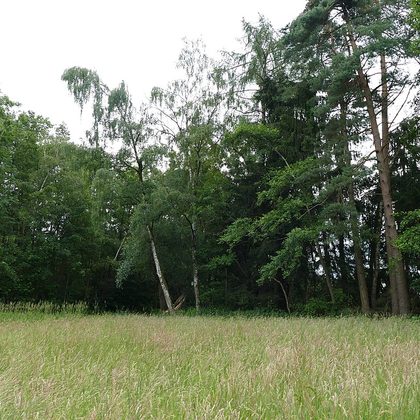
Grassland and hay meadow on deep, loose soil in the Dinaric karst: the flat floors of the poljes, sheep pastures on the plateaus, small hay meadows around hamlets and unmown margins between stone piles. The Kupreško Polje, the type locality, lies at over 1,100 m. In karst landscape suitable soil is scarce and sharply bounded: where limestone lies at the surface no digging is possible, so the species is confined to places with sufficiently deep weathered soil, such as poljes, dolines and stream valleys. Woodland, rock and waterlogged ground are avoided.
Where the animal is most at home, classified with EUNIS — the European standard for habitats.
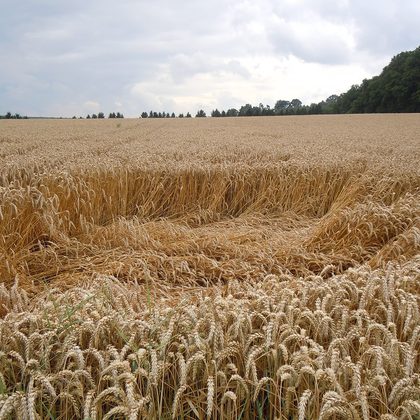
Distribution
The uplands of Bosnia and Herzegovina, with the Kupreško Polje in the centre of the country as the type locality, and according to the Mammal Diversity Database also Croatia. The range is fragmented; each polje forms a separate habitat. The boundary with the forms to the east and north is not precisely known, because this requires trapping and karyotyping, which have hardly been carried out in this part of the Balkans since the 1970s and 1980s. Maps from before 2024 show this area under the name Nannospalax leucodon. Blind mole-rats are absent from western and northern Europe and from the Iberian Peninsula.
Way of life
Almost nothing has been described from direct observation of this species; the following applies to the complex. The animals live solitarily and almost entirely underground, are active around the clock with most digging at the beginning and end of the day, and do not hibernate: in the karst winter, which is long and snowy at this altitude, they live on store chambers filled in autumn with bulbs, tubers and thick roots. One animal occupies one system and tolerates no conspecifics except in the mating season at the end of winter. Gestation is about thirty days; two to four young are born in March or April, and females have their first litter only in their second year. Predators are Red Fox, Stoat, Polecat, shepherd dogs and Eagle Owl. For most aspects of the way of life there are no data.
Where and when to look
In May or June, as soon as the snow has gone and the meadows are still short, visit a polje such as the Kupreško, Glamočko or Livanjsko Polje, and search the flat floor for a line of low mounds tens of metres apart; fresh soil is dark, damp and coarsely clodded. Compare with nearby molehills; side by side the differences in shape and grain are clear. The animal itself is almost never seen. Record place and altitude, leave the mounds intact and report the find: knowledge of the distribution rests largely on fieldwork from half a century ago.
Conservation status
Not evaluated by the IUCN. The Red List recognises only the collective species Nannospalax leucodon, assessed as Least Concern; that assessment says nothing about this species. The researchers who reclassified the group point out that several species of the complex are threatened, enjoy no protection and have never been assessed separately. The size and trend of the Bosnian populations are unknown. In Croatia the blind mole-rat was considered extinct from 1984; in 2023 it was rediscovered at Vučedol on the Danube, after which a small project began to map the site. The Mammal Diversity Database includes Croatia in the range of this species, but Vučedol lies in Srem, the area of the lowland forms, and which species lives there has not been established. The threats are grassland conversion, the decline of extensive sheep farming, which lets the poljes become overgrown, and control as an agricultural pest.
Scientific name
Nannospalax monticola | (Nehring, 1898)
Nehring described the species in 1898 as Spalax monticola; because it was later moved to another genus, the author and year stand in brackets. Nannospalax joins Greek nannos, 'dwarf', to Spalax: the small blind mole-rat. monticola is Latin for 'mountain-dweller', from mons, 'mountain', and colere, 'to inhabit'; Nehring described the animal from the uplands at Kupres in Bosnia. The specimen the first description was based on came from Bosnia and Herzegovina, Kupres.