All species › Bats › Vesper bats › Nathusius's pipistrelle
Nathusius's pipistrelle | Pipistrellus nathusii
Ruige dwergvleermuis | Murciélago De Nathusius
Nathusius's Pipistrelle is one of the few European bats that migrate over long distances: it breeds mainly in north-eastern Europe and winters in the south-west. Forearm 32 to 37 mm, weight about 6 to 15.5 grams. Von Keyserling and Blasius described it in 1839 as Vesperugo nathusii from Berlin. An animal ringed in Latvia was recovered 2224 km away in northern Spain, and in 2022 a movement of 2486 km from Russia to the French Alps was published.
Tracks
Roosts are in hollow trees, bird and bat boxes, rock crevices, expansion joints of bridges, houses and other buildings, behind timber cladding and in wooden churches. Maternity colonies hold a few tens to a few hundred animals and are often shared with Common Pipistrelle, Brandt's Bat and Pond Bat. Winter roosts are in rock crevices, cliffs, caves, mines and buildings in towns, which presumably benefit from the urban heat. During migration the animals have been caught or recorded on offshore platforms and fishing boats; with detectors on ferries across the southern North Sea the species was recorded in May, September and October up to 106 km offshore. In the mating season males hold a territory at swarming sites, which they defend against other males, and call there.
Identification
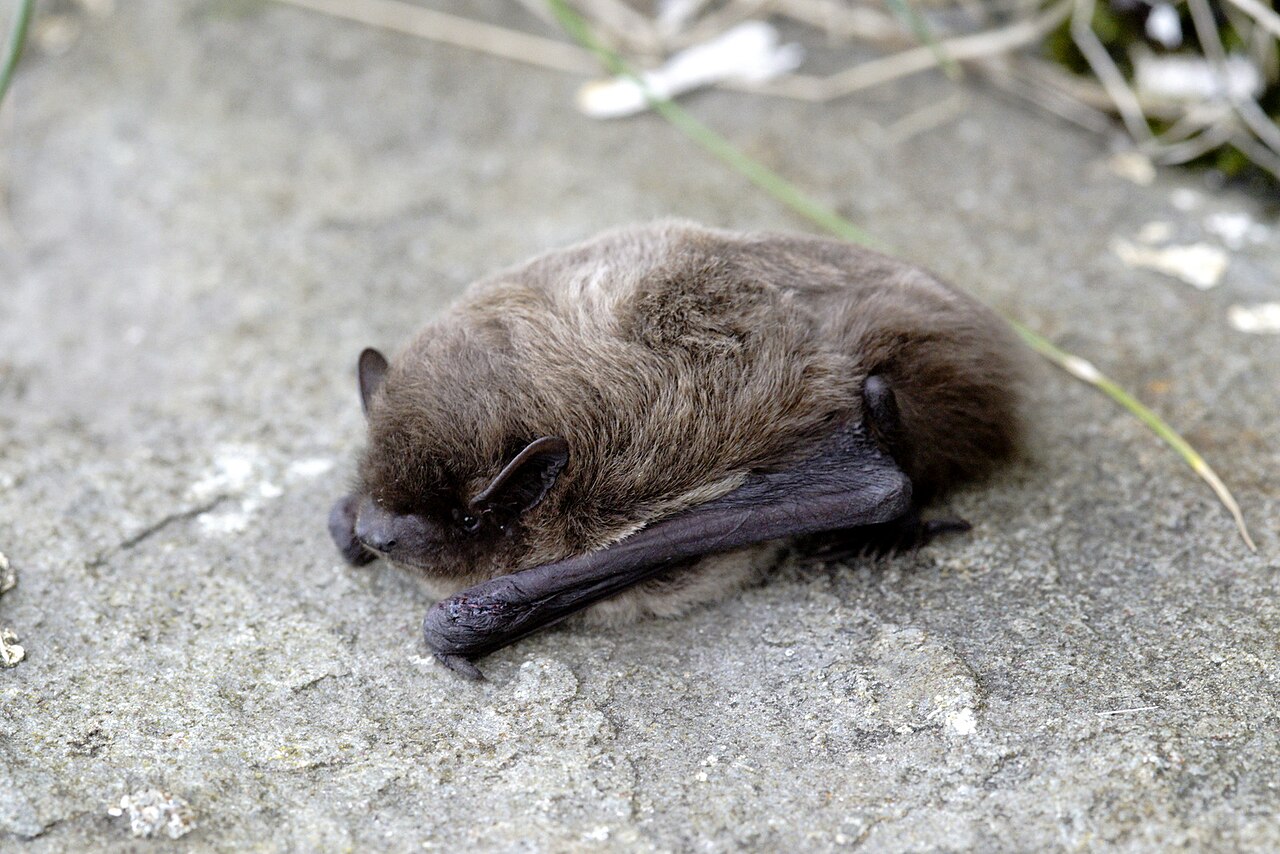
A small bat, slightly larger than the Common Pipistrelle, with long, uniformly coloured fur; the underparts are slightly paler or more yellowish than the back. The colour changes with the season: dark brown or greyish brown in winter, reddish in summer. The tail membrane is furred over its inner half. The bare skin is dark brown and the snout short and rounded; the ears are short and triangular, with a slender, rounded tragus. The wings are long for a pipistrelle (wingspan 23 to 25 cm). In the wing venation the cell between elbow and fifth finger is divided by a clear vein; this character is used but is not always reliable. The inner upper incisor has two cusps. Flight is less erratic than in the other pipistrelles, straighter and more predictable. Search calls have a 'hockey-stick' shape: a frequency-modulated sweep with a quasi-constant end, with the peak around 38 to 43 kHz (41 kHz on average in Britain) and a duration of up to 12 ms.
Similar species
Kuhl's Pipistrelle (Pipistrellus kuhlii) is about the same size and calls with a peak of 34 to 41 kHz; the search calls cannot be reliably separated, but the social calls can, and recordings of flying bats are assigned by them. Kuhl's usually has a white wing border, shorter fur, a different wing venation and a single-cusped inner upper incisor. The Common Pipistrelle (P. pipistrellus) is smaller, with shorter wings, and calls higher (42 to 51 kHz); the Soprano Pipistrelle (P. pygmaeus) calls higher still (50 to 60 kHz) and has a clearly smaller nose. Calls of Savi's Pipistrelle (Hypsugo savii, 30 to 35 kHz) can also be confused with those of Nathusius's. In cluttered surroundings the pulses become strongly modulated and resemble those of Myotis species; in open space the frequency-modulated part may disappear.
Habitat
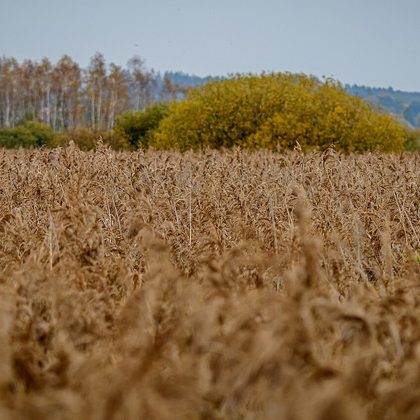
From lowland to alpine zones, from sea level to about 2200 m in the Alps (probably single vagrants). The species selects woodland, woodland edges, wetlands, open ground and grassland; within woodland deciduous, lowland, riparian and coniferous forest, and also urban gardens with isolated trees. It seeks out ponds, lakes and other water and is common in wetlands, swamp forest and floodplains, especially on migration. In the wintering areas it prefers to hunt over natural wetlands and avoids farmland and pasture. Hunting takes place at 3 to 20 m along woodland edges, avenues, forest tracks and over water, from small ponds to large lakes, and sometimes over the sea.
Where the animal is most at home, classified with EUNIS — the European standard for habitats.






Distribution
Most of Europe, from Ireland and the Iberian Peninsula east to Russia and western Kazakhstan, also Turkey and the Caucasus, and Mediterranean islands such as Crete and Mallorca. Maternity colonies are known only from northern and eastern Europe: Great Britain, eastern Germany, the Baltic states, Belarus, Ukraine and Russia. The species winters in the south-west. It used to be reported mainly in the north but is now recorded more often in the south, and in recent decades it has been reported or established in the Netherlands, the United Kingdom, Switzerland, Italy and Spain. Ringing has shown movements between southern England and the continent, including the Dutch coast, Latvia and Lithuania.
- Native
- dark = core range, pale = thinly spread
Way of life
Nocturnal; Nathusius's Pipistrelle emerges at dusk to catch flying insects. The food consists of flies and moths, especially non-biting midges, mosquitoes and blackflies; the composition differs between the maternity, swarming and migration periods. During the maternity period foraging areas lie less than 6.5 km from the colony. Mating runs from June to November: in the maternity colonies, on migration and at swarming and wintering sites. In June mostly twins are born, and at the end of July the animals leave the colonies. Young females are sexually mature in their first year. Migration runs from August to October or November; females leave before males. The animals presumably follow coastlines, but have also been caught over high mountains and along rivers. In Latvia a strategy of flying and foraging along the way has been described during migration. Record distances are 2224 km, from Pape Nature Park in southern Latvia to the Laguna de Pitillas nature reserve in northern Spain, ringed on 21 August 2015 and recovered on 12 March 2017 (Alcalde et al. 2020), and 2486 km, from Russia to the French Alps (Vasenkov et al. 2022). Hibernation runs from midwinter to early spring. The greatest known age is 13 years.
Where and when to look
Outside the breeding area the best chance of a record is on migration in September and October, along coasts, large lakes, rivers and wetlands. A bat detector at 38 to 42 kHz picks up the calls; they can be separated from those of Kuhl's Pipistrelle only by the social calls. From the Common Pipistrelle the call differs in pitch: a peak clearly below 42 kHz does not fit the Common Pipistrelle. The straight, less erratic flight along a woodland edge or over water is a clue.
Conservation status
Least Concern (2016). The species is not numerous but is widespread. Because it is one of the few long-distance migrants among European bats, changes to and fragmentation of habitat and flight routes may hamper its movements. As direct threats the handbook names disturbance and destruction of roosts, the loss of old trees in wetlands and direct persecution. Like all bats in the European Union, Nathusius's Pipistrelle is listed in Annex IV of the Habitats Directive and is covered by the EUROBATS Agreement.
Scientific name
Pipistrellus nathusii | (von Keyserling & J. H. Blasius, 1839)
Von Keyserling & J. H. Blasius described the species in 1839 as Vesperugo Nathusii; because it was later moved to another genus, the author and year stand in brackets. Pipistrellus is formed from Italian pipistrello, 'bat', which goes back to Latin vespertilio, from vesper, 'evening'. nathusii honours Hermann Engelhard von Nathusius (1809–1879), the German agriculturist and zoologist known for his work on breeds of domestic animals. The specimen the first description was based on came from Germany, Berlin.