All species › Bats › Vesper bats › Common Pipistrelle
Common Pipistrelle | Pipistrellus pipistrellus
Gewone dwergvleermuis | Murciélago Enano
The Common Pipistrelle (Pipistrellus pipistrellus) is the most numerous bat in Europe and the species that hunts around street lamps and between rooftops on summer evenings: small, with a fast, erratic flight. Its roosts are almost always in buildings, in wall crevices and behind cladding. It weighs 3.5 to 8 g.
Tracks
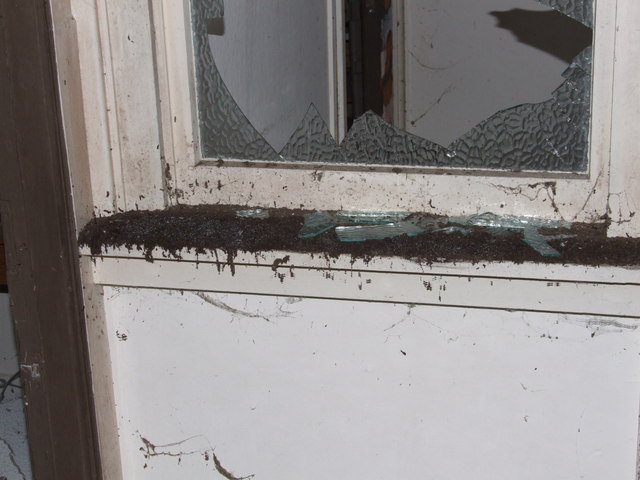
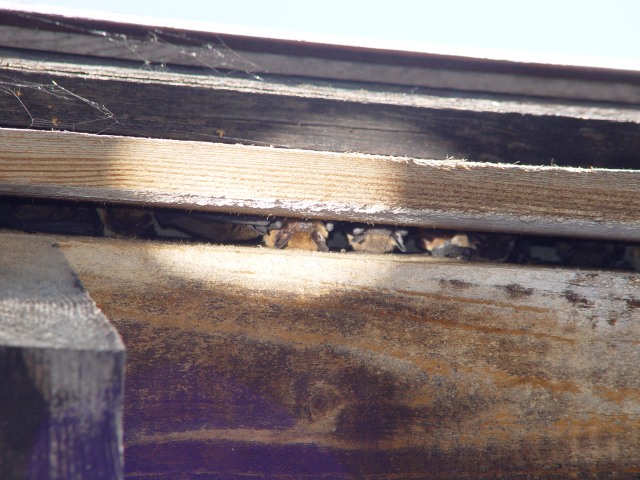
The species lives in buildings, and that is where its signs are found. Below a gap in the wall, beneath the fascia, behind cladding or where tile meets brickwork lie the droppings: 5 to 8 mm long and barely 2 mm thick, black, dry and slightly curved, as a streak or small pile on a windowsill, a doorstep or a loft floor. The decisive difference from a mouse dropping is the texture: bat droppings are brittle and crumble into glittering insect remains in which wings and legs can be seen with a lens, whereas mouse droppings stay hard, smear and smell of urine. Around the access gap there are often dark grease and urine stains on the render, and in a loft a band of droppings lies below the colony. Prey remains are absent: a pipistrelle eats small prey on the wing, so that, unlike with long-eared or horseshoe bats, no moth wings lie under a feeding perch. The most useful sign is countable behaviour: 15 to 30 minutes after sunset, with the house behind the observer, the animals emerging one by one from the same crevice can be counted; this is how a maternity colony is censused. In August and September the males' song can be heard, a series of dry clicks with a gurgling ending, given on a fixed circuit along the housefronts; on a detector the sound carries far in late summer.
In its habitat
Head close-up
Identification
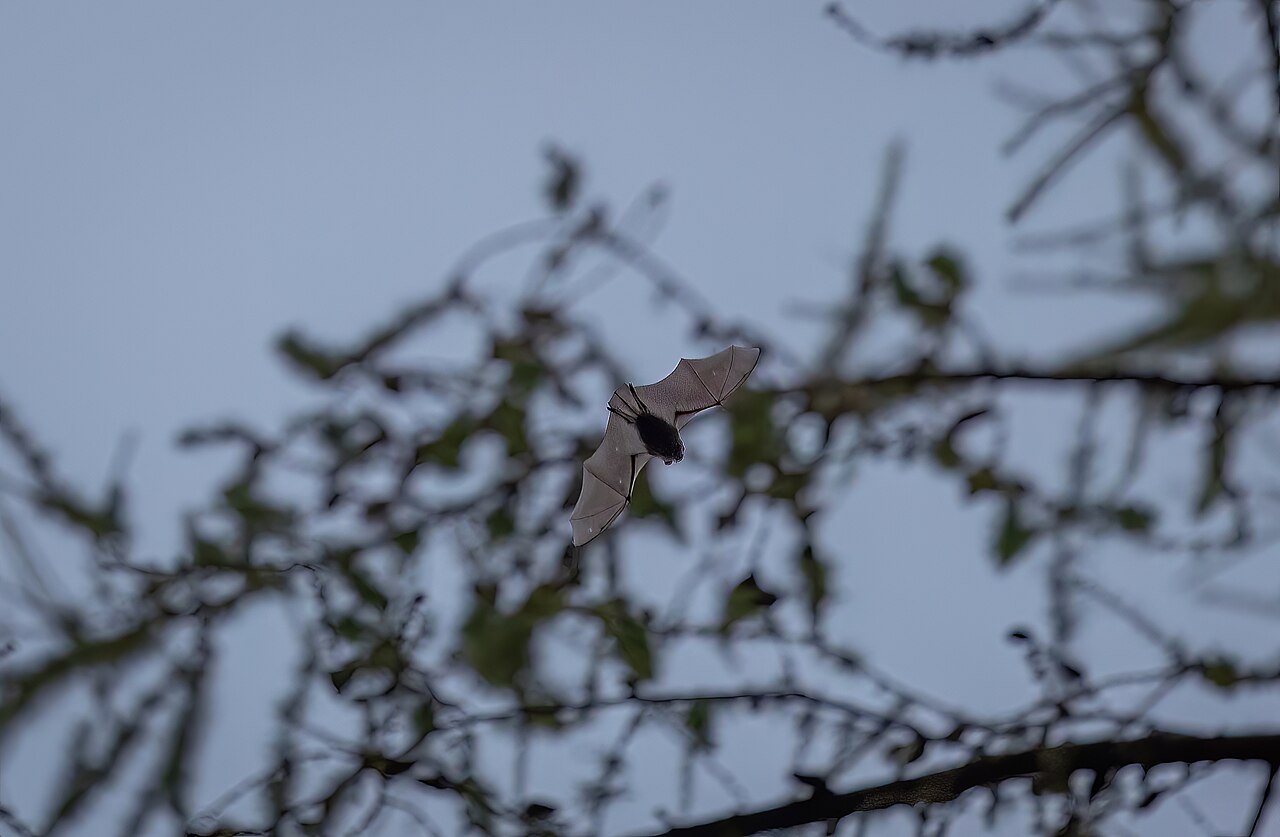
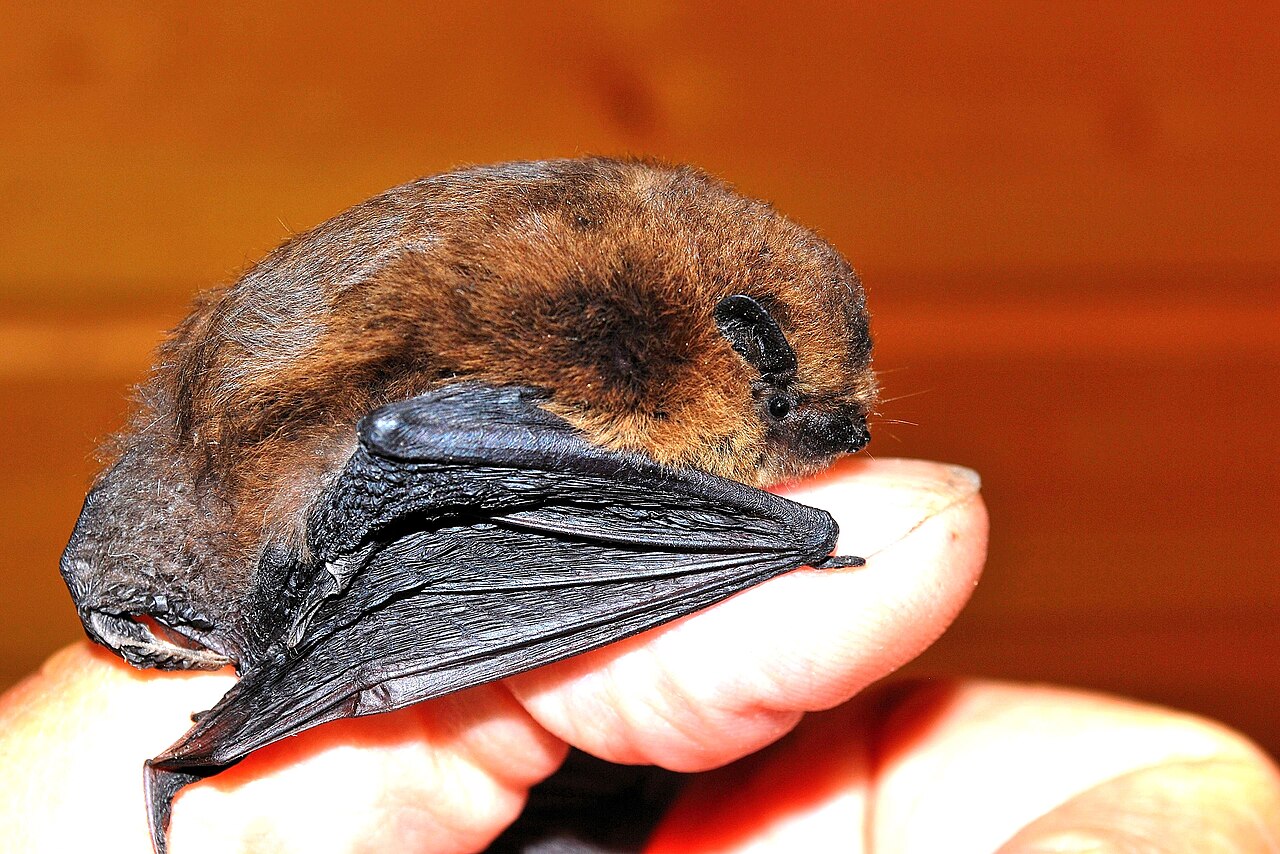
One of Europe's smallest bats: head-body 3.6 to 5.1 cm, forearm 28 to 34.5 mm, weight 3.5 to 8 g. The fur is dark red-brown to chestnut above and barely paler below; face, ears and wings are blackish-brown and virtually naked. The ear is short and triangular with a rounded tip and has a short, curved, blunt-ended tragus; this is not a decisive character, but separates the species from the long-eared bats, whose ears are nearly as long as the body. The wings are narrow and pointed; the flight is fast, agile and erratic, with tight turns and sudden dives at 2 to 5 m, usually on fixed circuits along a row of houses, a street lamp, a hedge or a pond edge. In a roost the animal squeezes flat into a crevice rather than hanging free; when one is found behind cladding, this is a clue.
Similar species
Reliable identification is made with a bat detector. Nathusius's Pipistrelle (Pipistrellus nathusii) is slightly larger and longer-haired, with a paler belly, and migrates long distances in autumn. The Soprano Pipistrelle (Pipistrellus pygmaeus), recognised as a separate species in 1999, is barely separable by appearance: the difference lies in the call, with a peak frequency around 55 kHz against about 45 kHz in the Common Pipistrelle, and otherwise in small features of the face and wing venation visible only in the hand. Without a detector a pipistrelle over a pond can therefore be identified only to genus. Kuhl's Pipistrelle (Pipistrellus kuhlii) of the Mediterranean, which is spreading rapidly northwards, has a white trailing edge to the wing. Larger and with a different flight are the Noctule and the Serotine: they fly higher and straighter, with much slower wingbeats; the Serotine is about the size of a Blackbird in silhouette. A Swift in the last light is the most frequent error: it flies on stiff, sickle-shaped wings in wide arcs and makes no sharp, angular turns.
Habitat
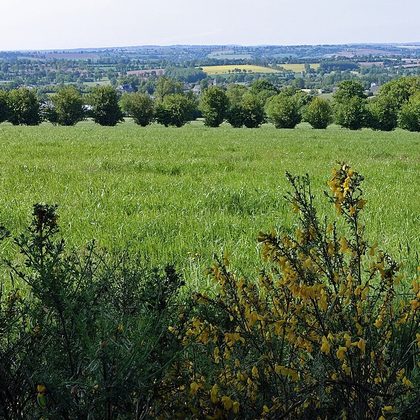
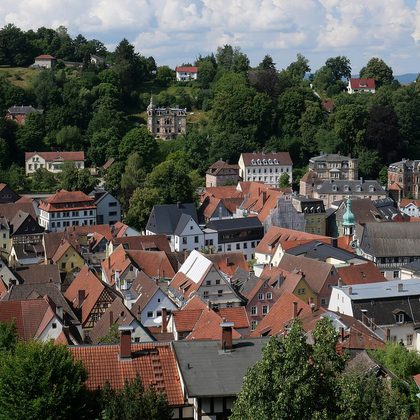
Villages and towns and the linear landscape features around them: avenues, tree lines, hedgerows, woodland edges, parks, gardens, canals, ditches and ponds. The species hunts preferably along and above tall vegetation and over still water, where midges rise, and makes use of street lamps where insects gather. The roost is almost always a building (a cavity wall, a crevice behind cladding, a fascia board, a gap under tiles) and much less often a tree hole or bat box. Open arable land without margins, bare pasture and dense conifer forest are avoided.
Where the animal is most at home, classified with EUNIS — the European standard for habitats.





Distribution
All of Europe to about the Arctic Circle, and further North Africa and the Near East; the most widespread and most numerous bat in Europe, and in almost every bat survey in Europe the first species on the detector. In the British Isles it is absent nowhere: common throughout England, Wales and Scotland to the Highlands, on the Isle of Man and throughout Ireland, where it is one of the few mammals to have arrived under its own power. In the Netherlands and Belgium the species occurs in almost every village and town district, is the bat most often found in houses and produces the most reports. In the Iberian Peninsula it occurs everywhere, from sea level to the middle mountains, and is the common bat of city centres such as Madrid, Barcelona, Seville and Zaragoza, where it uses cavity walls, expansion joints and roller-shutter boxes; there it lives alongside Kuhl's Pipistrelle, which in many cities of the south and east is even more numerous, so that a pipistrelle in a Spanish city can only be identified with a detector. It is also common in the Balearics, Italy and Greece, into city centres.
- Native
- dark = core range, pale = thinly spread
Way of life
Nocturnal; emergence begins fifteen to thirty minutes after sunset, after which the animal hunts for two to four hours, rests in the middle of the night and flies out again towards morning. Food consists of small, soft insects caught on the wing: non-biting midges, mosquitoes, caddisflies, lacewings and small moths, several hundred to several thousand per night. In May and June the females form maternity colonies of a few dozen to a few hundred animals in a cavity wall or behind a facade; in mid-June a single young is born, occasionally two, which flies at four weeks. In late summer males hold a song territory with a fixed circuit and attract females to a mating roost; mating takes place in autumn and fertilisation only in spring. From November to March the species hibernates, usually in a crevice in a building, sometimes in a quarry, cellar or tree, and changes roost during the winter. A pipistrelle can live sixteen years, a high age for an animal of six grams.
Where and when to look
Choose a still summer evening, half an hour after sunset, by a pond, a canal, an avenue or a lit wall: against the pale evening sky the animals can be seen from below. A bat detector set to 45 kHz makes the species audible; the Common Pipistrelle sounds like a series of wet, fatty slaps that accelerate into a rattle at each capture. In August and September singing males can be heard along housefronts and bats swarm at hibernation sites. If a bat flies into a house, switch off the light and open a window wide; the animal finds its own way out. Bats are not handled with bare hands.
Conservation status
Least Concern (LC, 2020) and the most numerous bat in Europe, but like all European bats strictly protected: in the European Union through the Habitats Directive and national legislation, and in Great Britain through its own wildlife legislation. The problem is that its roosts are in inhabited buildings: cavity-wall insulation retrofits, roof renovation and demolition remove maternity colonies within a single working day, often with the animals inside. The wave of insulation retrofits and energy renovation of recent years is therefore the largest known threat to populations in the Low Countries and Great Britain and to urban populations in general. Light pollution along commuting routes, the removal of hedgerows and tree lines, and the general decline of insects also play a part. Measures are survey before building work, keeping or replacing access gaps, and maintaining dark linear landscape features.
Scientific name
Pipistrellus pipistrellus | (von Schreber, 1774)
Von Schreber described the species in 1774 as Vespertilio pipistrellus; because it was later moved to another genus, the author and year stand in brackets. Pipistrellus is formed from Italian pipistrello, 'bat', which goes back to Latin vespertilio, from vesper, 'evening'. The specific name repeats the genus name. The specimen the first description was based on came from France.