All species › Lagomorphs › Hares and rabbits › Mountain Hare
Mountain Hare | Lepus timidus
Sneeuwhaas | Liebre Variable
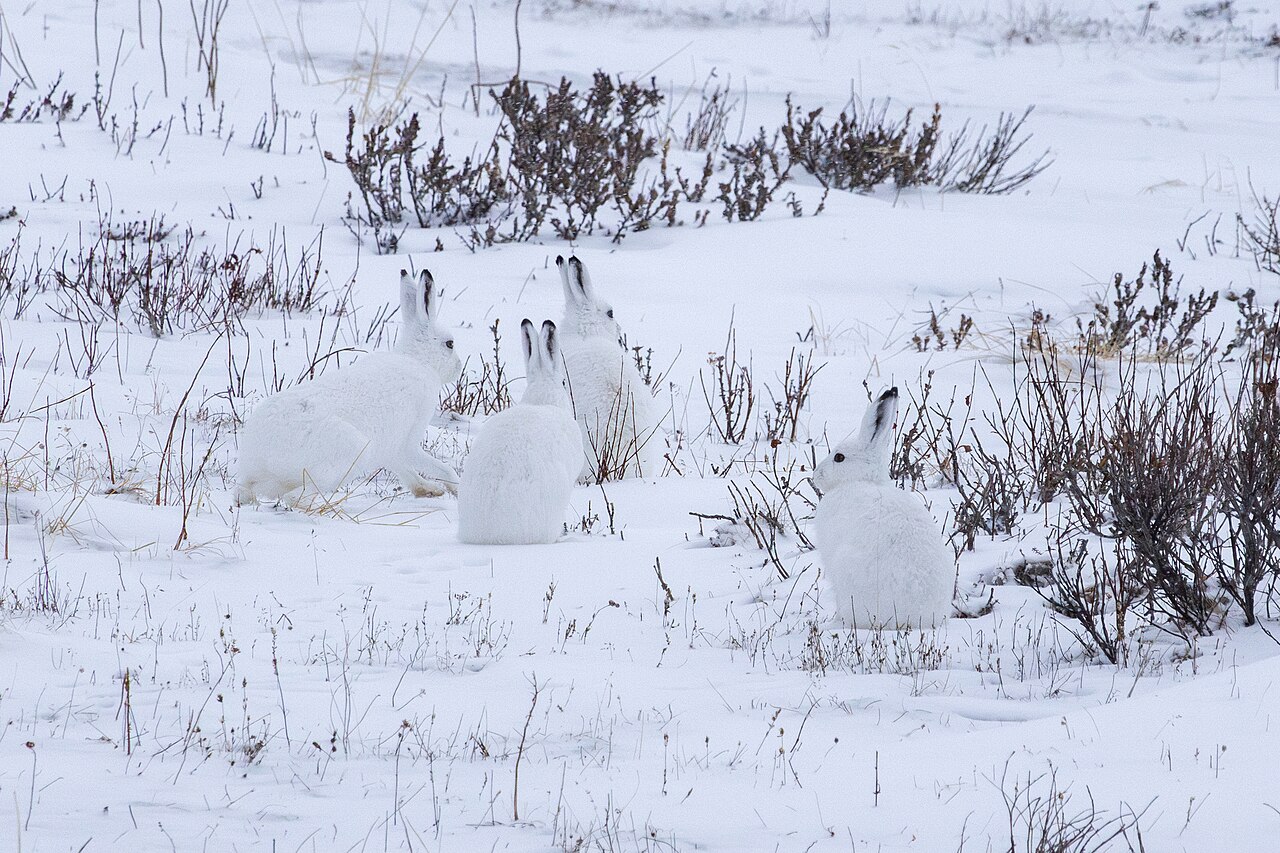
The Mountain Hare is the hare of the north and of high mountains. Its coat changes colour completely twice a year: grey-brown in summer, white in winter. This colour change largely determines its distribution and its vulnerability in a warming Europe; in Ireland the species remains mainly brown in winter.
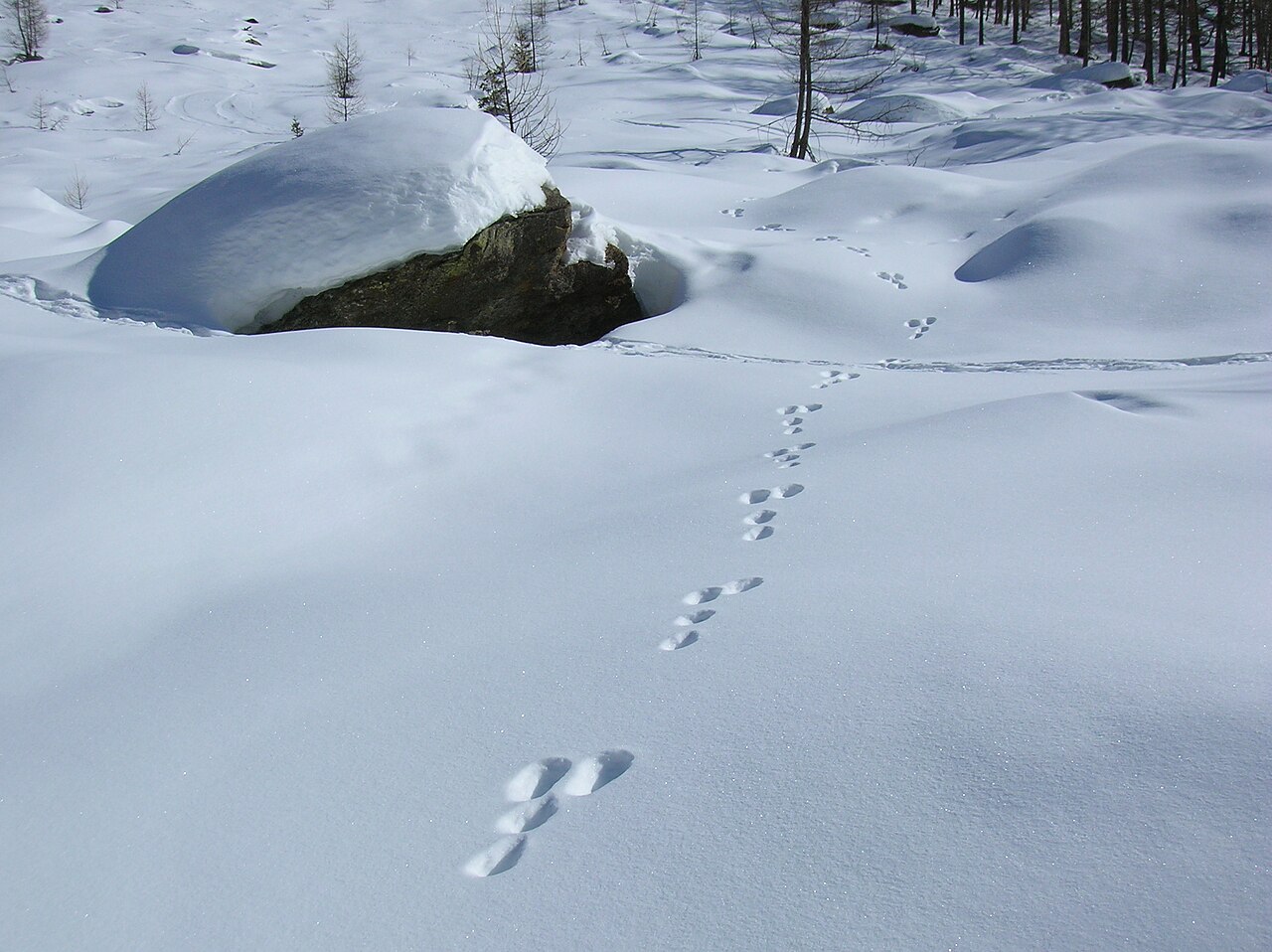
Tracks
In snow the tracks of the Mountain Hare are easier to find than the animal itself. The trail forms a Y: the two long hind feet land side by side and ahead of the two fore feet, which sit obliquely one behind the other, so that the group points forward; the animal bounds and places the hind feet beyond the fore feet. The hind print is 12 to 17 cm long in fresh snow, clearly broader than a Brown Hare's because the toes are splayed and the sole is densely furred; as a result the animal barely sinks into powder snow. Bounds measure 50 to 80 cm at an easy pace and over two metres in flight. The droppings are flattened pellets of 1 to 1.5 cm, pale brown to grey-green, coarsely fibrous and almost odourless in dry weather; they lie scattered over the ground and in small heaps at the form. The form is a shallow scrape under a dwarf birch or juniper or in the lee of a stone, in winter often a chamber in the snow with a smooth-worn entrance. In winter the feeding signs are characteristic: the bark of young birch, willow and juniper is stripped to the wood, with the sharp oblique cut of the incisors, and twigs are clipped cleanly at forty-five degrees, as by the Brown Hare but above the snow layer, sometimes a metre up. White hairs on twigs and wire fences indicate that a run is in use.
In its habitat
Head close-up
In summer coat

Identification
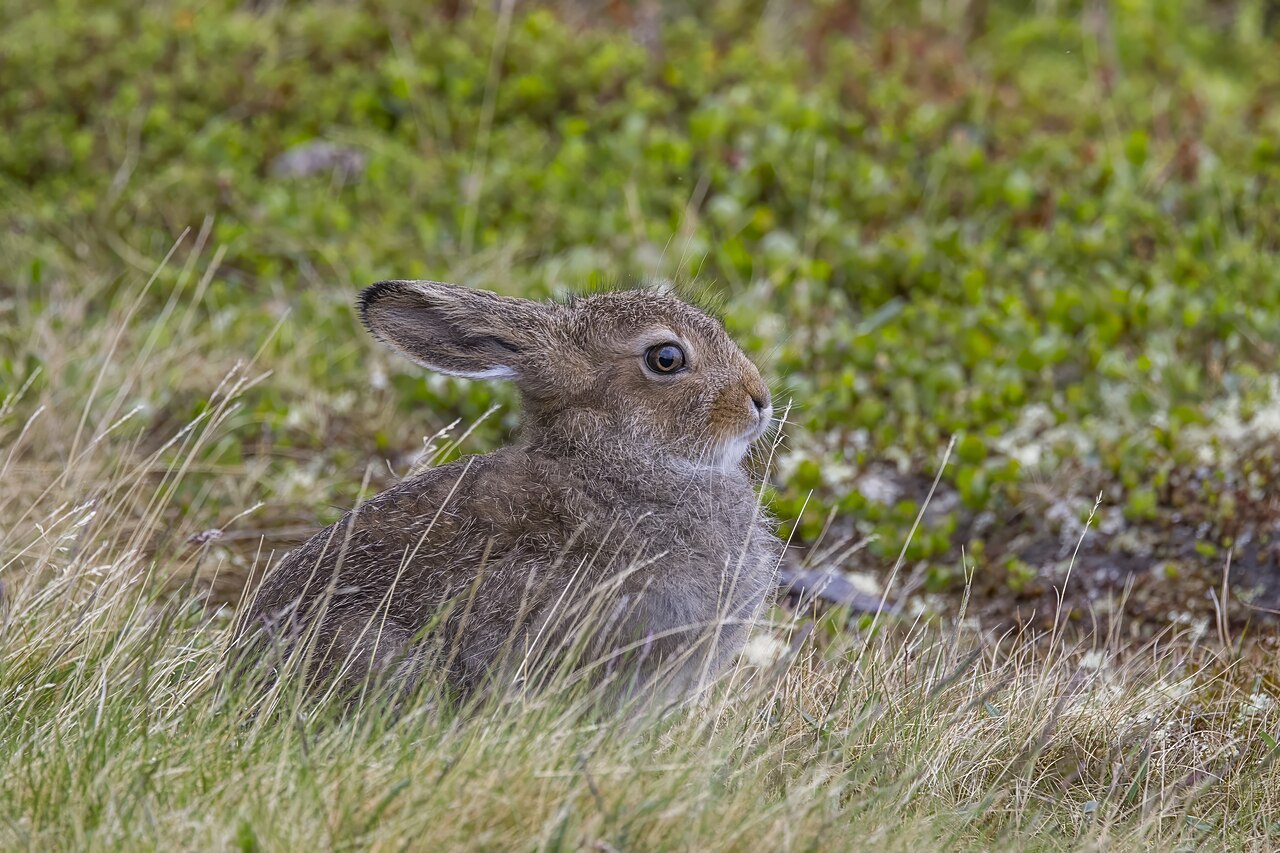
A medium-sized hare, shorter and stockier than the Brown Hare, with a rounded head and short ears clearly shorter than the head. The hind feet are broad and densely furred, so that it does not sink into a snow crust through which a Brown Hare breaks. In summer grey-brown to slate grey, without the warm russet tone of the Brown Hare; from October the coat changes within a few weeks to pure white, with only black ear tips. In March and April the process reverses, and for some weeks the animals are piebald: white flanks, brown head, white feet. The tail is white above and below all year round; this character does not change and is usable in summer and at a distance.
Similar species
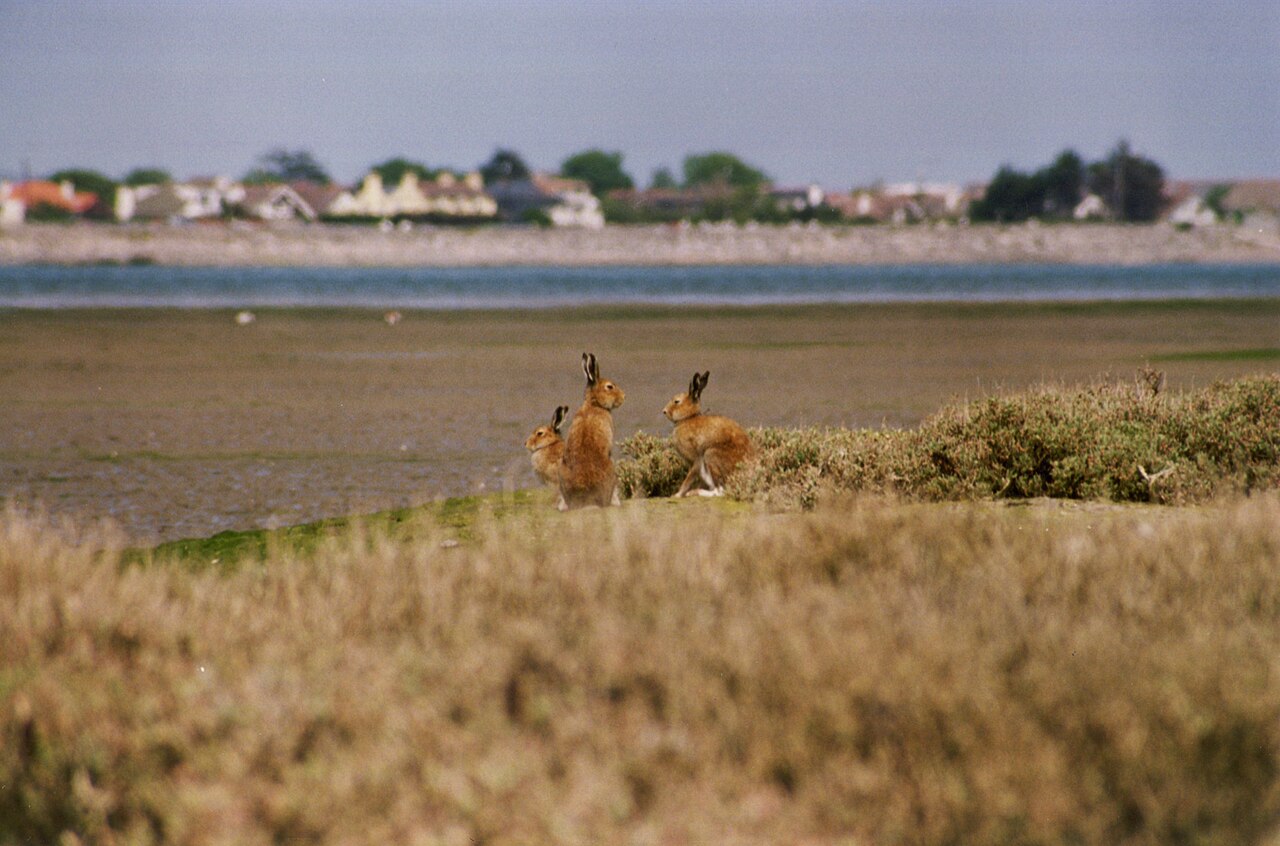
The Brown Hare (Lepus europaeus) overlaps in Fennoscandia, the Baltic states, the Alpine foothills and Scotland and is the only species with a real risk of confusion. It is larger and longer-legged, russet, and has long ears exceeding the head, with the whole rear edge black, not only the tip. The tail is decisive: black above in the Brown Hare, entirely white in the Mountain Hare, and this is clearly visible on a running animal. The Brown Hare becomes at most paler and blotchy in winter, never white. A Rabbit is much smaller, with short ears without a black tip and a short tail that is black above. In Ireland and Scotland there are separate subspecies: the Irish hibernicus is russet and seldom or never turns white, the Scottish scoticus does turn white but often keeps a brown head; in both the white tail is the deciding character. The Mountain Hare does not occur on the Iberian Peninsula; in the Cantabrian Mountains lives the Broom Hare (Lepus castroviejoi), which is brown all year and has a grey nape.
Habitat
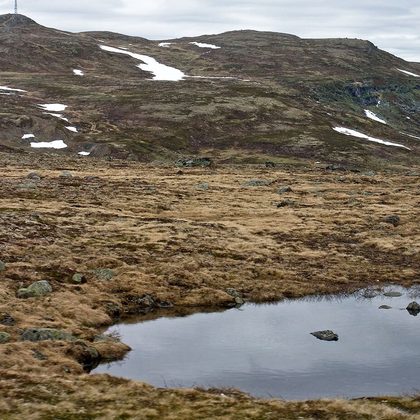
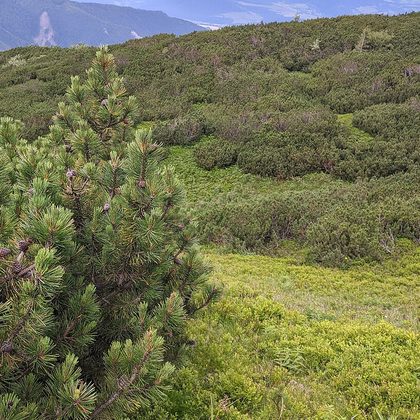
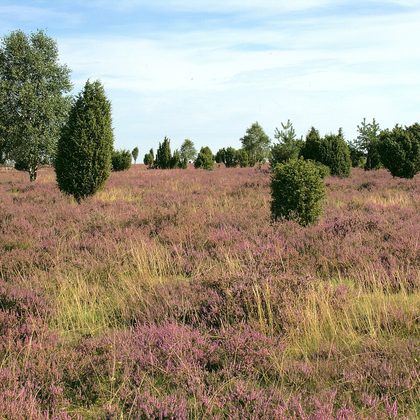
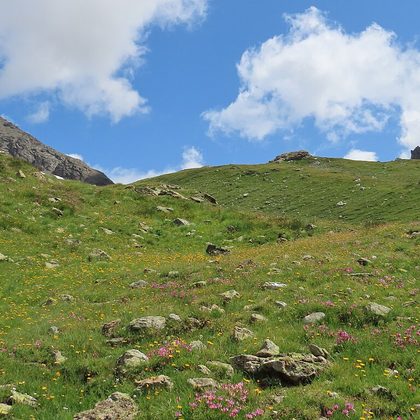
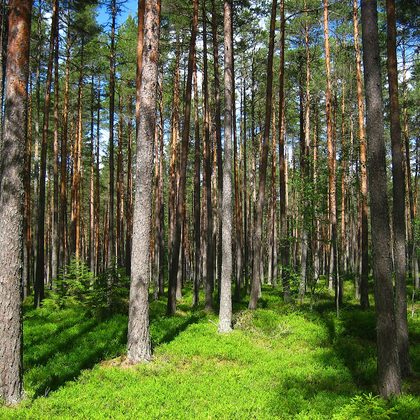
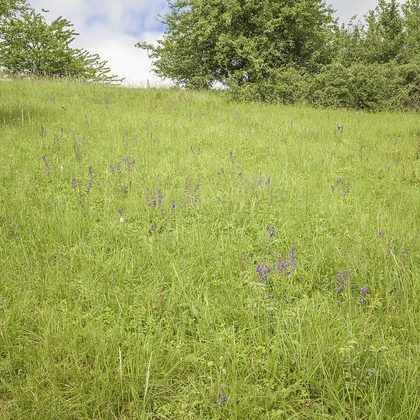
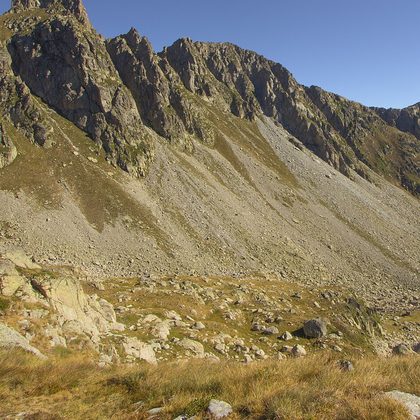
Tundra, birch scrub, blanket bog and open coniferous forest in the north; in the Alps above the treeline, alpine grassland, dwarf scrub and scree to well over 3000 metres. In Scotland heather moorland on the high plateaux, in Ireland the lowlands: rough pasture, dunes, saltmarsh and also airfield margins. Everywhere cover is decisive, such as a dwarf shrub, a boulder or a ditch under which the form can lie, rather than the richness of the food. In the north the species moves to lower scrub in winter, where twigs are still available above the snow.
Where the animal is most at home, classified with EUNIS — the European standard for habitats.
Distribution
From Fennoscandia and the Baltic states through northern Russia far into Siberia, with isolated relict populations in the Alps (Switzerland, Austria, Bavaria, northern Italy, Slovenia and the French Alps), in Scotland, in Ireland and on the Faroes. The last central European lowland populations live in Poland and Belarus, ice-age relicts that are disappearing one by one. In Britain the species is native to the Scottish Highlands, where it is the only hare on the high tops, and introduced to Shetland, Orkney, the Isle of Man and the Peak District in England. In Ireland, where the Brown Hare is a recent introduction, the Irish Hare is the only native lagomorph and occurs from the Kerry mountains to Dublin Bay. The species does not occur, and has not occurred in historical times, in the Low Countries or on the Iberian Peninsula, including the Pyrenees.
- Native
- dark = core range, pale = thinly spread
Way of life
Mainly nocturnal and crepuscular, and therefore active almost round the clock in the arctic summer. In summer the species grazes grasses, sedges and herbs; in winter it eats twigs and bark of birch, willow, juniper and heather. Like all lagomorphs it re-ingests its own soft night pellets to digest the food a second time. It does not hibernate and stays above ground even at thirty degrees of frost, in a snow chamber with its nose under its tail. The mating season runs from March to July, when the animals box on their hind legs. After 47 to 54 days one to four leverets are born, furred, with open eyes and able to run at once; they lie in a shallow scrape and are suckled once every twenty-four hours, shortly after sunset. There are one or two litters a year in the north, often one in the Alps. Predators are Lynx, Red Fox, eagles and Stoat; in the north numbers fluctuate on a cycle of about ten years.
Where and when to look
The best chance is a clear day in March or April, when the snow is melting and a still-white hare on brown heather is visible from a great distance. Suitable areas are the Cairngorms in Scotland and, in the Alps, the slopes just above the treeline; scan with a telescope from the opposite slope. In the north you can follow tracks after fresh overnight snow: the Y-shaped bounds lead to the form, where the animal often sits tight to within ten metres. The white tail is a more reliable character than coat colour at any time of year.
Conservation status
Least Concern (2019) across the whole range, but in Europe the species is declining in many places. The lowland populations in Poland, Belarus and the Baltic states have been shrinking for decades, and the Alpine populations are shifting to higher altitudes as winters become shorter. An important factor is the colour change: it is controlled by day length and not by snow, so that a white hare on a snowless slope is conspicuous, which increases mortality. Where the Brown Hare is advancing, as in Sweden, the Alps and Scotland, competition and hybridisation follow; animals with genes of both species now occur. In Scotland Mountain Hares were culled in large numbers on grouse moors for decades to control ticks; since 2021 they have been legally protected there.
Scientific name
Lepus timidus | Linnaeus, 1758
Linnaeus described the species in 1758 and placed it straight away in the genus where it still stands. Lepus is the Latin word for 'hare'. timidus is Latin for 'shy, fearful', from timere, 'to fear'. The specimen the first description was based on came from Sweden, Uppsala.