All species › Rodents › Blind mole-rats › Lesser mole rat
Lesser mole rat | Nannospalax leucodon
Westelijke blindmuis | Spalax leucodon
The Lesser Blind Mole-rat is a cylindrical rodent, as heavy as a large rat but without a visible neck, ear pinnae, eyes or tail, which spends its whole life underground and digs tunnels through the steppe soil with its incisors. It is the name-bearing species of one of Europe's taxonomically most difficult rodent groups: until recently the name Nannospalax leucodon covered more than twenty chromosomal forms, nine of which the Mammal Diversity Database now recognises as separate species. The following description therefore applies first of all to the animals of Odessa, Moldova, Dobruja and north-eastern Bulgaria, and only secondarily to the eight split species.
Tracks
The animal itself is rarely seen; its earthworks are, and they are extensive. The burrow has a main gallery with side branches and runs to a total of 65 to 195 metres spread over 194 to 1000 square metres. Feeding tunnels lie 15 to 25 centimetres down, deep connecting passages to well over four metres; the nest chamber is about 28 by 18 by 16 centimetres, grass-lined, at 25 to 50 centimetres, with separate store chambers and latrines. The tunnels themselves are five to seven centimetres wide. One animal digs roughly a metre and a half of new tunnel a day and pushes out ten kilos of soil doing it. That soil reaches the surface as mounds, and these mounds are the main character: they lie twenty-one to thirty metres apart in a meandering line, they are broad and low rather than conical, they are built of coarse clods rather than fine crumbs, and no open hole is ever visible — the tunnel is plugged from within. A molehill is smaller, higher, finer-grained and comes from a vertical shaft; Hungarian fieldwork only counts a mound as a mole-rat's when its base measures more than sixty centimetres. Beyond that: bitten-off roots, bulbs and tubers in the tunnel, store chambers holding six to twenty kilos of hauled-in roots and bulbs, and at the surface small patches where a plant has been pulled down from below. Finally, skull remains in the pellets of Barn, Little, Long-eared and Eagle Owls are, over much of the range, the only hard distribution records there are.
Identification
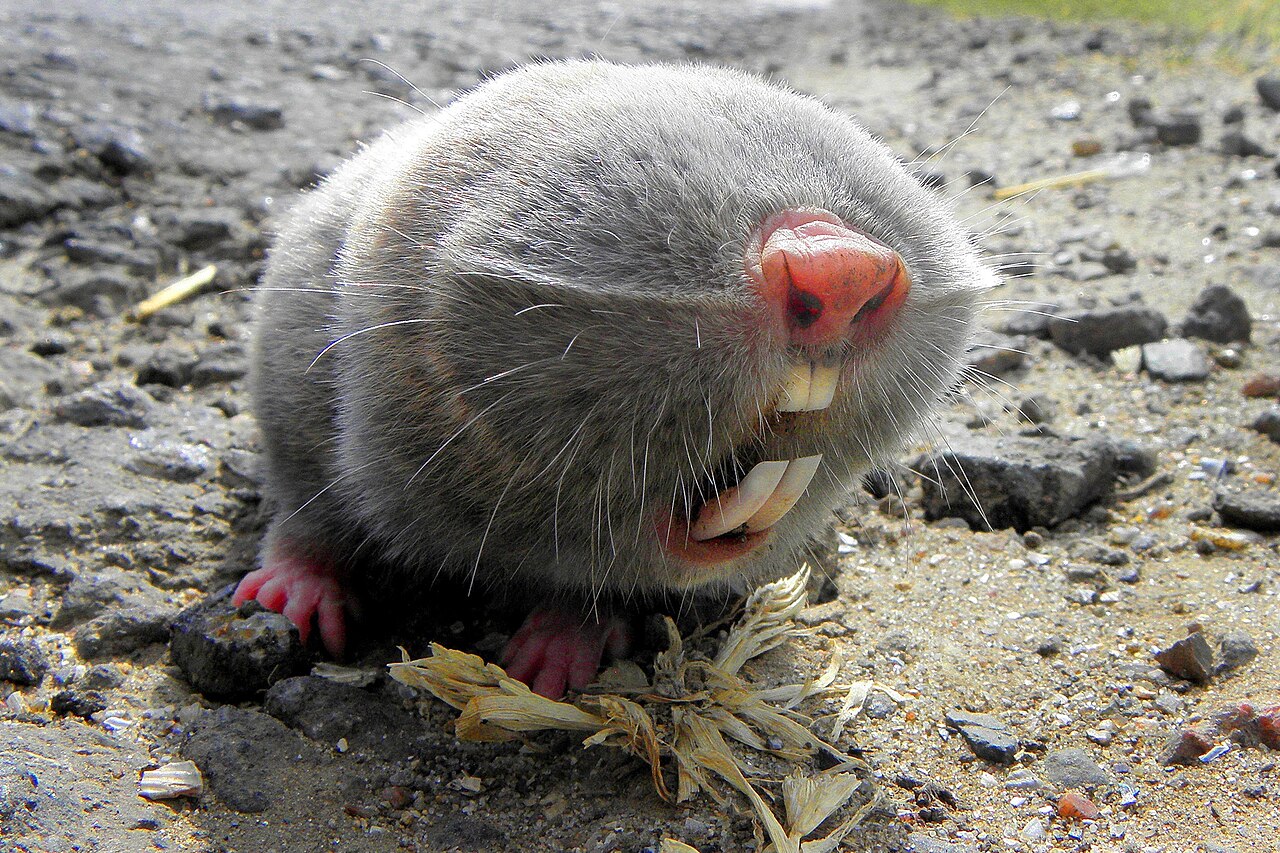
The Lesser Blind Mole-rat is a cylindrical, neckless animal of 15 to 24 centimetres and 162 to 504 grams, with a broad, flat, wedge-shaped head and a heavy forequarter. Males are larger than females. The fur is velvety and lies in any direction, brownish grey with a yellow, ginger or reddish cast, the belly greyer; in the north of the range many animals carry white or yellow spots on the head. The face is characteristic: a large, bare, triangular nose pad, and from it a stiff keel of pale bristly hairs running back about halfway to the ear openings; with this ridge the animal pushes soil aside. External ears are entirely absent and the eyes are reduced to lenses about a millimetre across beneath a closed fold of skin; the animal forms no image, only light and dark. The upper incisors are yellow to orange, the lower ones yellow or white, and both protrude in front of the lips, so that it can bite into the ground with its mouth shut. There is no external tail: where another rodent's tail would begin, the fur simply continues.
Similar species
Within Europe the blind mole-rats as a group are unmistakable — no other rodent combines protruding incisors, absent ears, sunken eyes and the lack of a tail — but within its own species group this species cannot be recognised on appearance. The blind mole-rats of the leucodon group differ in chromosome number and DNA and hardly in any character visible in the field. Accordingly: a blind mole-rat in Ukraine, Moldova, Romanian Dobruja or north-eastern Bulgaria is a Lesser Blind Mole-rat; one in the Balkans or in Hungary is not. There live N. hungaricus, N. montanosyrmiensis, N. monticola, N. montanoserbicus, N. serbicus, N. bulgaricus, N. hellenicus and N. insularis, and none of those eight can be told from this species externally. In European Turkey and on Lesbos the range of the Western Anatolian Blind Mole-rat (N. xanthodon) begins, itself a superspecies and equally impossible to separate by eye. The following confusions can be resolved: the mole is smaller, with shovel-shaped forefeet and a short tail; the water vole has ordinary ears, eyes and a tail a third of its body length; and the Northern Mole Vole (Ellobius) of the Ukrainian steppe is half the length and half the weight. For field records, noting blind mole-rat together with the locality is sufficient; the species follows from the locality.
Habitat
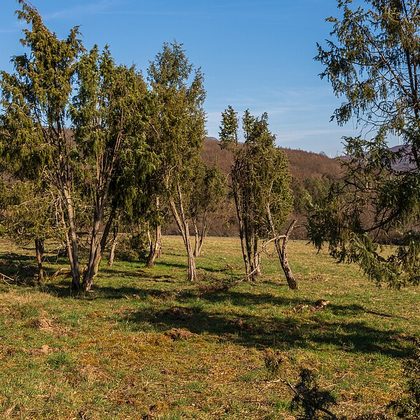
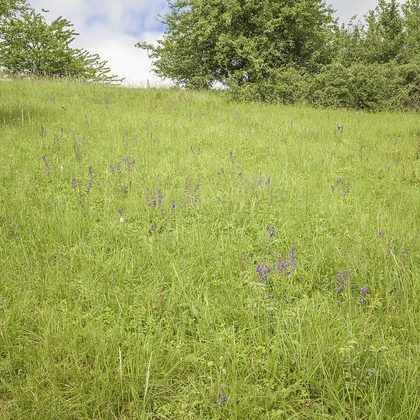
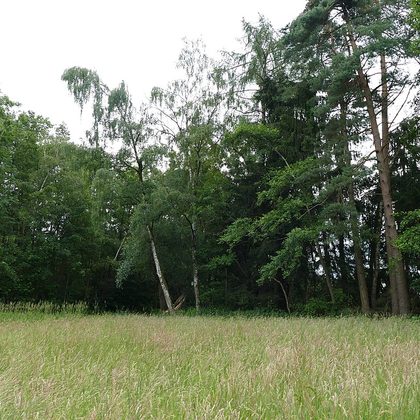
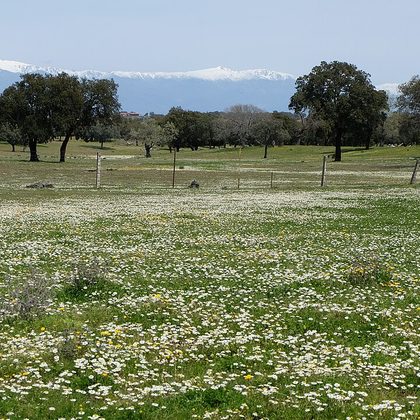
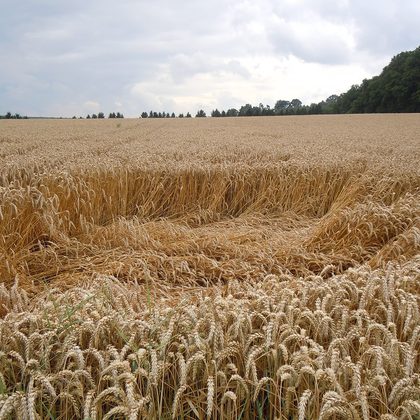
The Lesser Blind Mole-rat lives in steppe, grassland, hay meadow and pasture, from sea level to 2400 metres. It requires deep, loose, free-draining soil with an underground larder of bulbs, tubers and thick roots, and avoids woodland, marsh, rocky ground and heavily worked arable. Where the landscape allows, it also occurs in woodland clearings, small fields beside pasture, and orchards. Within the range of the species in the strict sense this means chiefly the Pontic steppe and the loess belt along the Black Sea: odd corners, burial mounds, road and railway verges and the unploughed margins of large fields, because hardly any continuous original steppe remains.
Where the animal is most at home, classified with EUNIS — the European standard for habitats.
Distribution
Under the delimitation of the Mammal Diversity Database, the Lesser Blind Mole-rat in the strict sense occupies the north-western Black Sea region: south-western Ukraine west of the Dniester including the Odessa area, Moldova, south-eastern Romania with Dobruja, and north-eastern Bulgaria, where the srebarnensis form of Ruse, Targovishte and Silistra is placed with this species. The type locality is near Odessa. In the older literature — and on virtually every map drawn before 2024 — this name covers everything from eastern Hungary to Greece and European Turkey; that is the superspecies, not the species. No blind mole-rats occur west of Hungary and the Balkans; in western Europe, including the Iberian Peninsula, the Low Countries and Britain and Ireland, the group is entirely absent.
- Native
- dark = core range, pale = thinly spread
Way of life
The Lesser Blind Mole-rat is active around the clock, with peaks that differ from study to study: one reports two, around midday and around one in the morning, another three, in the late morning, the early morning and the evening. The species is classed as crepuscular because the hours when it pushes soil to the surface, and in which it can therefore be observed, fall at the beginning and end of the day. It neither hibernates nor lies up, living through the winter on its stores. It eats bulbs, tubers, rhizomes and thick roots, with green plant material in late spring and the occasional insect, and works through more than a third of its own weight daily. It is solitary and aggressive towards its own kind; outside the mating season one burrow system belongs to one animal. Densities run at one to thirteen animals per hectare, exceptionally twenty-three. Pregnant females are caught mostly in March; after about thirty days, two to four young of six to six and a half grams are born in March or April, the extremes being one and six. They are weaned at two to two and a half months and weigh well over a hundred grams by the end of May; females first breed in their second year. In captivity males reach four to five years. Predators are Red Fox, Least Weasel, Stoat, Steppe Polecat, dog and cat, and among birds Little, Barn, Long-eared and Eagle Owls, Egyptian Vulture, Eastern Imperial Eagle, Long-legged Buzzard and even Magpie.
Where and when to look
The mounds are easier to find than the animal. In March or April, when the grass is still short and fresh soil shows dark, an occupied system on the steppe or an unploughed field margin is visible, when looking across the ground, as a line of broad, low mounds meandering through the grass twenty to thirty metres apart. The line follows the course of the tunnel. Fresh, damp, coarsely clodded soil indicates an occupied system; grassed-over mounds an abandoned one. The animal itself can only be seen with patience and luck: by waiting a few metres from a fresh mound for the next load of earth to be pushed out from inside; very occasionally the head appears briefly. Digging is pointless and not permitted. Most records of this species are chance events: an animal crossing a metalled road, or one brought home by a cat or a dog.
Conservation status
Globally Least Concern (LC, 2024), but that assessment needs qualification. It covers the species as the Red List delimits it, and that delimitation does not match the taxonomy of the Mammal Diversity Database: what are nine separate species there count on the Red List largely as one widespread species. For the animals of Odessa, Moldova and Dobruja 'Least Concern' is probably correct; for several of the split species it is demonstrably incorrect, and the Handbook of the Mammals of the World states that several species in this complex are undoubtedly threatened, lack protection and urgently need separate assessment. The threat is the same everywhere: the species depends on unploughed, deep, dry ground, and that is precisely the land that was first brought under cultivation in eastern Europe. Ploughing a field means the end of the animals living beneath it.
Scientific name
Nannospalax leucodon | (von Nordmann, 1839) (GBIF: Spalax leucodon)
Von Nordmann described the species in 1839 as Spalax typhlus leucodon; because it was later moved to another genus, the author and year stand in brackets. Nannospalax joins Greek nannos, 'dwarf', to Spalax: the small blind mole-rat. leucodon is Greek for 'white-toothed', from leukos, 'white', and odōn, 'tooth', after the colour of the incisors; von Nordmann set it against xanthodon, 'yellow-toothed', in the same work. The specimen the first description was based on came from Ukraine, Odessa.