All species › Rodents › Dormice › Garden dormouse
Garden dormouse | Eliomys quercinus
Eikelmuis | Lirón Careto
The Garden Dormouse (Eliomys quercinus) is a dormouse with a black mask, large thin ears and a tail ending in a black-and-white brush. It lives in broadleaved and mountain forest, rock crevices, dry-stone walls, lofts and nest boxes, and is very vocal at night. Its range has contracted strongly over recent decades, especially in the east; since 2024 the species has been listed as Vulnerable (VU).
Tracks
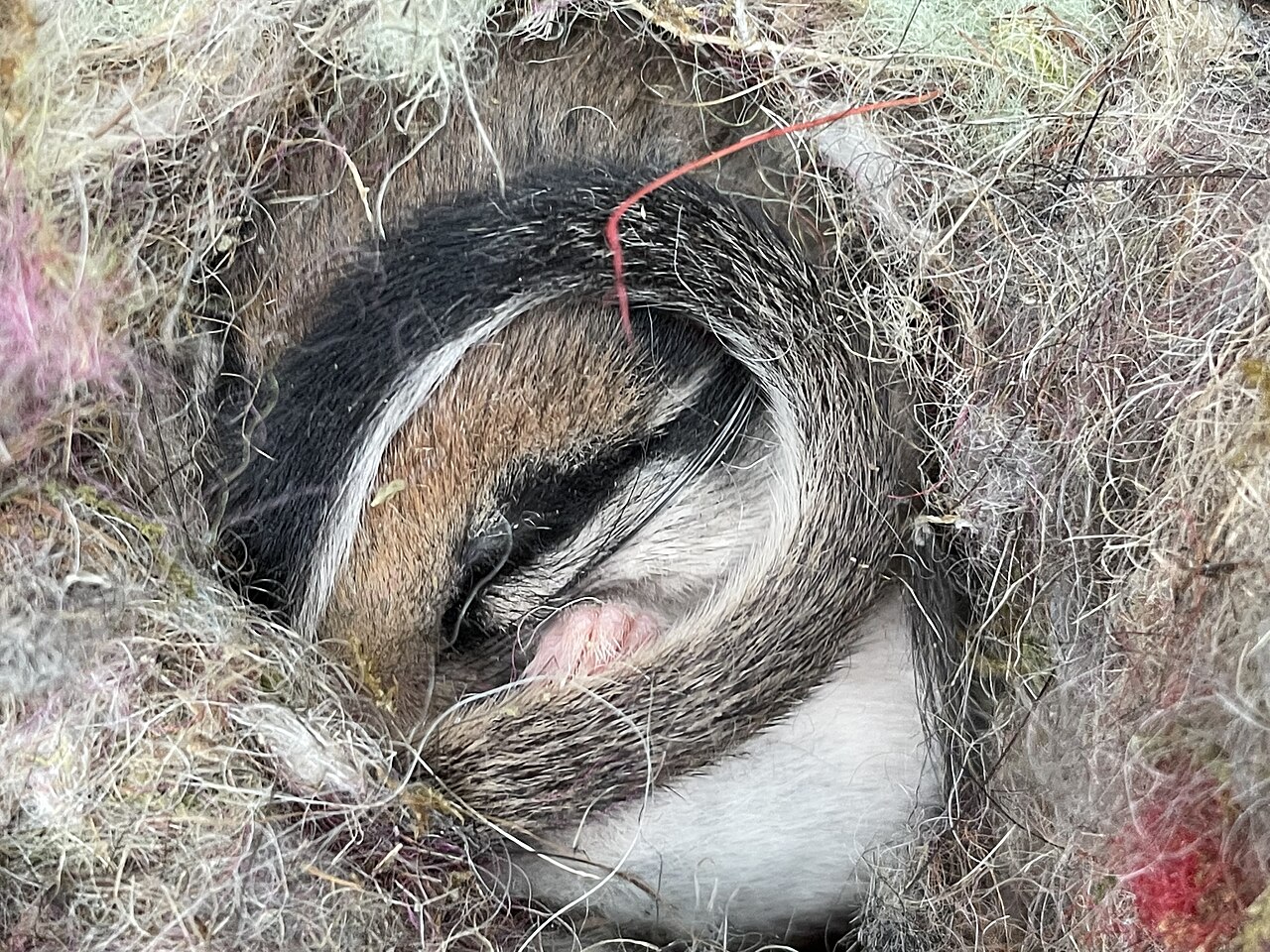
The Garden Dormouse is the noisiest dormouse in Europe; the most useful sign is sound: a series of sharp, penetrating whistles, alternating with grunts and a rattling chatter, usually after midnight and often from a roof, a wall or a woodpile. High-pitched whistling at night in August and September in mountain and hill villages is characteristic of this species. The species uses cavities, which simplifies searching. Nest boxes for birds, bats or dormice are taken over and filled with an untidy nest of grass, moss, leaves and other available material, including plastic and insulation; the same happens in rock crevices, dry-stone walls, woodpiles, sheds and lofts. In autumn such a nest becomes the winter chamber, in which the animal lies curled up with the black-and-white tail over its head. The droppings are 8 to 12 mm long and 3 to 4 mm thick, dark brown to black, twisted and tapering, and lie in small heaps at fixed places in and near the nest; they contain glossy beetle wing cases and centipede legs, because, unlike the other dormice, this species eats a large proportion of animal food. Feeding places therefore hold gnawed-open snail shells, remains of ground beetles and sometimes small bones and feathers. Apples, pears and plums are hollowed out on the tree, leaving a skin with a large, irregular hole.
In its habitat
Head close-up
Identification
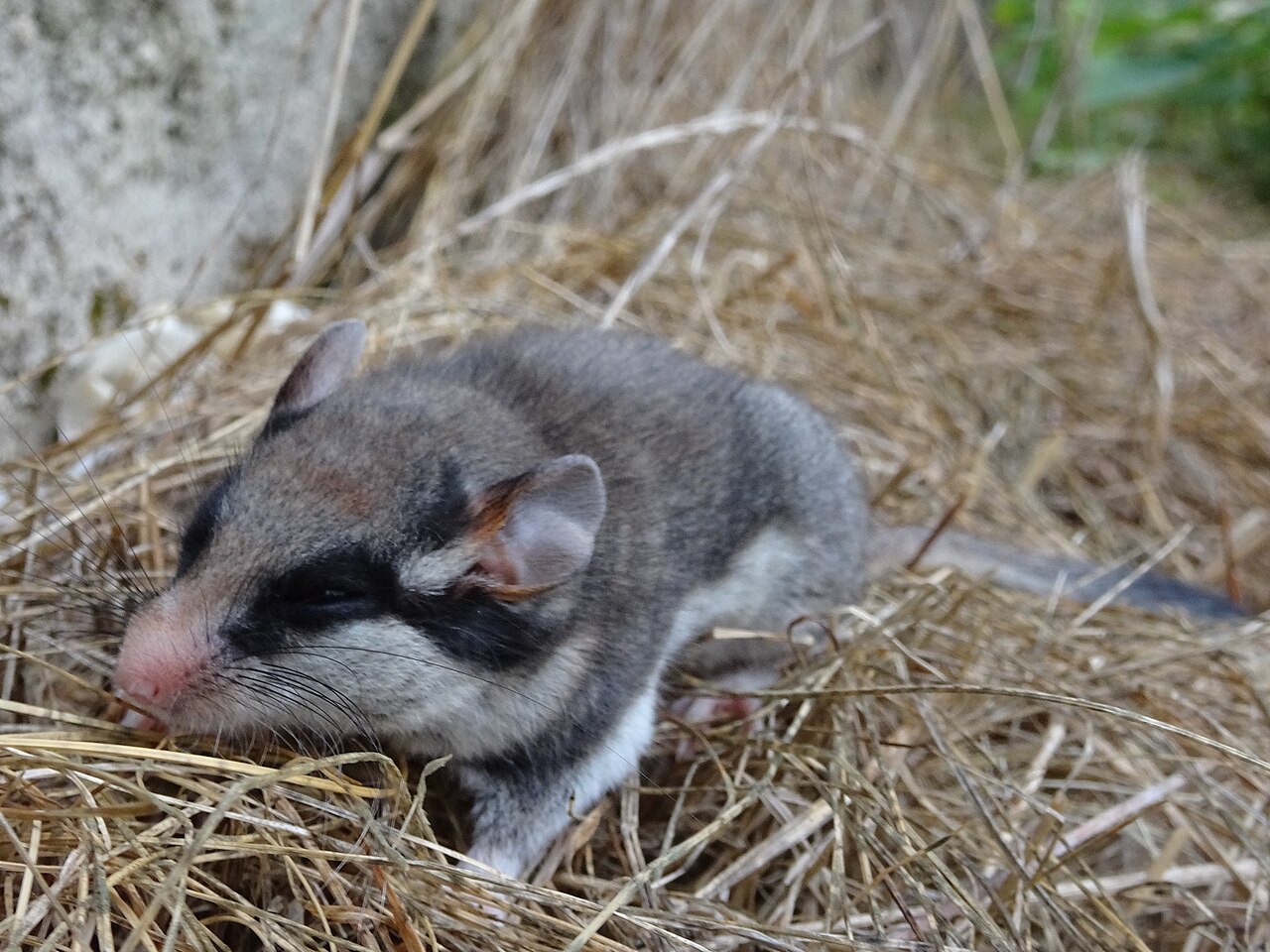
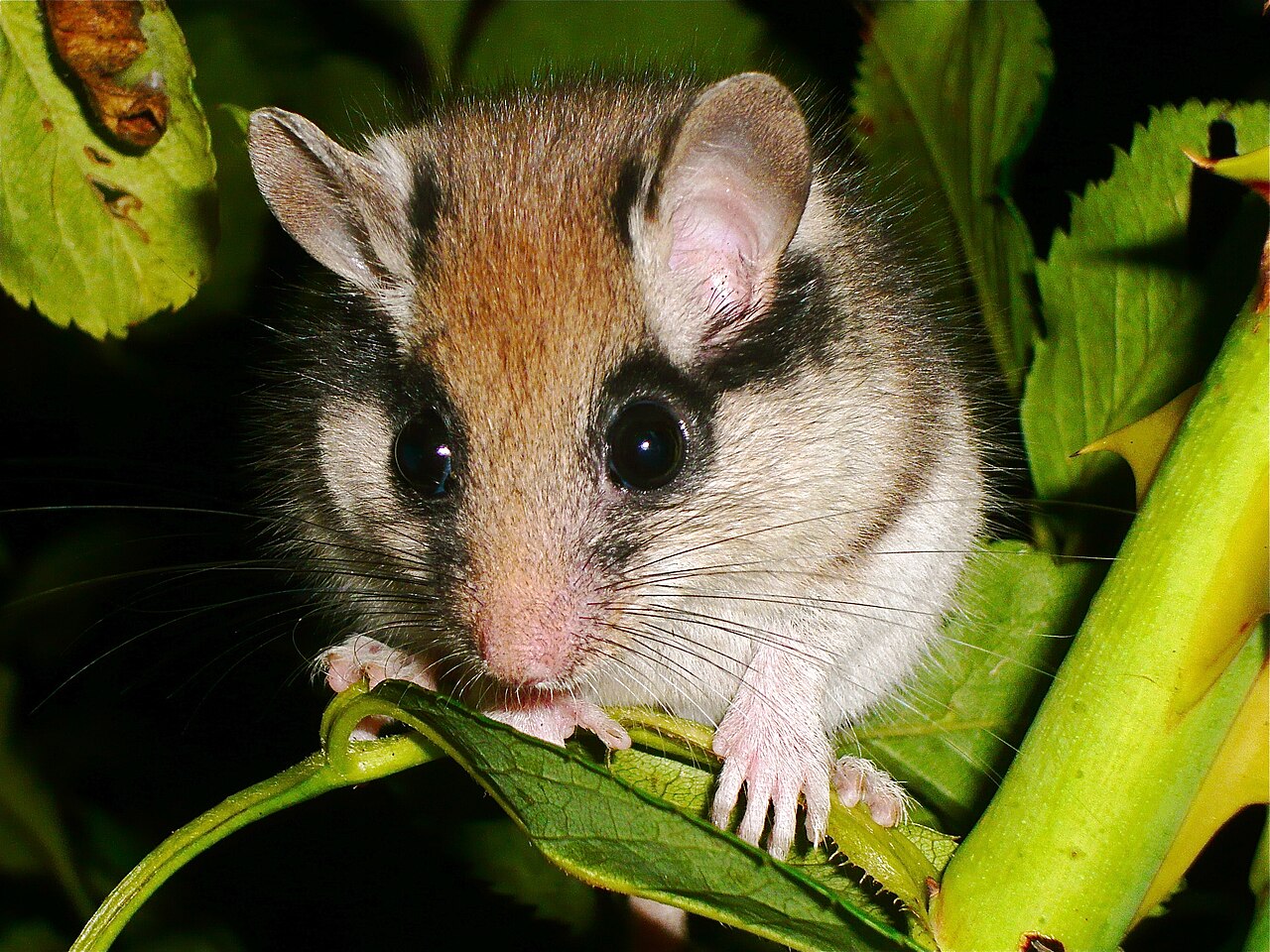
A large dormouse, head-body 10 to 17.5 cm and tail 9 to 13.5 cm, with a weight that rises from 45 to 120 g before hibernation. The back is grey-brown to reddish brown, throat, chest and belly are pure white and sharply demarcated. The main character is the black mask: it runs from the whiskers through the eye and continues behind the eye to behind and below the ear, where it ends in a point; in all other European dormice the dark marking stops at or before the ear. The ears are large, thin, almost membranous and project clear of the coat. The tail is thin and short-haired at the base and ends in a flattened brush that is black with a white tip and white edges; this too occurs in no other species. The eyes are large, domed and black, the feet pink with long toes. The tail skin comes away when the tail is seized; animals with a bare tail tip have usually lost that part during an escape.
Similar species
The Hazel Dormouse is half the size, plain golden orange, has small round ears and no mask; the head rules out confusion. The main source of confusion in central and eastern Europe is the Forest Dormouse: also grey-brown with a white belly and a black eye stripe, but that stripe stops at the ear and does not run behind it, and the tail is evenly grey-brown and slightly bushy, without a black brush with a white tip. The Forest Dormouse is also clearly smaller. The Edible Dormouse is larger, plain grey, without a mask, with an evenly grey bushy tail and dark rings round the eyes that do not form a stripe. The furred tail separates it from true mice: Wood Mouse and Black Rat have naked, ringed tails. In the south of the Iberian Peninsula and in the Maghreb the closely related Maghreb Garden Dormouse (Eliomys munbyanus) occurs, which cannot be reliably separated in the field; there distribution is decisive.
Habitat
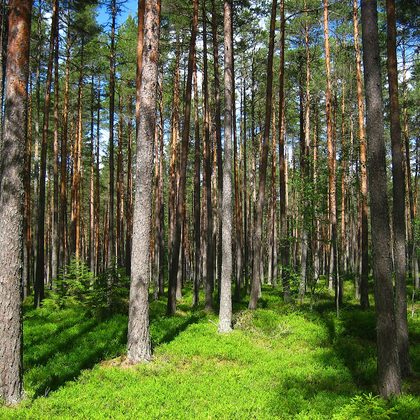
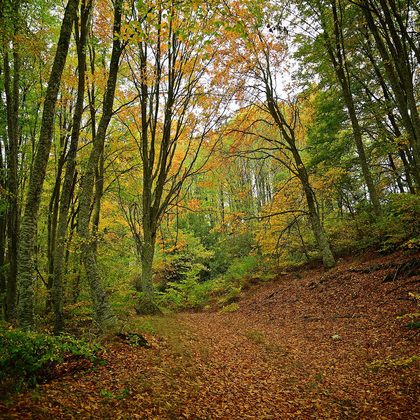
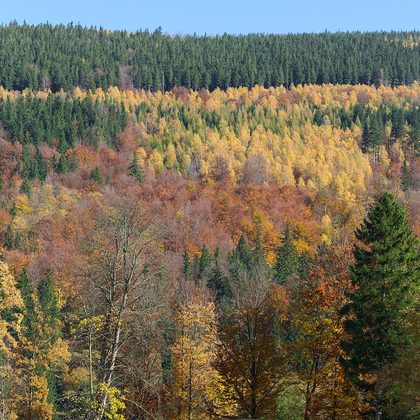
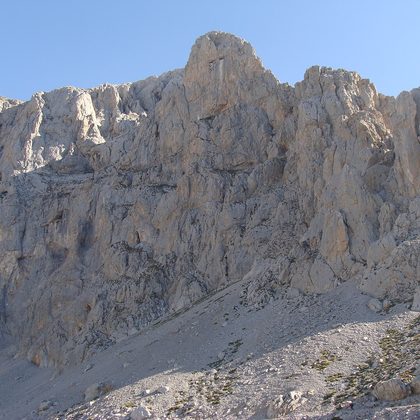
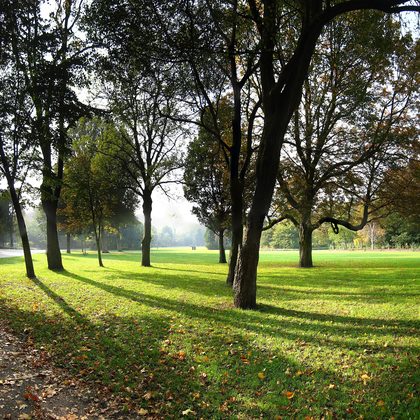
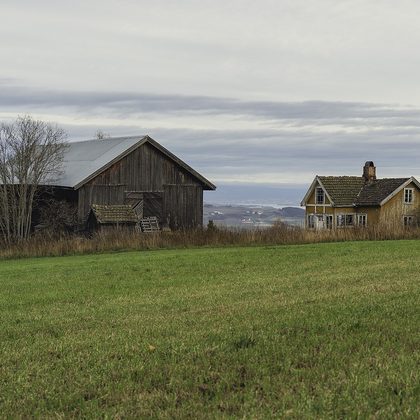
Habitat differs by region. In the south and west of the range (Iberian Peninsula, southern France, Italy) the species lives in broadleaved woodland, olive groves, orchards, dry-stone walls and village edges, into gardens and houses; in the Iberian Peninsula also in oak and beech woodland and mountain pine forest. In central Europe it has been pushed back over the last half century into coniferous forest and rocky mountain terrain, mainly old spruce and pine forest with much dead wood, block fields and scree; in Germany it now occurs mainly there and not in broadleaved woodland. Cavities are needed everywhere: tree holes, crevices, walls and nest boxes. From sea level to about 2300 m in the Alps.
Where the animal is most at home, classified with EUNIS — the European standard for habitats.
Distribution
The core of the range lies in south-western and central Europe. In the Iberian Peninsula the species occurs almost throughout, from the Cantabrian Mountains and the Pyrenees to the Sierra Nevada, and also on the Balearics; it is the most frequently found dormouse there. It also lives in France, Italy with Sicily, Sardinia and Corsica, the Alps, southern and central Germany, Czechia and scattered in the western Balkans. The eastern part of the original range, which reached into southern Poland, has largely emptied: the species is regionally extinct in Estonia, Finland, Latvia, Lithuania, Belarus, Poland, Slovakia and Ukraine and scarcely occurs east of Germany and western Czechia. In the Netherlands the Garden Dormouse is the rarest mammal species; it survives only in the South Limburg hills, where a targeted search in 2007 found nine animals in two woods. In Flanders and Wallonia the species is also very rare. It does not occur in Britain and Ireland; the only free-living dormice there are the native Hazel Dormouse and the introduced Edible Dormouse in the Chilterns.
- Native
- dark = core range, pale = thinly spread
Way of life
Nocturnal, most active in the first half of the night. It climbs well but forages much on the ground and on walls, and of the European dormice it is the most carnivorous: beetles, grasshoppers, caterpillars, centipedes, snails and regularly also eggs, nestlings and other small rodents, supplemented with fruit, nuts and seeds. From October to April it truly hibernates, alone or with several animals in one winter chamber; in the Alps hibernation lasts up to seven months, so that the active period is limited to four and a half months. In the north there is one litter a year of four to six young, in the south sometimes two. The young are born blind and naked, first have a grey coat and acquire the mask gradually. In the wild the Garden Dormouse seldom lives beyond three years.
Where and when to look
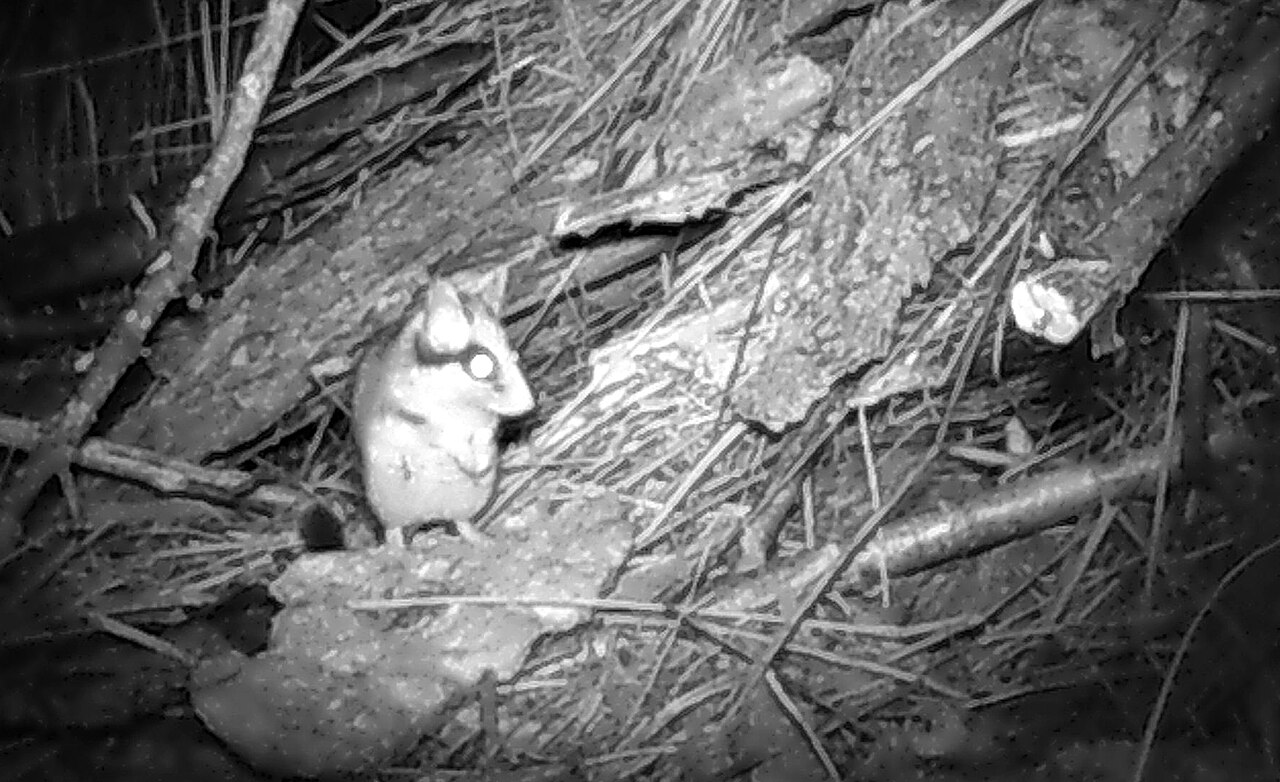
Listen in August or September after midnight along a village edge, in an orchard or on a mountain slope for the sharp whistling; this is the most reliable method of establishing the species. Then locate the source of the sound: a woodpile, a dry-stone wall, an eave. Check nest boxes for birds or bats in September and October; report a box with an untidy nest and a masked occupant. In the Iberian Peninsula and southern France the species is common enough to be seen at dusk on an old dry-stone wall or in an olive grove. In the Netherlands and Belgium the chance of a sighting is small.
Conservation status
Vulnerable (VU, 2024). In 2008 the species was still listed as Near Threatened (NT); the revised distribution map of 2017 showed a reduction in range of a third compared with 2008, and in the three decades before that an estimated up to half of the original range was lost. The causes are multiple: loss of old orchards, dry-stone walls and cavity-rich woodland, crop protection that reduces the insect supply, and probably climate change, which interrupts hibernation so that animals wake with depleted fat reserves. A national research programme based on sound, droppings and nest boxes has been running in Germany since 2018 and has produced the first reliable map of the decline. In the Iberian Peninsula the species is still widespread.
Scientific name
Eliomys quercinus | (Linnaeus, 1766)
Linnaeus described the species in 1766 as Mus quercinus; because it was later moved to another genus, the author and year stand in brackets. Eliomys is Greek, from eleios, Aristotle's word for the dormouse, and mys, 'mouse'. quercinus is Latin for 'of the oak', from quercus, 'oak'. The specimen the first description was based on came from Germany.