All species › Rodents › Dormice › Asian garden dormouse
Asian garden dormouse | Eliomys melanurus
Woestijnslaapmuis | Eliomys melanurus
The Asian Garden Dormouse is the desert-edge relative of the Garden Dormouse: it has the same build, the same mask and the same dark tail brush, but is sand-coloured and has even larger ears. The species does not reach Europe; its range ends at the Levantine coast and the rim of Sinai, in the south-east of the Mediterranean region.
Tracks
Of the eight dormouse species of Europe and its surroundings, least is known about the signs of this one. It is certain, however, that this is an animal of cavities in stone: nests of grass, root fibre and feathers in rock crevices, under overhanging limestone, in dry-stone walls, in old buildings and in the voids of ruins, and in the same places lie its droppings — 8 to 12 mm, dark, twisted and tapering, in small heaps at a fixed spot. Because it lives largely on animal food, the contents of those droppings are characteristic: glossy beetle wing cases, centipede legs; and at feeding places under an overhang lie gnawed-open snail shells, sometimes by the dozen together. Where it comes to houses the signs are those of any rodent in an outbuilding: gnawed fruit, spilt grain, droppings along a beam. A footprint is all but unreadable in the dry dust and loose sand of its country, and there is no usable print material for this species.
Identification
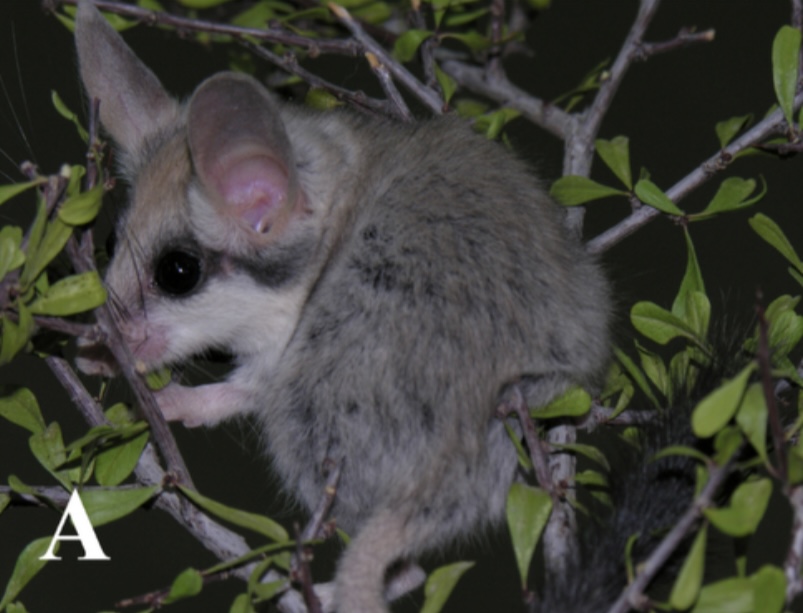
The Asian Garden Dormouse is the size of the Garden Dormouse: head-body 11 to 14.5 cm, tail 10 to 13.5 cm, weight 38 to 63 g. The upperparts are pale sandy-grey to light brown, far paler and duller than in the Garden Dormouse; the underparts and cheeks are white. The mask runs from the muzzle through the eye and ends in a black patch below and just behind the eye; it does not draw out into a long point onto the neck as it does in the Garden Dormouse. The ears are strikingly large, thin, pink and almost bare — in animals from the driest country the largest in the family. The tail is long, short-haired at the base and ends in a dark, almost black brush; hence the scientific name melanurus, black-tail. The eyes are large and black, the whiskers long and pale, the feet pink. The animal is paler in every respect than the Garden Dormouse, and that is the first field character.
Similar species
Within its range there is scarcely anything to confuse it with, for it is the only dormouse of the Levant and the Egyptian desert edge. Confusion arises mainly in the literature: the Garden Dormouse is very similar, and until the 1980s the two were treated as one species. The separation is colour — the Garden Dormouse warm brown to grey-brown, this one pale sandy — ear size, and the mask, which in the Garden Dormouse carries on behind the ear and in this species stops there. They do not meet in the field: the Garden Dormouse comes no further south than southern Europe. In the same rocks live jirds and gerbils, but those have naked or thinly haired tails with at most a small end tuft, no mask and much smaller ears, and they bound on long hind legs instead of climbing. The House Shrew is much smaller with a pointed, mobile snout.
Habitat
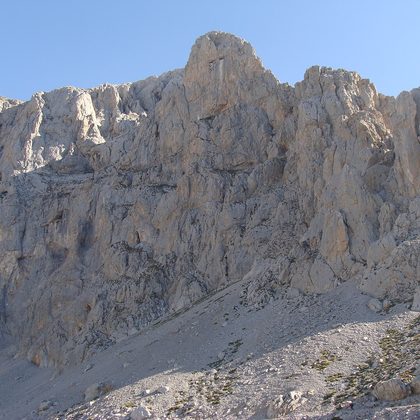
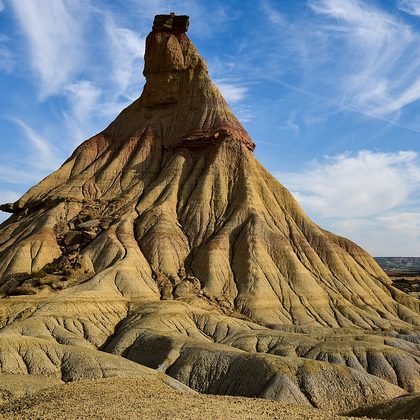
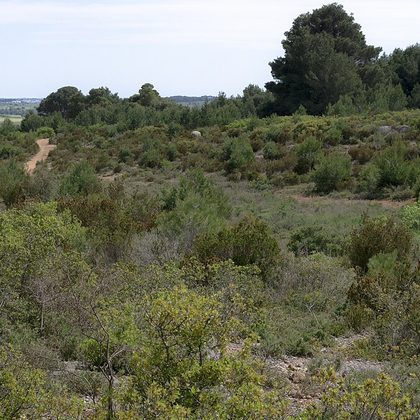
The Asian Garden Dormouse lives in the dry parts of the Mediterranean region and on the rim of the desert, always on stony ground: rock faces and limestone cliffs, wadis with scrub, screes, wormwood and thorn steppe, garrigue and scattered maquis, rocky coastal dunes, and around people: dry-stone walls, orchards, gardens and old buildings. It occurs from sea level to about 2850 m in the mountains of Arabia. It needs not dense vegetation but crevices and cavities: a boulder field with a few herbs between the stones is suitable, an even sand plain is not.
Where the animal is most at home, classified with EUNIS — the European standard for habitats.
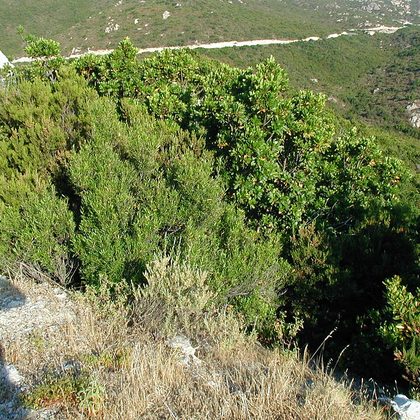

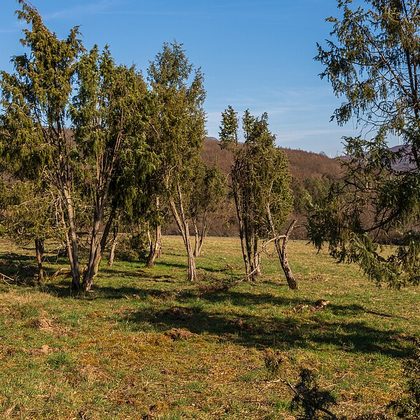
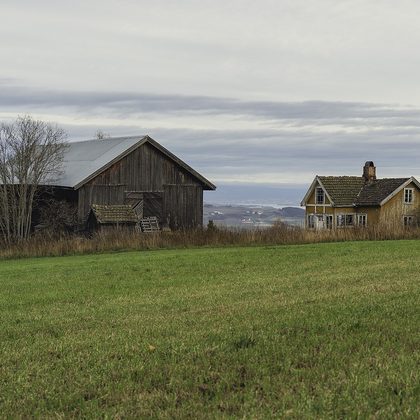
Distribution
The Asian Garden Dormouse occurs from eastern Libya through Egypt and Sinai north into Syria and Iraq, and south into south-western Saudi Arabia. The species does not reach Europe: its range ends at the Levantine coastal strip — Israel, the Palestinian territories, Lebanon, western Syria, Jordan — and at the Mediterranean coast of Egypt and Cyrenaica. An old record exists from southern Turkey, but recent material is lacking and it is uncertain whether that population survives. It does not occur on the European mainland.
- Native
- dark = core range, pale = thinly spread
Way of life
The Asian Garden Dormouse is strictly nocturnal, with the peak of activity about two hours after dark. It climbs well and moves nimbly through rock crevices and along walls, but takes most of its food on the ground. The diet is unusually carnivorous for a dormouse: insects, grasshoppers, beetles, centipedes, snails, small rodents and even geckos, supplemented with fruit, seeds and nuts. Unlike the Hazel and Garden Dormice it keeps no true, long hibernation: in the coldest months it becomes markedly less active and drops into torpor when it is cold, but in mild winters it is active all year. Less is known of its breeding than of the European species; one to two litters a year are reported, of four to six young.
Where and when to look
The species is found where there are rocks, and is active only at night. In Israel, Jordan and Sinai a wadi with limestone walls in the first hour or two after sunset, with a weak lamp, is the most suitable place: the reflection of two large eyes on a ledge and rustling in the crevices reveal the animal. By day the feeding places under overhanging stones with gnawed-open snail shells can be found; they confirm that the species is present. Around field stations, monasteries and old buildings on the desert edge it is sometimes seen on a wall in lamplight. Most records of this species are chance encounters.
Conservation status
Least Concern (LC, 2021). It has a large range, is not fussy about food and profits locally from gardens, orchards and buildings, and there is no sign of decline in the core of its range. It is, however, scarce and local everywhere, and knowledge of it is thin: no population has a run of counts behind it, and most finds come from owl pellets and chance captures. Where it is under local pressure that is chiefly through the loss of old dry-stone walls and the conversion of steppe to irrigated farmland.
Scientific name
Eliomys melanurus | (J. A. Wagner, 1839)
J. A. Wagner described the species in 1839 as Myoxus melanurus; because it was later moved to another genus, the author and year stand in brackets. Eliomys is Greek, from eleios, Aristotle's word for the dormouse, and mys, 'mouse'. melanurus is Greek for 'black-tailed', from melas, 'black', and oura, 'tail', after the black tuft of the tail. The specimen the first description was based on came from Egypt, Mount Sinai.