All species › Bats › Vesper bats › Escalera's Myotis
Escalera's Myotis | Myotis escalerai
Myotis escalerai | Myotis escalerai
Escalera's Myotis is the cave-dwelling species of the Natterer's Bat complex on the Iberian Peninsula. Ángel Cabrera described it in 1904 from Valencia as a separate species; it was then long treated as a synonym or subspecies of Natterer's Bat (M. nattereri), until genetic work by Ibáñez and colleagues in 2006 showed that the Iberian bats form a separate lineage. Forearm 37.1 to 42 mm, weight 4.5 to 6.3 grams. Its closest relative is M. zenatius from North Africa. In appearance it closely resembles Natterer's Bat.
No photograph of a living wild animal of this species with a suitable Creative Commons licence exists. Do you have one that meets the rules? Send it in.
Tracks
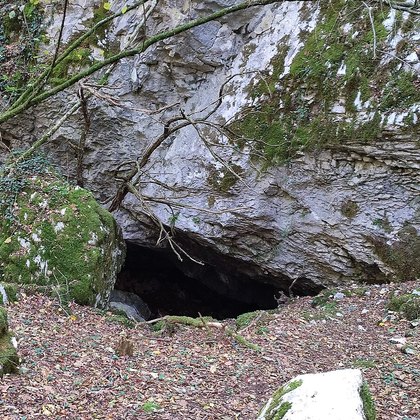
The bats roost in natural and artificial caves, mines, tunnels and other underground sites, usually hidden in crevices; roosts in tree holes or under bridges have been reported only occasionally. Maternity colonies number from a few dozen up to 800 females with young, sometimes together with Long-fingered Bat and Geoffroy's Bat. In autumn the number of males at swarming sites rises sharply in cave-rich areas. Because the species is tied to caves, colony counts in caves are the main source of data.
Identification
Head-body 42 to 50 mm, tail 42 to 50 mm, ear 15.1 to 18 mm, forearm 37.1 to 42 mm. A medium-sized Myotis with the characters of the Natterer's Bat complex: a fringe of hairs along the tail membrane and a clearly S-shaped calcar. The upperparts are brown to grey, the underparts pale grey to whitish; young bats are much darker. Along the edge of the tail membrane there is a distinct row of inward-pointing hairs and a shorter row of outward-pointing hairs. The wing is attached at the metatarsus. The face is bare and pink, especially around the eyes, with a long muzzle; the ears reach beyond the tip of the nose when laid forward and have several folds on the outer edge. Chromosomes 2n = 44. The call consists of short, strongly modulated pulses starting at 120 to 140 kHz and ending at 15 to 20 kHz, a range of about 130 kHz, as in Natterer's Bat.
Similar species
The species is hardly distinguishable externally from Natterer's Bat (M. nattereri), Cryptic Myotis (M. crypticus) and M. zenatius. Against M. crypticus, with which it co-occurs in the mountain forests of the northern half of the Iberian Peninsula, there are two characters in the hand: the wing attachment at the metatarsus (in M. crypticus at the base of the toe) and the two rows of hairs along the tail membrane (in M. crypticus one row of short, outward-pointing hairs). All measurements overlap; the describers of M. crypticus could separate the species completely only by a combination of many skull and body measurements. M. zenatius lives in North Africa and does not co-occur with this species. According to the handbook, separating calls within the complex, and from other small Myotis species, is difficult and disputed. The fringe of hairs on the tail membrane separates the complex from other Myotis species.
Habitat
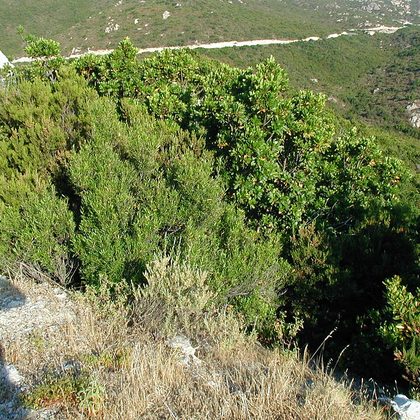
A wide range of habitats, from dry areas such as the Ebro basin to montane broadleaved and coniferous forest, oak woodland, parks and orchards of olive and almond, usually at lower elevations but up to about 1400 m. The decisive factor is the presence of caves or other underground roosts; summer roosts have a temperature of 17 to 21 °C.
Where the animal is most at home, classified with EUNIS — the European standard for habitats.





Distribution
The Iberian Peninsula, north into the French Pyrenees, and the Balearic Islands. The handbook notes that the species may be commoner than known, especially in the coldest and most humid parts of its range. Because Iberian Natterer's-type bats have been treated as a separate species only since 2006, and M. crypticus was described only in 2019, older Iberian records of Natterer's Bat cannot be assigned to either species without DNA.
- Native
- dark = core range, pale = thinly spread
Way of life
The species is considered sedentary. It probably hunts like Natterer's Bat: close to vegetation, branches and leaves, taking prey from leaves or from the ground, also with the tail membrane. Mating takes place in autumn, from September to November, during swarming. Young are usually born in May, are independent at less than two months old in July and then leave the colony. The bats switch roosts readily. Hibernation takes place in underground sites.
Where and when to look
In Spain and Portugal a Natterer's-type bat in a cave, in a large maternity colony, is probably this species; one in a tree hole or building in the mountain forests of the north may also be M. crypticus. Disturbance of colonies in caves is one of the main threats: count from outside, at emergence, and do not enter maternity caves. Capturing and handling bats requires a licence throughout the European Union.
Conservation status
Near Threatened (NT) on the global Red List, assessed in 2023. Disturbance, vandalism and destruction of caves are the main threats and can affect large colonies. According to the handbook two of the largest known colonies have disappeared after the cave entrance was closed off in an unsuitable way. In the European Union it falls, like all bats, under Annex IV of the Habitats Directive.
Scientific name
Myotis escalerai | Cabrera, 1904
Cabrera described the species in 1904 and placed it straight away in the genus where it still stands. Myotis is Greek, from mys, genitive myos, 'mouse', and ous, genitive ōtos, 'ear': 'mouse-ear'. escalerai honours the Spanish entomologist and collector Manuel Martínez de la Escalera (1867–1949), who gathered the type material near Valencia. The specimen the first description was based on came from Spain, Valencia.