All species › Bats › Vesper bats › Hovel's Myotis
Hovel's Myotis | Myotis hoveli
Myotis hoveli | Myotis hoveli
Myotis hoveli is the species of the Natterer's Bat complex in the Levant, on Cyprus and in southern and eastern Anatolia. Harrison described it in 1964 as a subspecies of Natterer's Bat, M. nattereri hoveli, with Aqua Bella near Jerusalem as the type locality. Genetic work by Çoraman and colleagues (2019) and by Uvizl and Benda (2021) showed that the Natterer's-type bats of the Middle East belong to different lineages; the Mammal Diversity Database has since listed M. hoveli as a species. The handbook still treated it as a subspecies in 2019, pending further study. Little has been published on this form on its own.
No photograph of a living wild animal of this species with a suitable Creative Commons licence exists. Do you have one that meets the rules? Send it in.
Tracks
No roosts, colonies or other signs have been described for this species on its own in the sources consulted. There are hardly any external signs, and within the complex the call cannot be assigned to species.
Identification
A separate description with measurements cannot be found in the sources consulted; the handbook includes it under Natterer's Bat and gives no separate measurements. What applies to the Natterer's Bat complex as a whole: a medium-sized Myotis with a fringe of stiff hairs along the rear edge of the tail membrane, an S-shaped calcar, long ears with folds on the outer edge, a pointed tragus longer than half the ear, a bare pink face, brown to grey upperparts and pale grey to whitish underparts. Uvizl and Benda distinguished three morphotypes in the Middle East that differ mainly in size, alongside genetic lineages. Call data for this species on its own have not been published.
Similar species
Four species of the complex occur in the Middle East, according to Uvizl and Benda in allopatry or parapatry: Natterer's Bat (M. nattereri in the strict sense) only in western Anatolia and on Samos, M. hoveli in the Levant, on Cyprus, in southern Anatolia and in the mountains of eastern Turkey and northern Iraq, M. tschuliensis in a belt from Crimea via the Caucasus and northern Iran to Turkmenistan, and M. schaubi only in Iran and Armenia. Locality is therefore the first clue; where the ranges meet, and in Turkey in general, no external character for separating them has been described and DNA is required. Because mitochondrial DNA has been exchanged between lineages several times within the complex, identification by mitochondrial DNA alone can mislead. According to the Mammal Diversity Database M. hoveli may be paraphyletic with respect to M. schaubi, and possibly conspecific with it. The fringe of stiff hairs on the tail membrane separates the complex from other Myotis species in the region.
Habitat
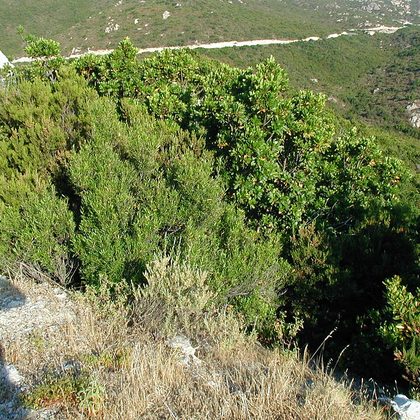
In Syria the species is confined to the mountains of the coastal region and the south-west. Uvizl and Benda also found it in the mountains of eastern Turkey and northern Iraq. Further data on the habitat of this form on its own have not been published; Natterer's Bat in the strict sense lives mainly in forest and wooded semi-open country, but whether this also applies to this species has not been studied.
Where the animal is most at home, classified with EUNIS — the European standard for habitats.



Distribution
Israel, Jordan, Lebanon, Palestine, Syria, Cyprus and southern Turkey, and the mountains of eastern Turkey and northern Iraq. In Syria the species is considered rare and local; older records come from Qal'at Salah ad-Din, Tell Shhab, Serghaya, Yabroud, Qal'at Al-Marqab and Mount Hermon. The species is treated as monotypic. Because older records from this region are filed under M. nattereri, the range has to be derived from genetically examined bats.
- Native
- dark = core range, pale = thinly spread
Way of life
No data on diet, foraging, reproduction, hibernation or longevity of this species on its own have been published in the sources consulted. The species of the Natterer's Bat complex take their prey, mainly spiders, caterpillars and flies, largely from leaves and the ground, but this has not been studied for this form.
Where and when to look
A bat with a fringe of stiff hairs along the tail membrane in Israel, Lebanon, Syria, Jordan or on Cyprus is this species under the current classification. Because of the small number of records, every documented observation, with locality and if possible DNA, adds to knowledge of the range. On Cyprus capturing and handling bats requires a licence.
Conservation status
Not Evaluated (NE) on the global Red List; the species has not yet been assessed separately since the split. Data on numbers, trend and threats are lacking. On Cyprus it falls, like all bats in the European Union, under Annex IV of the Habitats Directive.
Scientific name
Myotis hoveli | D. L. Harrison, 1964
D. L. Harrison described the species in 1964 and placed it straight away in the genus where it still stands. Myotis is Greek, from mys, genitive myos, 'mouse', and ous, genitive ōtos, 'ear': 'mouse-ear'. hoveli honours a Hovel, presumably whoever supplied Harrison with the material from Jerusalem; the describer gives no explanation and the man has not been identified. The specimen the first description was based on came from Israel, Jerusalem.