All species › Bats › Vesper bats › Christie's Long-eared Bat
Christie's Long-eared Bat | Plecotus christii
Noordoost-Afrikaanse grootoorvleermuis | Orejudo de Egipto
Christie's Long-eared Bat is the long-eared bat of the desert and semi-desert belt of north-east Africa and the southern Levant: the Nile Valley in Egypt and northern Sudan, Sinai, the Negev, the Dead Sea area and south-west Jordan. J. E. Gray described it in 1838 from the Nile Valley; for a long time it was treated as a subspecies of the Grey Long-eared Bat. Forearm 36.4 to 41.3 mm, weight 6 to 8 grams. It differs from the other long-eared bats in its region in its pale colour.
No photograph of a living wild animal of this species with a suitable Creative Commons licence exists. Do you have one that meets the rules? Send it in.
Tracks
The species roosts in caves, rock crevices, tunnels and other underground sites, but also in beach resort buildings, monasteries and other buildings. It usually lives in colonies, sometimes alone. Maternity colonies of up to 40 bats have been found in rock crevices, tunnels and caves. Droppings lie beneath the hanging spots; the call is so faint that the species is referred to as a ‘whispering’ bat and can only be recorded at close range with a detector.
Identification
A medium-sized long-eared bat with ears of 32 to 39 mm. The dorsal fur is very pale, umber brown or greyish brown; the hairs are 8.5 to 9.3 mm long and tricoloured, the basal half rusty brown, the terminal half pale brownish grey with a brown tip. The underparts are whitish. The face is pale and almost naked, the forehead covered with short white hairs; the muzzle is long and narrow. The ears are translucent and unpigmented except for pale brown tips and usually have many horizontal furrows; at the base the inner margins are joined by a low band. The tragus is mostly translucent, brownish along the margins, about half the height of the ear, and tapers to a blunt point. The wings are thin, semi-translucent and pale grey. The thumb is short, 5.5 to 5.6 mm. The skull is smaller than in the other species of the genus, with a broad braincase and a short, blunt muzzle. Chromosomes 2n = 32. The subspecies P. c. petraeus is larger than the nominate form. Echolocation consists of faint, broadband frequency-modulated pulses: start 42.5 to 48.7 kHz, end 20.8 to 25.7 kHz, maximum energy at 31.4 to 35.6 kHz, duration 1.3 to 1.7 ms, with a second harmonic at 45 to 60 kHz that is usually fairly intense.
Similar species
According to the handbook it differs from the long-eared bats it occurs alongside in its pale colour, small, narrow baculum and medium-sized tympanic bullae (4.3–4.6 mm); the skull is smaller than in the other species. The call is almost identical to that of the Grey Long-eared Bat (P. austriacus), which does not occur in this region. From Kolombatovic's Long-eared Bat (P. kolombatovici), which probably reaches Israel and Jordan, it differs in the almost naked, pale face (in P. kolombatovici the face is almost entirely furred) and the translucent ears. Gaisler's Long-eared Bat (P. gaisleri) of Libya and the Maghreb has dark brown to dark grey-brown fur and a dark face, ears and tragus.
Habitat
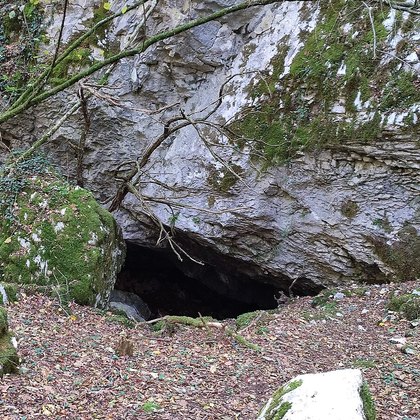
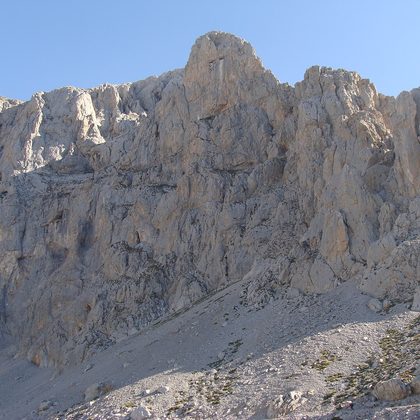
The subtropical desert and semi-desert belt of the Sahara. The bats forage in moist places along rivers such as the Nile, in oases near the coast, in open terrain around water, inland in mountains, and in gardens and at natural pools. Roosts are in rock and caves, but also in buildings.
Where the animal is most at home, classified with EUNIS — the European standard for habitats.




Distribution
Two subspecies. P. c. christii (Gray, 1838) lives in Egypt and northern Sudan, in the guide area in the Nile Valley and Nile Delta. P. c. petraeus (Benda, 2008) lives in southern Israel, south-west Jordan and north-east Egypt (Sinai). The range is small; within it the species is locally abundant.
- Native
- dark = core range, pale = thinly spread
Way of life
The diet consists mainly of moths: in droppings from Israel it consisted entirely of moths; elsewhere grasshoppers and beetles have also been reported, and around the Dead Sea also caddisflies and flies. In the Negev a female was in early pregnancy at the beginning of March; at the Dead Sea half of the females caught in mid-April were lactating, and one was still lactating in mid-June. No data have been published on winter behaviour, movements or longevity; whether and for how long the bats enter torpor in the cool months has not been studied.
Where and when to look
Caves, tunnels and rock crevices in the wadis of Sinai, the Negev and around the Dead Sea, and old buildings and monasteries near water, are where the species has been found. The pale fur and translucent ears are visible in a close-up photograph. Avoid visiting roosts during the breeding season, from March to June; disturbance of roosts is cited as a probable threat.
Conservation status
Data Deficient (DD) on the global Red List, assessed in 2019. There are no population estimates. Its natural habitat is reduced and heavily fragmented, and the species is probably affected by human disturbance, especially at roosts.
Scientific name
Plecotus christii | J. E. Gray, 1838
J. E. Gray described the species in 1838 and placed it straight away in the genus where it still stands. Plecotus is Greek, from plekein, 'to plait, twist together', and ous, genitive ōtos, 'ear', after the huge ears joined across the forehead. christii honours Turnbull Christie, the British physician and traveller who supplied the British Museum with the Egyptian specimens on which Gray based his description. The specimen the first description was based on came from Egypt.