All species › Bats › Vesper bats › Grey long-eared bat
Grey long-eared bat | Plecotus austriacus
Grijze grootoorvleermuis | Orejudo Gris
The Grey Long-eared Bat is the long-eared bat of warm, open country: in central Europe of lowlands with fields, pastures and villages, in southern Europe of a wider range of landscapes. Ears 31 to 41 mm, forearm 36.5 to 43.5 mm and weight 6 to 10 grams. In the north of its range it roosts almost only in buildings, mainly churches and old houses; in the south also in rock crevices, cave entrances and bridges. Since 2023 it has been listed as Near Threatened (NT) on the global Red List.
No photograph of a living wild animal of this species with a suitable Creative Commons licence exists. Do you have one that meets the rules? Send it in.
Tracks
In church lofts, towers and old houses the bats hang along the ridge, between beams or in gaps in the roof boarding; droppings lie beneath the hanging spots. Beneath regular feeding perches, as with the Brown Long-eared Bat, there are discarded moth wings; in the Grey these are mainly geometrids. Maternity colonies are small and stay in the same building throughout the summer. In winter the bats hang singly or in small groups in caves and mines, sometimes a short distance from the summer roost. On a bat detector the pulses are faint and can only be recorded at close range; they cannot be separated from those of the other long-eared bats.
Identification
A medium-sized long-eared bat with ears of 31 to 41 mm joined across the forehead. The dorsal fur is dark grey to grey with a brownish tinge, the underparts whitish or frosted. The dark face with a long, dark muzzle stands out as a mask. The tragus is dark, broad (over 5.5 mm) and long (over 14 mm). The thumb is short, under 6.5 mm, and the feet are sparsely haired. The penis is club-shaped, broadened at the tip. At rest the ears lie back under the wings and only the tragus sticks out. Echolocation is that of all long-eared bats: pulses with two frequency-modulated harmonics, the first falling from about 40 to 20 kHz, the second from 70 to 40 kHz. Pulses are faint, which makes the species difficult to monitor with acoustic surveys.
Similar species
The Brown Long-eared Bat (P. auritus) is the species it most often occurs alongside. That species has a pale, cream to light brown face without a mask, browner upperparts with yellowish underparts, a narrower tragus (under 5.5 mm wide), a thumb longer than 6.5 mm with long, curved claws, hairy feet and a penis that narrows towards the tip. The Mountain Long-eared Bat (P. macrobullaris) closely resembles the Grey in call, flight and diet, but has an inverted triangular chin pad, a thumb longer than 6.2 mm, a pale tragus and a cylindrical penis; in Switzerland and the Pyrenees the two largely replace each other, the Grey in the lowlands and the Mountain higher up. Kolombatovic's Long-eared Bat (P. kolombatovici) of the Adriatic and Aegean coasts was treated as a subspecies of the Grey until the early 2000s: it is smaller (forearm 36–39 mm), with a tragus shorter than 14 mm, a face and chin almost entirely furred, and also a club-shaped penis. On Sardinia the Sardinian Long-eared Bat (P. sardus) differs in a tragus longer than 18 mm and a paler, pinkish-brown muzzle without a dark mask. On Malta and Gozo, where the handbook still lists the Grey, and on Pantelleria, DNA identified P. gaisleri in 2020. Colour characters overlap in young bats; a secure identification rests on a combination of tragus width, thumb length and penis shape in the hand, or on DNA.
Habitat
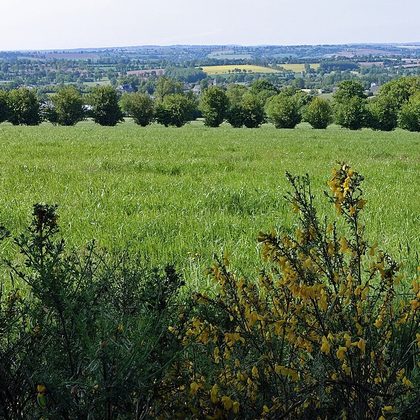
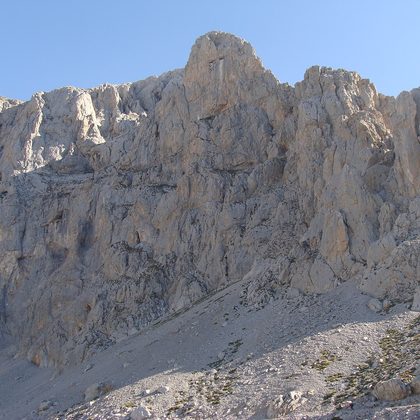
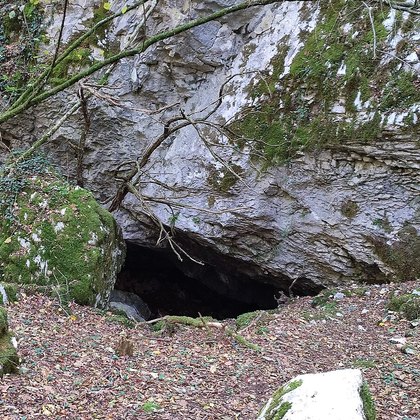
From lowland valleys and grasslands to high pastures and woodland, up to 1390 m. In central Europe mainly warm lowlands, around villages and in farmland, closely tied to open landscape; in southern Europe a broader range of habitats. Maternity colonies are usually below 550 m. The species forages in open and semi-open terrain, along hedgerows, over pasture, at 2 to 5 m height and sometimes above the canopy at about 10 m. Summer roosts in the north are in churches, castles, lofts and old buildings; in the south also in rock crevices, cave entrances, fissures in cliffs and bridges. Hibernation sites are caves and mines.
Where the animal is most at home, classified with EUNIS — the European standard for habitats.
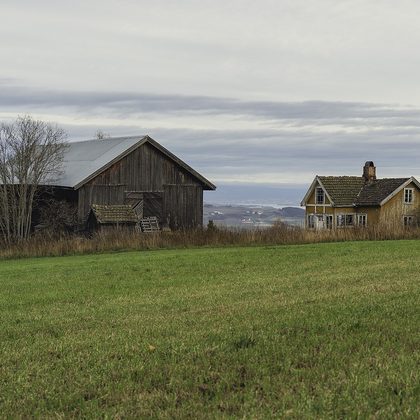
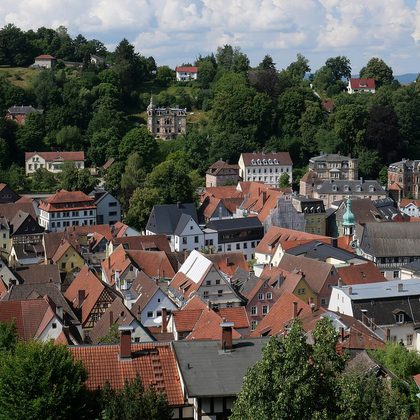
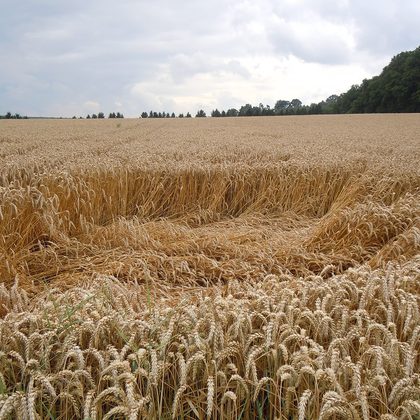
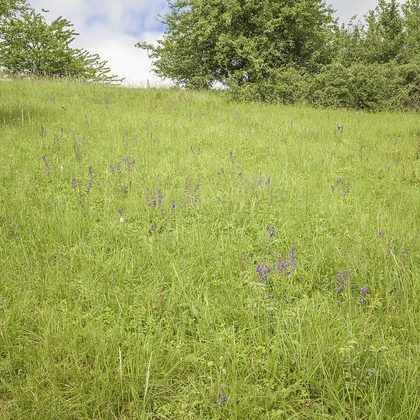
Distribution
Southern England, western France and Iberia, east through central Europe and the far south of Sweden to western Ukraine and the Balkans; also the large islands of the western Mediterranean (Balearics, Corsica, Sardinia, Sicily) and Madeira. The handbook also lists Malta, but DNA has since identified the bats there as P. gaisleri. The species is monotypic. Populations from North Africa, the Canary Islands, the eastern Mediterranean and Asia formerly included in P. austriacus are now assigned to other species (P. gaisleri, P. teneriffae, P. kolombatovici, P. christii and Asian species). It is common in the Mediterranean region and locally rare in eastern Europe.
- Native
- dark = core range, pale = thinly spread
Way of life
The species hunts in flight more often than by gleaning. The diet consists largely of moths, mainly geometrids, which were present in 70 to 100 per cent of examined droppings; depending on season and availability also beetles, crane flies and other flies. Its food niche overlaps with that of the Mountain Long-eared Bat (grassland moths), less so with that of the Brown Long-eared Bat (woodland prey). At night the bats commute up to 12 km to foraging areas, usually about 5 km, and the foraging areas themselves are small. Maternity colonies hold a few tens of females, rarely 100. Young are born at the end of June; mating activity has been reported from May to November. In winter the bats move to caves or mines to hibernate, usually over short distances; the longest recorded movement is about 62 km.
Where and when to look
Churches and castles in open farmland are the places to look for Grey Long-eared Bats; in daylight the bats can sometimes be seen between the beams in the loft. At dusk the bats fly out to pastures and hedgerows around the village, where a red-filtered torch will show the long ears. The dark face is often visible in a close-up photograph, but young Brown Long-eared Bats do not always have pale faces; without tragus and thumb measurements the identification remains provisional.
Conservation status
Near Threatened (NT) on the global Red List, assessed in 2023; before that the species was listed as Least Concern. The handbook describes it as widespread and common in the Mediterranean region, but locally rare in eastern Europe, with declines reported in Austria and Croatia. Causes cited are disturbance and loss of roosts and habitat fragmentation through agricultural intensification. The species is listed in Annex IV of the Habitats Directive and is covered by the Bern Convention and the EUROBATS Agreement.
Scientific name
Plecotus austriacus | (J. B. Fischer, 1829)
J. B. Fischer described the species in 1829 as Vespertilio auritus Austriacus; because it was later moved to another genus, the author and year stand in brackets. Plecotus is Greek, from plekein, 'to plait, twist together', and ous, genitive ōtos, 'ear', after the huge ears joined across the forehead. austriacus means 'Austrian'; Fischer distinguished the animal as the Viennese form of the common long-eared bat. The specimen the first description was based on came from Austria, Vienna.